
Understanding the Dental Implant Investment in 2026
Implant-supported tooth replacement is widely considered the gold-standard option — and for good reason. The American Academy of Implant Dentistry (AAID) reports that dental implants have a success rate of up to 98% in appropriate cases, and unlike dentures or bridges that require replacement every 5 to 15 years, implants are designed for long-term service with proper maintenance. Many patients in Marlborough are surprised to learn that over a 20-year horizon, implants are often the most cost-effective option for replacing missing teeth when you factor in the replacement cycles, complications, and ongoing costs of alternatives.
This guide provides transparent, current pricing for dental implants in Massachusetts, breaks down every factor that affects cost, compares implants to alternatives on a true lifetime basis, and explains every financing option available to MetroWest patients. Our office serves patients from Framingham, Shrewsbury, Northborough, Hudson, and communities throughout MetroWest who are comparing implant costs across providers.
How Much Do Dental Implants Cost in Massachusetts in 2026?
At Innova Smiles in Marlborough, a complete single-tooth implant restoration typically runs $3,343–$6,685 all-in. The top of that range is our standard fee; the low end is what a patient whose plan covers implants typically pays. A bone graft at the implant site, when needed, adds $555–$1,110; a sinus lift is estimated separately at your consultation. Rather than a bare sticker price, that figure represents everything required to replace the tooth — three components plus the diagnostics that make the result predictable:
- The Implant Fixture (titanium or zirconia post surgically placed into the jawbone)
- The Abutment (the custom connector piece between implant and crown)
- The Crown (the custom-milled porcelain or zirconia tooth)
The fee also includes your comprehensive exam, 3D CBCT imaging, and guided surgical planning. Worth knowing: some offices advertise a lower headline price that covers only the surgical placement of the post — which can be misleading, because the custom abutment and permanent crown add substantially to reach the finished tooth.
Complete Pricing by Procedure Type
The exact fee depends on your anatomy, the implant system selected, materials for the final restoration, need for bone grafting, and the provider’s level of training. We provide written, itemized estimates after a comprehensive exam and 3D CBCT imaging--no surprises.
How Do Massachusetts Dental Implant Costs Compare Nationally?
Dental implant costs in Massachusetts run higher than the national average due to the higher cost of living and operating a dental practice in the Northeast. National figures published in the American Dental Association’s Survey of Dental Fees often quote the surgical phase or individual components rather than the finished tooth, which is part of why advertised national numbers can look lower than a true all-in MetroWest fee that bundles the placement, custom abutment, permanent crown, and 3D imaging. The good news: Massachusetts patients also tend to have better insurance coverage (the state has the highest rate of dental insurance enrollment in the country), which offsets some of the premium — and the implant is a one-time investment designed to last decades.
How Does That Compare to Alternatives?
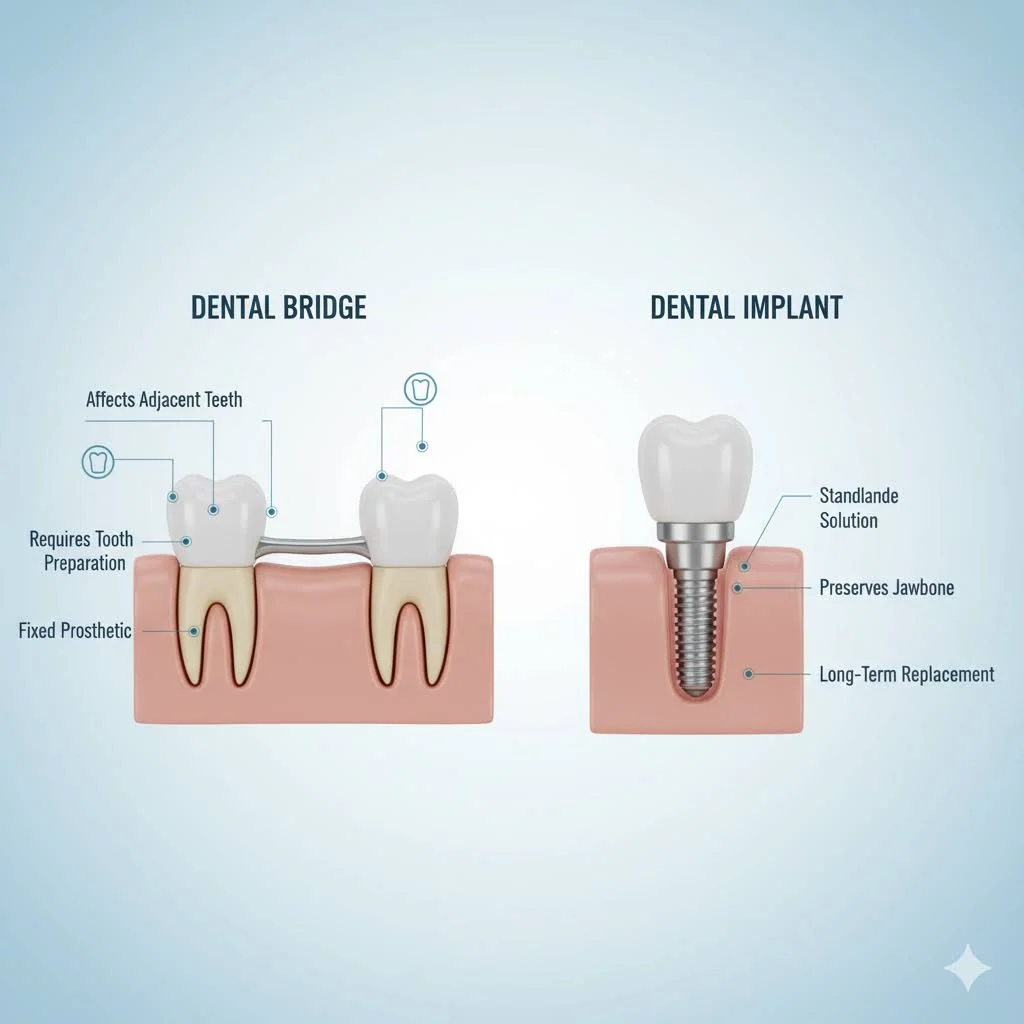
A dental bridge may look cheaper upfront, but it requires grinding down two healthy adjacent teeth for crown preparation--permanently altering their structure. Those teeth are then at higher risk for decay, root canal needs, and fracture. When the bridge fails in 7 to 15 years, you may need to replace it (and potentially treat the abutment teeth). The 20-year cost of a bridge often exceeds the one-time cost of an implant.
A removable partial denture carries the lowest initial price tag, but relines (needed every 1-2 years), adhesives, and the inevitable bone loss under the prosthesis accumulate. Research shows that abutment teeth are at significantly higher risk for extraction compared to non-abutment teeth. Studies indicate cumulative survival rates of 65.6% or lower for abutment teeth at 10 years, along with framework breakage occurring in 27–44% of dentures at 10 years, both requiring costly repairs or replacement.
What Factors Influence Dental Implant Cost?
1. Number of Implants and Teeth Being Replaced
A single missing tooth requires one implant and one crown. Replacing three adjacent teeth may require only two implants supporting a three-unit bridge, reducing per-tooth cost. A full arch (All-on-4) replaces 10 to 14 teeth with just four implants. The per-tooth cost drops significantly as you scale up, which is why full-arch solutions offer strong value for patients missing many teeth. For a full breakdown of full-arch and full-mouth pricing, see our full mouth dental implants cost guide.
2. Bone Health and Need for Grafting
If you need a bone graft or sinus lift to support the implant, a graft at the implant site adds $555–$1,110; larger grafts and sinus lifts are estimated separately at your consultation. Patients who have been missing teeth for more than a year, have a history of periodontal disease, or wear dentures are more likely to need bone augmentation. Socket preservation performed at the time of extraction ($527–$1,054 per site) is the most cost-effective way to maintain bone and avoid larger grafts later.
3. Implant System and Material Quality
Not all implant brands are equal. Premium implant systems from manufacturers like Straumann, Nobel Biocare, and BioHorizons are backed by decades of clinical research, extensive published survival data, and manufacturer-backed parts availability for the life of the implant. Budget implant systems may cost less initially but carry higher failure rates and may not have replacement components available in 10 or 20 years. At Innova Smiles, we use research-backed implant systems exclusively because the long-term cost of implant failure (removal, re-grafting, and re-placement) far exceeds the modest savings of a cheaper system.
4. Crown Material
- Porcelain-fused-to-zirconia (PFZ): Beautiful esthetics, strong, standard choice for front teeth.
- Full-contour zirconia: Extremely strong, ideal for molars. Highly resistant to chipping.
- Lithium disilicate (e.max): Exceptional translucency and esthetics for front teeth.
5. Provider Expertise and Training
Advanced training matters because it directly affects outcomes. Fellowship-trained implant dentists (FICOI, FAAIP, AAID credentials) have completed hundreds of supervised cases beyond dental school, including complex bone grafting, sinus lifts, and immediate-loading protocols. Research in the Clinical Oral Implants Research journal shows that provider experience is one of the strongest predictors of implant survival. Dr. Fatima holds three implant fellowships, including FICOI and FAAIP, and uses CBCT-guided surgical planning for every case.
6. Geographic Location
As noted above, Massachusetts costs run higher than the national average. Within MetroWest, prices are relatively consistent between Marlborough, Framingham, and Worcester, though Boston practices may charge 15 to 25% more due to higher overhead.
The True Long-Term Cost of Each Tooth Replacement Option
Making a decision based on initial price alone is misleading. Here is what each option actually costs over 20 years when you account for maintenance, replacements, and complications:
Single Dental Implant: Placed Once
- Year 0: Surgical placement + custom abutment + permanent crown + 3D imaging ($3,343–$6,685, one time)
- Ongoing: Professional cleanings (included in your regular hygiene visits); the crown may need replacing at 15-20 years
- Bone preservation: Implants transmit chewing forces to the jawbone, maintaining bone volume indefinitely. No additional bone-related costs.
- Over 20 years: one fee, and with 0% financing that one-time investment spreads into a manageable monthly figure.
Dental Bridge: Replaced at Least Once Over 20 Years
- Year 0: Bridge fabrication ($2,569–$5,138 for a 3-unit bridge; requires grinding down two healthy teeth)
- Year 7-15: Bridge replacement (the abutment teeth may now need root canals)
- Ongoing: Higher cavity risk on abutment teeth due to difficulty flossing under the bridge
- Bone loss: The bone under the pontic (false tooth) continues to resorb, creating a gap that traps food and bacteria
- Over 20 years: two bridges, and often two root canals
Removable Partial Denture: Relined and Replaced Over 20 Years
- Year 0: Partial denture ($1,193–$3,108)
- Every 1-2 years: Reline or adjustment
- Every 5-8 years: Replacement denture
- Hidden cost: Clasps damage adjacent teeth, often leading to additional extractions and a larger denture
- Bone loss: Continuous and progressive under the denture base
- Over 20 years: two or three dentures plus relines
The implant is the only option that does not require the sacrifice of healthy adjacent teeth, does not accelerate bone loss, and does not need periodic replacement of the anchor itself.
Insurance Coverage for Dental Implants in Massachusetts
Most PPO dental plans now provide some coverage for implants, a significant change from a decade ago when implants were considered "cosmetic" by most carriers. Here is what MetroWest patients can typically expect:
- PPO dental insurance: Covers approximately 50% of the implant surgical fee and/or the crown, up to your annual maximum (typically $1,500-$2,500 per year). Major carriers we accept include Delta Dental, Blue Cross Blue Shield, Aetna, Cigna, MetLife, Guardian, United Concordia, and Principal.
- Dental discount plans: Not insurance, but provide 15 to 30% fee reductions on implant services for an annual membership fee.
- Medical insurance: May cover implant surgery if tooth loss resulted from trauma, cancer treatment, or a congenital condition. We investigate medical coverage for qualifying patients.
- HSAs and FSAs: Pre-tax dollars from your Health Savings Account or Flexible Spending Account can be used for implants, effectively reducing your cost by your marginal tax rate (typically 22 to 35% for Massachusetts residents when you include state income tax).
- Dual-year strategy: For larger cases (multiple implants or full arch), we can strategically schedule the surgical and prosthetic phases across two calendar years to use two annual insurance maximums, doubling your benefit.
We submit pre-authorization to your insurance carrier before treatment begins and provide a written estimate of your exact out-of-pocket cost. No financial surprises. For a complete breakdown, visit our insurance and financing page.
Dental Implant Financing With No Credit Check
Cost should never prevent you from replacing a missing tooth. Many patients search for dental implant financing no credit check options, and there are legitimate programs designed to help. Here is how they work:
Soft-Credit-Check vs. Hard-Credit-Check Lenders
Traditional medical loans run a hard credit inquiry that can temporarily lower your FICO score by 5 to 10 points. Several dental-specific lenders now use a soft credit pull (or no credit check at all) during prequalification--your score is not affected unless you formally accept a loan offer.
How to Get Approved
- Apply online or in-office. CareCredit, Cherry, and Sunbit all offer quick applications you can complete on your phone while you are in the waiting room. No documentation needed beyond your ID and phone number.
- Choose your plan. Once approved, select a monthly payment amount that fits your budget. Many patients qualify for 0% interest promotional periods of 12 to 24 months.
- Start treatment immediately. Approval is typically valid for 60 to 90 days, so you can schedule your implant placement right away.
What Monthly Payments Look Like
The implant cost calculator shows the monthly figure for your number of implants at 0% APR over 24 months, and the PPO estimator applies your plan first — so you see the balance you would actually finance, not a headline total.
Tips for Patients With Limited Credit
- In-house payment plans: Ask our team about splitting the cost into monthly installments directly with Innova Smiles--no third-party lender or credit check required. We work with patients individually to find a payment schedule that works.
- Combine insurance + financing: Use your PPO benefits to cover a portion and finance the remaining balance at 0%. For example, if your plan pays part of the implant fee, you finance only the remaining balance at 0% APR, which is how most patients bring the monthly figure down.
- HSA/FSA first: Spend pre-tax dollars before financing the rest, reducing the total amount you need to borrow.
- Tax deduction: Dental implant costs exceeding 7.5% of your adjusted gross income may be tax-deductible as a medical expense. Consult your tax advisor.
If you have been putting off implants because of cost concerns, these no-credit-check and soft-credit-check programs make it possible to move forward. Contact us to discuss which option works best for your situation.
How to Avoid Overpaying for Dental Implants
The implant market has grown rapidly, and pricing transparency varies widely. Here are practical steps to protect yourself:
- Get an all-inclusive written estimate. Make sure the quote includes the implant, abutment, crown, imaging, and any grafting--not just the surgical fee. Some offices advertise a low "implant special" that covers only the titanium post, with the abutment and crown billed separately at full price.
- Ask about the implant brand. Research-backed systems (Straumann, Nobel Biocare, BioHorizons, Zimmer Biomet) have published 10 to 20-year survival data. Generic or white-label implants may lack this evidence and may not have replacement parts available years from now.
- Verify provider credentials. Look for fellowship training (FICOI, FAAIP, AAID) and ask how many implants the dentist places annually. Volume correlates with outcomes--a provider placing 100+ implants per year has more refined skills and troubleshooting experience than one placing 10.
- Ask about guided surgery. CBCT-planned, guide-assisted implant placement is more accurate and predictable than freehand surgery. A meta-analysis in Clinical Oral Implants Research demonstrated that guided surgery reduces complications and improves implant positioning accuracy.
- Beware of "dental tourism" pricing. Implants placed overseas may cost 50 to 70% less, but follow-up care, warranty coverage, and complication management are difficult or impossible to access from MetroWest Massachusetts. Implant failure abroad can cost more to correct than the original domestic procedure.
FAQ: Common Dental Implant Cost Questions
Why do quotes vary so much between offices?
Diagnostic standards, implant systems used, whether 3D imaging is included, whether adjunctive procedures like bone grafting are included in the quote, and the provider’s level of training all affect the number. Case complexity is always the main cost driver. An office quoting a low number for an "implant" may be quoting only the surgical placement of the post, while our all-in fee ($3,343–$6,685) bundles every component — the placement, the custom abutment, the permanent crown — plus all imaging and planning. Comparing a surgery-only price to an all-in price is the most common reason quotes look so different.
Are dental implants worth the cost?
The clinical evidence strongly supports implants as the best long-term value. A systematic review in the International Journal of Oral & Maxillofacial Implants (Jokstad, 2009) found that implants had the highest patient satisfaction scores of any tooth replacement option, along with the lowest rate of complications requiring retreatment. The ability to eat, speak, and smile without worry--while preserving jawbone health--is a quality-of-life improvement that patients consistently rate as transformative.
How long is the recovery?
For a single implant placed with guided surgery, most patients return to desk work the next day. However, a soft-food diet is required for 1–2 weeks, with gradual progression to semi-soft foods over weeks 2–4. Most patients can return to a normal, unrestricted diet by 6–8 weeks, once soft-tissue healing and initial osseointegration are established. Discomfort is typically managed with ibuprofen and acetaminophen for two to three days. Complete bone integration takes 3–4 months, during which a temporary tooth is worn.
Can I finance dental implants with no credit check?
Yes. CareCredit, Cherry, and Sunbit use soft credit pulls or no credit check at all for prequalification. You can apply in our office in under a minute and receive an instant decision without affecting your credit score.
How many dental implants do I need?
One implant per missing tooth is ideal for single-tooth gaps. For multiple missing teeth, an implant-supported bridge uses two implants to replace three to four teeth. For a full arch, the All-on-4 protocol uses four to six implants to replace an entire set of teeth. Dr. Fatima recommends the most conservative approach that delivers long-term predictability.
Is there an age limit for dental implants?
No upper age limit exists. Healthy patients in their 70s, 80s, and even 90s receive implants successfully. The key requirements are adequate bone volume (or willingness to graft), controlled systemic conditions, and the ability to maintain oral hygiene. Implants are not placed in patients whose jaws are still growing (typically under age 18).
Ready for a transparent, written estimate with no hidden fees? Start with a consultation and complimentary 3D imaging. Contact Innova Smiles or call (508) 481-0110. We serve patients from Marlborough, Framingham, Shrewsbury, Westborough, Sudbury, Hopkinton, and throughout MetroWest Massachusetts.
Useful Links
Related Articles
- What to Expect After Implant Surgery: Recovery Timeline
- Your Dental Implant Consultation: Step by Step
- Dental Implant Awareness Month: Benefits of Implants
- Does Dental Insurance Cover Implants? A Massachusetts Guide
Related Services
How our pricing works
Single dental implant, all-inclusiveOur fee range$3,343–$6,685 per tooth
- Our implant fee covers the full journey from 3D imaging through final crown placement, guided by a fellowship-trained implant dentist using 5D digital technology. Many practices bill the scan, surgical guide, and abutment separately, adding several hundred dollars to the total.
- More PPO plans now contribute toward implant treatment, usually up to the plan's annual maximum. When yours does, the covered portion is billed at the plan's negotiated fee, which is what the low end of this range reflects.
- 0% APR financing through CareCredit or Cherry spreads the cost from about $139/mo with nothing down.*
- No insurance? Our in-house membership plan (from $395/yr) includes your preventive care and takes a flat 20% off our standard fee for this treatment.
- The top of the range is our standard fee; the low end is what a patient whose plan covers the treatment typically pays before their share is applied. A bone graft at the implant site, when needed, is priced separately (see the fee guide); sinus lifts are estimated at your consultation.
- Your exact fee is confirmed in writing at your visit, after your exam and after we have checked your insurance — never a surprise afterward.
- Patients aged 65 and older get 10% off all dental treatments. Mention it when booking and we'll apply it automatically.
*Estimated payment is the lowest published PER-TOOTH fee ÷ 24 months at 0% APR with $0 down, and covers one tooth — a multi-tooth case multiplies it. Financing is provided by third-party lenders (e.g. CareCredit, Cherry), not by Innova Smiles, and is subject to credit approval — not all applicants qualify. Your actual cost, term, and monthly payment depend on your treatment plan and approved offer.
Sources & Further Reading
- What Are Dental Implants? — Patient Resources — American Academy of Implant Dentistry
- Survey of Dental Fees — American Dental Association, Health Policy Institute
- Tahmaseb et al. — Accuracy of Computer-Aided Implant Placement (systematic review of guided surgery) — Clinical Oral Implants Research (PubMed)
- Jokstad — Systematic Review of Patient Outcomes and Implant Survival — International Journal of Oral & Maxillofacial Implants