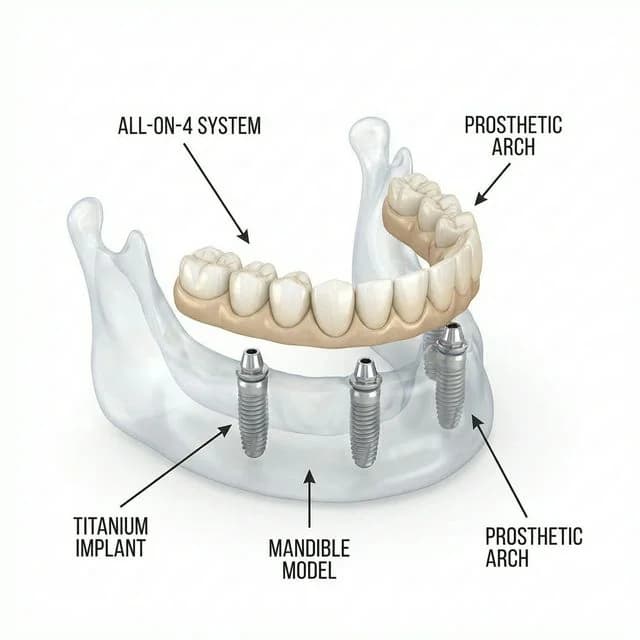
Featured Answer: What are All-on-4 dental implants?
All on 4 dental implants (written "All-on-4") is a full-arch restoration that uses four (sometimes more) strategically angled implants to support a fixed bridge--often avoiding major bone grafting and shortening treatment time compared to traditional implant approaches. The result is a complete set of non-removable teeth anchored permanently to the jawbone.
For patients in Marlborough, MA and the surrounding MetroWest communities who are missing most or all of their teeth, All-on-4 dental implants offer a way to restore a complete, fixed smile in fewer appointments than conventional implant methods. At Innova Smiles, your full-arch care is delivered by one coordinated team on a single plan: Dr. Ambereen Fatima uses advanced 3D planning to design your case and crafts the final fixed teeth, while a trusted local oral surgeon performs the guided surgical placement. This continuity means one dentist who knows you guides your restoration from first scan to finished smile.
How All-on-4 Dental Implants Work
The All-on-4 concept is built on a biomechanical principle originally developed by Dr. Paulo Malo in Lisbon, Portugal, beginning in the early 1990s, with his first documented patient treated in 1998. According to research published in Clinical Implant Dentistry and Related Research (Malo et al., 2003), angling the two posterior implants at approximately 30 to 45 degrees allows the clinician to engage more of the available cortical bone and create a wider anteroposterior (AP) spread--the distance between the front-most and back-most implants--without the need for bone grafting in many cases. A wider AP spread reduces cantilever forces on the prosthesis, which improves long-term mechanical stability.
The two front implants are placed vertically in the dense anterior bone of the premaxilla or anterior mandible. Together, these four implants provide a stable foundation for a complete arch of 10 to 14 fixed teeth. The prosthetic bridge is screw-retained (not cemented), which means it can be removed by your dentist for maintenance while remaining completely fixed in your daily life.
This approach is particularly valuable in the upper jaw, where bone density decreases toward the back of the mouth near the maxillary sinuses. The angled posterior implants bypass the sinus cavity entirely, often eliminating the need for a sinus lift procedure--saving months of healing and thousands of dollars.
The Science Behind Angled Implants
Traditional implant approaches for a full arch might require six to eight vertically placed implants, often combined with bone grafting to create sufficient bone volume in the posterior jaw. The breakthrough of the All-on-4 protocol is that tilting the posterior implants achieves three biomechanical advantages simultaneously:
- Longer implants in existing bone: Angling allows the surgeon to place longer implants (often 15 to 18mm) by following the natural bone contour anterior to the sinus or mental foramen, maximizing bone-to-implant contact without grafting.
- Greater AP spread: The wider base of support distributes occlusal (biting) forces more evenly across the bridge, reducing stress at any single implant. A 2011 finite element analysis in the Journal of Oral Implantology demonstrated that a 30-degree tilt reduced cantilever stress by approximately 40% compared to four parallel implants.
- Cortical bone engagement: The angled trajectory engages the dense cortical bone of the anterior sinus wall (maxilla) or external oblique ridge (mandible), providing higher primary stability--the initial mechanical grip that makes same-day loading possible.
A 10-year prospective study published in Clinical Implant Dentistry and Related Research (Malo et al., 2011) reported a cumulative implant survival rate of 98.1% for All-on-4 restorations, with prosthetic survival of 99.7%. These numbers are comparable to conventional implant approaches but achieved with fewer implants, fewer surgeries, and lower overall cost.
Benefits of All-on-4 Over Traditional Implant Approaches
- Fewer implants, same support: Four implants per arch instead of six to eight reduces surgical complexity, cost, and healing time
- Often graft-sparing: The angled design bypasses areas of bone deficiency, meaning many patients who were told they "don’t have enough bone" for implants are actually candidates for All-on-4
- Immediate function: Same-day provisional teeth are possible in the majority of cases, so you leave the office with a fixed smile
- Single surgical appointment: All four implants are placed in one session rather than staged over multiple surgeries
- Bone preservation: Implants transmit chewing forces to the jawbone, stimulating continued bone remodeling and halting the progressive resorption that occurs under dentures
- Proven long-term track record: Over 20 years of published clinical data supporting the protocol
All-on-4 vs. Traditional Implants: A Direct Comparison
"Traditional" full-arch implants use six to eight vertically placed implants, frequently combined with bone grafting and sinus lifts to build up the posterior jaw, then a staged restoration months later. All-on-4 reaches the same goal--a fixed, non-removable full arch--with fewer implants and, in many cases, no grafting. Here is how the two approaches compare:
Both approaches are surgeon-referred at Innova Smiles: Dr. Fatima plans the case and restores the final teeth, while a trusted local oral surgeon performs the placement. The right approach depends on your bone, bite, and goals--your 3D CBCT scan and consultation determine which fits. Costs above are estimates as of 2026, not quotes, and vary by case.
Step-by-Step All-on-4 Process
- Comprehensive consultation -- Dr. Fatima performs a full clinical examination, reviews your medical history, and captures a 3D CBCT scan at our Marlborough office. Impressions or digital scans of your current teeth (or dentures) are taken for prosthetic planning.
- Digital treatment planning -- The CBCT data is imported into surgical planning software where Dr. Fatima virtually positions each implant in three dimensions, accounting for bone density, nerve proximity (the inferior alveolar nerve in the mandible), sinus location, and the final prosthesis design. A surgical guide is 3D-printed from this plan.
- Surgery day -- A trusted local oral surgeon places all four implants in a single appointment, following Dr. Fatima's plan. Remaining failing teeth are extracted as needed. The 3D-printed surgical guide built from that plan helps place each implant according to the CBCT plan — no freehand guesswork. In many cases, Dr. Fatima then attaches a provisional (temporary) set of fixed teeth the same day, so you walk out with teeth.
- Healing period (3-6 months) -- The implants undergo osseointegration--biological fusion with the jawbone--while you function comfortably on the provisional bridge. A soft-food diet is recommended for six to eight weeks. Follow-up appointments at two weeks, six weeks, and three months monitor healing.
- Definitive prosthesis delivery -- Once osseointegration is confirmed (sometimes verified with resonance frequency analysis), your final bridge is fabricated from high-strength materials and permanently screw-retained to the implants.
Prosthesis Material Options
The final bridge material significantly affects esthetics, durability, and cost:
Dr. Fatima discusses these options in detail during your consultation, showing shade samples and examples of each material so you can make an informed choice.
Who Is a Candidate for All-on-4?
All-on-4 may be right for you if:
- You are missing all teeth in one or both arches
- You currently wear dentures and want a fixed, permanent alternative that does not come out
- You have been told you lack sufficient bone for traditional implants (the angled design often eliminates the need for grafting)
- You want to minimize the number of surgical procedures and overall treatment time
- You have failing teeth throughout an arch and need full-mouth extraction followed by immediate replacement
- You are tired of denture adhesives, sore spots, and dietary restrictions
Patients from Northborough, Hudson, Framingham, and across the MetroWest region who have been living with failing teeth or loose dentures are often excellent candidates. Even individuals with moderate bone loss may qualify because the angled implant design maximizes the use of existing bone. Medical conditions such as controlled diabetes, treated hypertension, and osteoporosis are generally not contraindications, though they require careful coordination.
Patients who are active smokers face higher complication rates. A 2018 meta-analysis in The International Journal of Oral & Maxillofacial Implants found that smoking increases early implant failure risk by 2.2 times. We strongly recommend smoking cessation at least two weeks before surgery and permanently afterward.
Same-Day Dental Implants: Teeth in a Day
One of the most compelling advantages of All-on-4 treatment is receiving a full set of fixed teeth on the same day as implant surgery. This protocol, often called "teeth in a day" or "same-day dental implants," works because the four implants are designed to achieve strong primary stability (measured in Newton-centimeters of insertion torque) in the bone. When primary stability is sufficient--typically 35 Ncm or higher--Dr. Fatima can attach a provisional fixed bridge immediately after the oral surgeon places the implants.
How same-day implants work with All-on-4:
- Your provisional bridge is pre-fabricated before surgery day based on digital planning and your pre-operative records
- After the implants are placed, the provisional is attached and adjusted for bite before you leave the office
- You walk out with a full arch of fixed, non-removable teeth--no denture adhesive, no removable prosthesis
- The provisional bridge is worn during the 3 to 6 month healing period while osseointegration occurs
- Once healing is confirmed, your definitive (permanent) bridge is fabricated and delivered
Not every patient qualifies for same-day loading. Factors that influence candidacy include bone density at the implant sites, the number of teeth being extracted simultaneously, and whether bone grafting is needed at any site. During your consultation, Dr. Fatima will assess your 3D CBCT scan and let you know whether immediate loading is appropriate for your case. Even when same-day teeth are not possible, the provisional bridge is typically delivered within one to two weeks.
Recovery Timeline After All-on-4 Surgery
Most patients experience moderate swelling and discomfort for the first three to five days after surgery, managed effectively with prescribed medications (typically ibuprofen alternating with acetaminophen, plus a short course of antibiotics) and cold compresses applied 20 minutes on, 20 minutes off. Here is a general timeline:
A soft-food diet is recommended for the first six to eight weeks while the implants integrate. Many patients return to work within three to five days. For a detailed day-by-day breakdown, see our dental implant recovery timeline.
All-on-4 vs. Traditional Dentures
This comparison matters because the decision between dentures and implant-supported teeth affects nutrition, bone health, and quality of life for decades:
A study in the Journal of Prosthetic Dentistry (Feine et al., 2002) concluded that implant-supported overdentures should be considered the minimum standard of care for edentulous patients, given the dramatic improvements in quality of life, nutritional intake, and patient satisfaction compared to conventional dentures.
Dr. Fatima’s FICOI and FAAIP fellowship credentials represent advanced surgical and prosthetic training beyond standard dental school education. Complex full-arch cases require this level of expertise for precise planning, predictable outcomes, and long-term prosthesis design.
What Goes Into All-on-4 Cost in Massachusetts
All-on-4 cost combines the two parts of the case: the referred surgical placement performed by a trusted local oral surgeon and the planning and restoration delivered by Dr. Fatima. The single biggest variable is the material chosen for your final fixed bridge, followed by whether you need extractions or minor grafting. Here is what the case includes:
- CBCT imaging and treatment planning
- Extractions (if needed)
- Four implants (referred surgical placement)
- Provisional (temporary) bridge
- Definitive bridge (acrylic/titanium or zirconia)
Your exact price depends on your case and is confirmed in a written, itemized estimate before any treatment begins.
What Drives All-on-4 Cost
Two patients can land at very different numbers. The factors that move yours include:
- Final prosthesis material -- Monolithic zirconia sits at the high end (most durable and stain-resistant); an acrylic-over-titanium bridge sits lower. This is the largest single driver.
- One arch or both -- A full-mouth (upper and lower) case is roughly double a single arch.
- Extractions needed -- Removing failing teeth at the same surgical appointment adds per-tooth cost.
- Grafting or sinus work -- All-on-4's angled implants often avoid this, but some anatomy still requires minor grafting, which adds cost.
- Four implants vs. six (All-on-6) -- A stronger bite or larger arch may call for two extra implants, raising the surgical portion.
- Provisional vs. definitive timeline -- Same-day provisional teeth are included in planning; the definitive bridge is fabricated after healing.
Financing, Membership, and How to Lower the Cost
All-on-4 is a significant investment, but it is often comparable to--or less than--the cumulative cost of decades of denture replacements, adhesives, relining appointments, and the nutritional consequences of poor chewing ability. We make it manageable several ways:
- 0% monthly payment plans through CareCredit and Cherry let qualified applicants spread the cost over time rather than paying in one lump sum.
- In-house membership plan -- For patients without dental insurance, our plan starts at $395/year for the primary member ($199/year per additional family member, paid as a single annual lump sum) and includes 20% off all treatments. It stacks with CareCredit or Cherry financing.
- Phasing across benefit years -- If you have PPO insurance, treatment can sometimes be split across two calendar years to use two annual maximums.
For more on what affects pricing, read our guide to the real cost of dental implants or try our implant cost calculator. When you are ready for real numbers, call (508) 481-0110 or book a consultation for a written, itemized estimate — we put every line item in writing before any treatment begins, so the figure you see is the figure you plan around.
Does Insurance Cover All-on-4?
Most PPO dental insurance plans cover a portion of implant treatment--typically the surgical placement and sometimes the prosthesis under major restorative benefits — but coverage varies by plan and is never guaranteed. Annual maximums ($1,500 to $2,500 for most plans) limit the total benefit per calendar year. Some patients strategically split treatment across two benefit years to maximize coverage. We submit pre-authorization to your insurance carrier and provide a written estimate of your out-of-pocket cost before scheduling surgery.
Medical insurance may also apply in specific situations: if tooth loss resulted from trauma, cancer treatment, or a congenital condition, medical carriers sometimes cover implant-related surgical costs. Our team investigates all avenues to reduce your financial burden.
All-on-4 vs. All-on-6: How Many Implants Do You Need?
Some patients are better served by six implants per arch rather than four. The decision depends on bone quality, arch size, and the forces your bite generates:
- All-on-4: Ideal for patients with adequate anterior bone density and a normal bite. Four implants provide excellent support for a standard-length bridge.
- All-on-6: Recommended when bone quality is marginal, the patient has a strong bite (history of bruxism), or the arch is large and requires a longer bridge with less cantilever. The additional two implants provide redundancy and reduce per-implant loading.
Dr. Fatima determines the optimal number of implants during your digital treatment planning session based on your CBCT data. The goal is always the most conservative approach that delivers long-term predictability--not the most implants possible.
Maintaining Your All-on-4 Restoration
All-on-4 bridges require consistent home care and professional maintenance:
- Daily brushing with a soft-bristled toothbrush or powered brush, paying special attention to the junction between the bridge and gums
- Water flosser (Waterpik) on a moderate setting to flush debris from beneath the bridge where traditional floss cannot reach
- Interproximal brushes (such as TePe or GUM) for cleaning between implant abutments
- Professional cleaning every 6 months at Innova Smiles, where we remove the bridge annually to clean the implant components and verify tissue health
- Night guard if you have a history of grinding, to protect both the implants and the prosthesis from excessive force
With proper care, the implants themselves can last for decades. The prosthetic bridge typically lasts 15 to 25 years for zirconia and 10 to 15 years for acrylic before requiring refabrication.
Frequently Asked Questions
How much do All-on-4 dental implants cost?
All-on-4 at Innova Smiles combines the referred surgical placement with Dr. Fatima's planning and fixed restoration. The investment depends on the prosthesis material (acrylic vs zirconia), whether one or both arches are treated, and individual anatomy. Innova Smiles provides a written, itemized estimate before any treatment begins, and offers financing through CareCredit and Cherry.
How long do All-on-4 dental implants last?
The titanium implants themselves can last for decades when they integrate with the bone and are well maintained. The fixed bridge they support typically lasts 15 to 25 years for zirconia and 10 to 15 years for acrylic before it needs refabrication. Daily cleaning and regular maintenance visits are what protect that lifespan.
Are All-on-4 dental implants worth it compared to dentures?
For many patients who have lost most or all of their teeth, yes. All on 4 can restore strong chewing efficiency compared with traditional dentures, the teeth are fixed (not removable), and the implants stimulate the jawbone to slow the bone loss that makes conventional dentures progressively looser. Whether it is the right choice depends on your bone, health history, and goals, which Dr. Fatima assesses with a CBCT scan.
Can All-on-4 implants be taken out, and how do you clean them?
An All-on-4 bridge is fixed and is not removed by the patient. It is cleaned at home like natural teeth with brushing, a water flosser, and interproximal brushes under the bridge. At Innova Smiles we remove and deep clean the bridge components periodically and verify the health of the gum and implants.
Considering a full-arch solution? Call (508) 481-0110 or book now. Dr. Fatima provides complimentary CBCT imaging with every All-on-4 consultation so you receive a complete treatment plan and written estimate at your first visit.
Related Articles
- Full Mouth Reconstruction: Process, Options & Cost Guide
- Dental Implants vs. Dentures: Which Is Right?
- The Real Cost of Dental Implants in Massachusetts
- Dental Implant Recovery: Day-by-Day Timeline
- Types of Dental Implants: Titanium vs Zirconia
Related Services
How our pricing works
All-on-4® full-arch restorationOur fee range$7,500–$30,000 per arch
- The fee covers the procedure as planned at your exam. Anything your case adds is written into your estimate before treatment, never after.
- More PPO plans now contribute toward implant treatment, usually up to the plan's annual maximum. When yours does, the covered portion is billed at the plan's negotiated fee, which is what the low end of this range reflects.
- 0% APR financing through CareCredit or Cherry spreads the cost from about $208/mo with nothing down.*
- No insurance? Our in-house membership plan (from $395/yr) includes your preventive care and takes a flat 20% off our standard fee for this treatment.
- The top of the range is our standard fee; the low end is what a patient whose plan covers the treatment typically pays before their share is applied. Extractions, bone grafting and sinus lifts, when needed, are estimated separately at your consultation.
- Your exact fee is confirmed in writing at your visit, after your exam and after we have checked your insurance — never a surprise afterward.
- Patients aged 65 and older get 10% off all dental treatments. Mention it when booking and we'll apply it automatically.
*Estimated payment is the lowest All-on-4 arch cost ÷ 36 months at 0% APR with $0 down — an extended term offered for full-arch cases. Financing is provided by third-party lenders, not by Innova Smiles, and is subject to credit approval — not all applicants qualify. Your actual cost, term, and monthly payment depend on your treatment plan and approved offer.