Featured Answer: What Is Guided Implant Surgery?
Guided implant surgery uses 3D cone-beam computed tomography (CBCT) imaging, digital planning software, and a custom-fabricated surgical guide to place dental implants with sub-millimeter accuracy. Instead of estimating implant position during surgery, the dentist plans every angle, depth, and trajectory in advance on a computer screen, then uses a physical guide during the procedure to execute that plan exactly.
For patients in Marlborough, MA and surrounding MetroWest communities, guided implant surgery represents the most predictable approach to implant placement available today. At Innova Smiles, Dr. Ambereen Fatima uses this technology for every implant case, from single-tooth replacements to full-arch All-on-4 restorations. The result: implants placed in the precise position that supports the best possible crown, the fastest healing, and the longest lifespan.
A 2020 meta-analysis published in Clinical Oral Implants Research analyzed 3,288 implants placed with surgical guides and reported a mean angular deviation of just 3.5 degrees and a mean apical (tip) deviation of 1.4mm, compared to 7.9 degrees and 2.7mm with freehand placement. That level of precision is the difference between an implant that functions flawlessly for 25 years and one that compromises the final restoration from day one.
What Is CBCT and Why Does It Matter for Dental Implants?
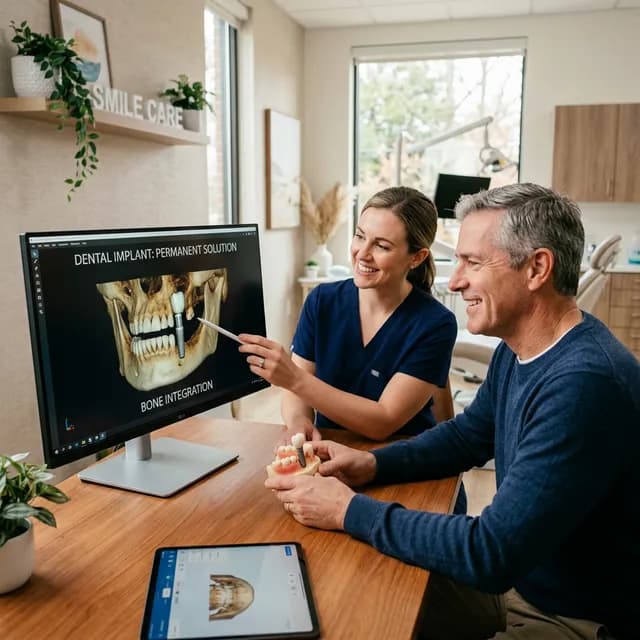
CBCT stands for cone-beam computed tomography. Unlike a traditional dental X-ray, which produces a flat two-dimensional image, a CBCT scan captures a full three-dimensional view of your jaw, teeth, nerves, sinuses, and surrounding bone in a single 15-second rotation. The machine circles your head once while you sit still, and the software reconstructs the data into a detailed 3D model that can be rotated, sliced, and measured from any angle.
How CBCT differs from traditional X-rays
| Feature | Traditional X-Ray (2D) | CBCT Scan (3D) |
|---|---|---|
| Dimensions captured | Height and width only | Height, width, and depth |
| Bone density assessment | Not possible | Measured in Hounsfield units at each point |
| Nerve location | Estimated from landmarks | Precisely mapped in three dimensions |
| Sinus floor mapping | Approximated | Exact distance measured to 0.1mm |
| Scan time | Seconds | 15 seconds |
| Radiation dose | Very low | Low (76 microsieverts, roughly equivalent to 1–2 days of background radiation) |
| Implant planning capability | None | Full virtual implant placement with angulation and depth control |
A 2D X-ray is like looking at a photograph of a building from the front, you can see height and width, but you have no idea how deep the building is. A CBCT scan is like walking through the building and measuring every room. For implant surgery, this distinction is critical because the jawbone is a three-dimensional structure with nerves, blood vessels, sinuses, and density variations that a flat image simply cannot reveal.
What the CBCT reveals for implant planning
This imaging technology allows Dr. Fatima to:
- Measure bone height, width, and density at the exact implant site, determining whether adequate bone exists or grafting is needed before making any incisions
- Identify the precise location of the inferior alveolar nerve in the lower jaw, this nerve runs through a canal inside the mandible and controls sensation in the lower lip and chin. Damage to this nerve during implant placement can cause numbness. CBCT mapping keeps the drill path at a safe distance.
- Map the sinus floor in the upper jaw to determine whether a sinus lift is needed, the maxillary sinus sits directly above where upper back teeth are replaced. Without 3D imaging, a dentist is guessing how much bone separates the implant site from the sinus cavity.
- Detect hidden infections, cysts, or anatomical variations before surgery begins, about 35% of patients have anatomical variations in the mandibular canal that are invisible on 2D X-rays, according to a 2017 study in Dentomaxillofacial Radiology
- Evaluate adjacent tooth roots to ensure the implant will not impinge on neighboring teeth
- Assess bone quality, dense cortical bone (type 1–2) provides immediate stability for the implant, while softer cancellous bone (type 3–4) may require adjusted surgical protocols
The CBCT scan is performed right in our Marlborough office using our in-house scanner, so there is no need for an outside radiology appointment. Patients from Hudson, Framingham, Northborough, and across MetroWest complete their scan and consultation in a single visit. The American Academy of Oral and Maxillofacial Radiology (AAOMR) recommends CBCT imaging for all dental implant cases, and the radiation dose (approximately 76 microsieverts) is significantly lower than a medical CT scan, roughly equivalent to one to two days of natural background radiation exposure.
How the Guided Surgery Process Works: From Scan to Placement
The guided implant workflow at Innova Smiles follows a precise sequence designed to eliminate guesswork at every stage. Here is a detailed walkthrough of what happens between your first scan and your completed implant.
Step 1: CBCT scan and digital impression (appointment 1 — 30 minutes)
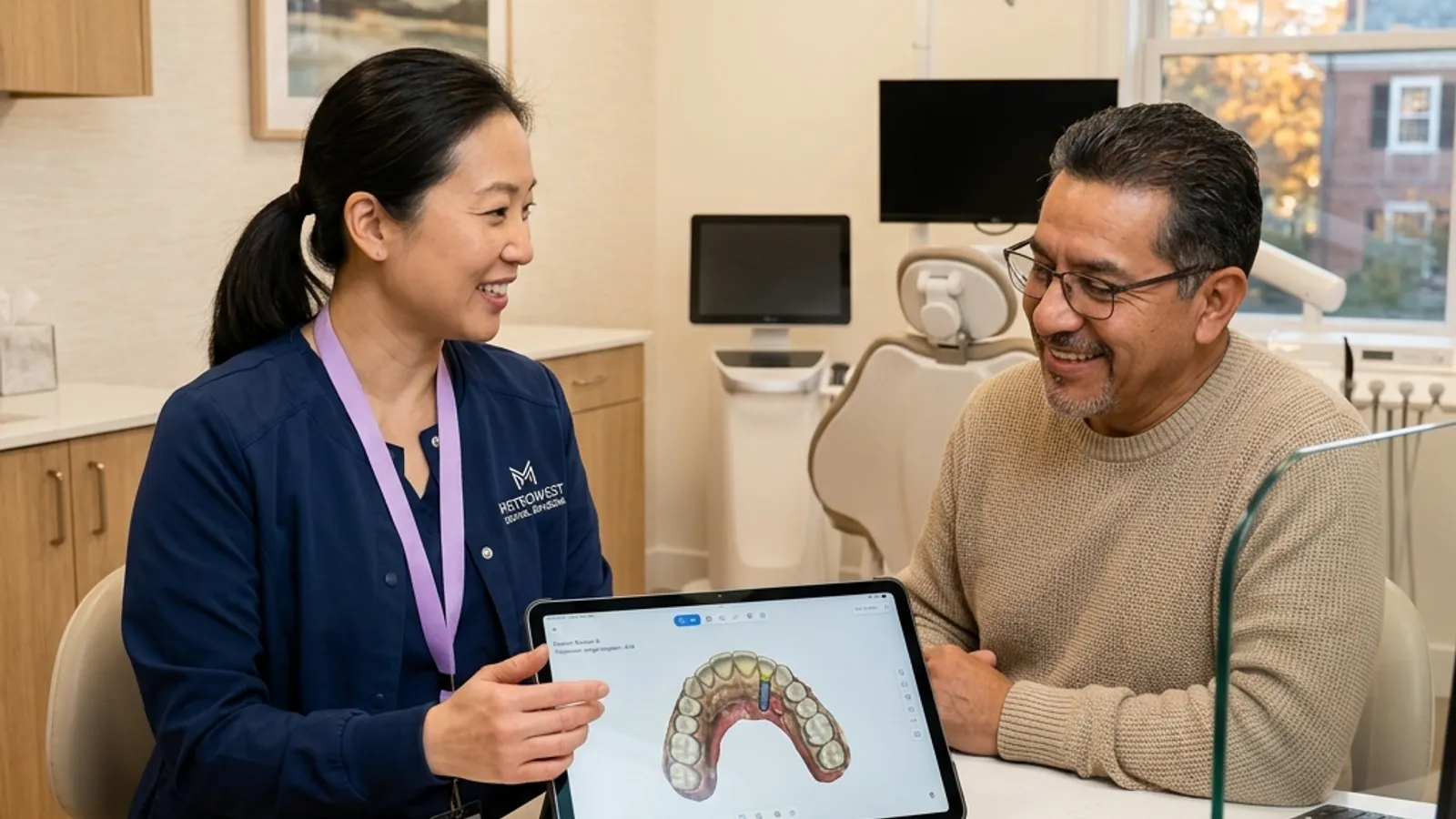
The CBCT scan takes approximately 15 seconds. We also capture a digital impression of your teeth and gums using an intraoral scanner, a wand-shaped device that creates a high-resolution 3D model of your mouth without gooey impression trays. These two datasets are merged in the planning software to create a complete digital replica of your jaw, teeth, and bone.
Step 2: Virtual implant planning (done by Dr. Fatima, typically 1–3 days)
Using specialized implant planning software, Dr. Fatima virtually positions each implant in the ideal location within your digital jawbone model. She can rotate the view, slice through the bone at any angle, and measure distances to nerves, sinuses, and adjacent roots with 0.1mm precision.
The planning process considers:
- Prosthetic-driven placement, the implant position is determined by where the final crown needs to be, not just where the most bone happens to exist. This "crown-down" planning philosophy ensures the implant supports natural-looking, functional tooth replacement.
- Bone density and volume, the software color-codes bone density, allowing selection of the densest bone for maximum initial stability
- Emergence profile, the angle at which the crown exits the gum tissue, which affects both appearance and cleanability
- Spacing from adjacent teeth, a minimum of 1.5mm from neighboring roots and 3mm between implants to maintain blood supply and prevent bone loss
- Implant diameter and length selection, matched to available bone and the planned restoration type
A 2018 study in the Journal of Oral and Maxillofacial Surgery found that prosthetically driven virtual planning improved crown-implant alignment by 42% compared to cases planned based on bone availability alone. In practical terms, this means the final crown looks more natural, fits more precisely, and distributes chewing forces more evenly.
Step 3: Surgical guide fabrication (3–7 days)
Once the virtual plan is finalized, the software generates a digital design for a custom surgical guide, a rigid plastic or resin template that fits precisely over your existing teeth or gums. The guide contains metal sleeves positioned at the exact angles and locations determined during virtual planning.
The guide is manufactured using either 3D printing (stereolithography) or milling, depending on the case complexity. At Innova Smiles, we review every guide for fit accuracy before the surgical appointment. Some practices outsource guide fabrication to remote labs, adding time and potential for error. Our workflow keeps quality control in-house.
Step 4: Guided implant surgery (surgical appointment, typically 30–60 minutes per implant)
On surgery day, the guide is placed in your mouth and seated over your teeth or gums. It locks into a stable position, there is no wiggle or movement. The drill passes through the metal sleeves in the guide, which control both the angle and the depth of each osteotomy (the hole drilled into the bone for the implant).
The sequence:
- Local anesthesia is administered (comfort options available for anxious patients)
- For flapless cases, a small tissue punch is used rather than a traditional incision, no scalpel, no sutures
- The guide is seated and stability is confirmed
- Sequential drills pass through the guide sleeves, each one slightly wider than the last, creating a precisely shaped channel in the bone
- The implant is threaded into the prepared site through the guide, ensuring final position matches the virtual plan exactly
- The guide is removed, and a healing cap or temporary restoration is placed
Many guided cases at our office are completed in 30 to 45 minutes per implant, roughly 30 to 50 percent faster than freehand placement. A study published in Clinical Implant Dentistry and Related Research (2019) reported a mean reduction in surgical time of 38% for guided single-implant cases compared to freehand, with a 52% reduction for multi-implant cases.
The Precision Advantage: What the Research Shows
A systematic review published in the International Journal of Oral & Maxillofacial Implants found that guided implant surgery reduces angular deviation by up to 78 percent and positional deviation by up to 74 percent compared to freehand placement. Let me explain why these numbers matter in practical clinical terms.
Angular deviation
If an implant is angled even 5 degrees off from the planned trajectory, the tip of the implant can miss the target location by several millimeters, potentially encroaching on a nerve canal, perforating a sinus floor, or exiting through the side of the bone (dehiscence). With guided surgery, the average angular deviation drops to approximately 3.5 degrees. With freehand placement, the literature reports averages between 7 and 9 degrees, and individual cases can deviate far more.
Positional deviation
The entry point of the implant at the bone surface determines where the crown emerges through the gum. A 2mm positional error at the bone level can result in an unnatural emergence angle, a crown that is visibly offset from the adjacent teeth, or difficulty cleaning around the restoration. Guided surgery reduces this positional error by nearly three-quarters.
Clinical outcomes
The precision advantages translate into measurable patient outcomes:
- Fewer nerve injuries, a 2021 retrospective study in Clinical Oral Implants Research reported zero cases of permanent nerve damage in 1,247 guided lower-jaw implant placements, compared to a 0.35% incidence in freehand cases
- Higher implant survival rates, a 2022 meta-analysis in the Journal of Prosthetic Dentistry found 97.3% survival at 5 years for guided implants vs. 95.1% for freehand
- Fewer complications, guided surgery showed 67% fewer intraoperative complications (perforation, nerve proximity events, sinus complications) in a 2020 multicenter study
- Better prosthetic fit, when implants land exactly where planned, the final crown or bridge requires fewer adjustments and fits more accurately
Flapless Surgery: The Minimally Invasive Option
One of the most significant advantages of guided surgery is that it enables flapless implant placement in many cases. Traditional freehand surgery requires lifting a "flap" of gum tissue away from the bone so the surgeon can see the bone surface directly. This visibility is necessary because without a guide, the surgeon needs to see anatomical landmarks in real time.
With guided surgery, the guide directs the drill path precisely, the surgeon does not need to see the bone because the plan has already accounted for every anatomical variable. Instead of a scalpel incision and flap elevation, a small tissue punch (4–5mm diameter) removes a circle of gum tissue directly over the implant site. The drill passes through this small opening, the implant is placed, and no sutures are needed.
Flapless vs. traditional flap surgery
| Factor | Flapless (Guided) | Traditional Flap |
|---|---|---|
| Incision size | 4–5mm tissue punch | 20–40mm scalpel incision |
| Sutures required | None in most cases | 3–6 sutures |
| Post-op swelling | Minimal | Moderate to significant |
| Pain level (patient-reported) | Mild, typically managed with OTC ibuprofen | Moderate, may require prescription pain medication |
| Return to normal activities | 1–2 days | 3–5 days |
| Surgery time | Shorter (no flap elevation/closure) | Longer (flap elevation adds 15–20 minutes) |
| Bone exposure time | Seconds | 30–60 minutes |
Randomized controlled trials demonstrate that flapless guided implant surgery significantly reduces postoperative pain and swelling compared to traditional flap surgery. Patients undergoing flapless procedures typically return to normal activities within 1–2 days, compared to 3–5 days for flap-based surgery.
Not every case qualifies for flapless placement. Patients who need bone grafting, significant gum tissue adjustment, or have unusually thin tissue may still require a traditional flap approach. During your consultation at Innova Smiles, Dr. Fatima reviews your CBCT scan to determine whether flapless placement is appropriate for your specific anatomy.
Recovery: Guided vs. Traditional Freehand Surgery
Patients who undergo guided surgery consistently report a smoother recovery compared to traditional freehand placement. With smaller incisions, less tissue manipulation, and shorter surgical times, post-operative swelling and discomfort are substantially reduced.
Typical guided surgery recovery timeline
| Timeline | What to Expect |
|---|---|
| Day 1 | Mild soreness at the surgical site. Most patients manage with ibuprofen alone. Cold packs help with any minor swelling. |
| Day 2–3 | Soreness diminishes significantly. Most patients return to desk work and normal daily routines. |
| Day 4–7 | Residual tenderness fades. Eating resumes normally (soft foods initially). |
| Week 2 | Healing check at Innova Smiles. The tissue around the implant is typically pink and healthy. |
| Months 3–6 | Osseointegration (bone fusion with the implant) completes. The final crown is placed. |
Many patients from Sudbury, Westborough, Southborough, Shrewsbury, and the broader MetroWest area tell us they were surprised at how quickly they felt normal after guided surgery, several have returned to work the same day for single-implant cases. For a complete day-by-day overview, read our dental implant recovery timeline.
Who Benefits Most from Guided Implant Surgery?
While guided surgery improves outcomes for all implant cases, certain patients benefit the most:
Patients needing multiple implants
When placing four to six implants for a full-arch restoration (such as All-on-4), precise spacing and angulation are critical for the final prosthesis to fit correctly. Each implant must be parallel to the others within a tight tolerance, and the spacing must accommodate the bridge or denture attachment points. Placing multiple implants freehand introduces compounding errors, a small angular mistake on the first implant cascades into progressively worse alignment on subsequent implants. Guided surgery eliminates this cascade effect.
Patients with limited bone
Guided surgery ensures the implant is placed in the exact location where bone is thickest and densest, potentially avoiding the need for bone grafting. In some cases, the planning software reveals bone adequate for implant placement that was not apparent on a 2D X-ray, saving the patient an additional surgical procedure, months of healing, and $500 to $3,000 in grafting costs.
Patients near critical anatomical structures
In the lower jaw, the inferior alveolar nerve runs through a bony canal close to where implants are placed. Damaging this nerve can cause permanent numbness of the lower lip, chin, and gums, a life-altering complication. In the upper jaw, the maxillary sinus cavity sits directly above the posterior tooth region, and perforation can lead to sinus infection or implant failure. Guided surgery maintains a predetermined safety margin from these structures that is impossible to guarantee with freehand technique.
Anxious patients
Shorter, more predictable procedures mean less time in the chair. For patients who manage dental anxiety, and this includes a significant number of our MetroWest patients, knowing the surgery will take 30 to 45 minutes rather than 60 to 90 minutes makes a meaningful difference. We also offer gentle care options including premium topical numbing that pair well with the already-reduced chair time of guided surgery.
Patients with complex medical histories
Patients on blood thinners (warfarin, Eliquis, Xarelto), patients with controlled diabetes, and patients with osteoporosis benefit from the reduced surgical invasiveness of guided procedures. Less tissue trauma means less bleeding, lower infection risk, and faster healing, all critical considerations for medically complex patients.
Cost of Guided Implant Surgery vs. Traditional Freehand
The guided protocol adds a cost for the CBCT scan and surgical guide fabrication. Here is a transparent breakdown:
| Component | Guided Surgery | Traditional Freehand |
|---|---|---|
| CBCT scan | $150–$350 | $150–$350 (often still needed for basic planning) |
| Surgical guide fabrication | $300–$500 per arch | Not applicable |
| Implant placement only (surgical fixture, single tooth) | $1,800–$3,000 | $1,800–$3,000 |
| Custom abutment | $1,200–$1,500 | $1,200–$1,500 |
| Crown (final restoration) | $1,800–$2,300 | $1,800–$2,300 |
These line items add up to the complete tooth. A full single-tooth implant at Innova Smiles, the surgical placement plus the custom abutment plus the permanent crown, plus the 3D CBCT imaging and digital planning that make it precise, generally runs $4,000 to $6,500 all-in. The low end reflects a straightforward site; the high end includes added steps such as a bone graft or sinus lift. That is a one-time investment in a tooth replacement designed to last decades, and we offer flexible payment plans from $199/month with 0% APR options through CareCredit and Cherry so you can spread the cost over time.
The guided protocol itself adds only $300 to $500 to that total, the price of the surgical guide. For many patients, this modest additional investment pays for itself through:
- Reduced need for bone grafting, guided planning identifies bone that freehand technique might miss, potentially saving $500 to $3,000
- Fewer follow-up appointments, smoother healing means fewer post-op visits
- Lower complication rates, avoiding a nerve injury or sinus perforation avoids the medical, emotional, and financial costs of managing these complications
- Better long-term implant survival, a 2% improvement in 5-year survival rate translates to fewer implant failures and re-treatments over a lifetime
At Innova Smiles, the guide fabrication cost is included in our implant treatment packages, so the precision of guided surgery is built into the all-in figure above rather than billed as an extra. Many patients also use dental insurance toward the surgery; a typical PPO contributes roughly $1,000 to $1,500 toward an implant, which reduces your out-of-pocket cost from the $4,000 to $6,500 base. Between insurance and the $199/month, 0% APR financing options through CareCredit and Cherry, most patients find the monthly commitment very manageable.
Common Questions About CBCT and Guided Surgery
Is the CBCT scan safe? Yes. The radiation dose from a dental CBCT scan (approximately 76 microsieverts) is a fraction of a medical CT scan and roughly equivalent to one to two days of natural background radiation. The American Dental Association and the AAOMR both confirm CBCT is safe and appropriate for implant planning.
How long does the entire guided process take from scan to implant? Typically 2 to 3 weeks. The CBCT scan and digital impression are captured at the first appointment. Virtual planning and guide fabrication take 7 to 14 days. The surgical appointment follows. In urgent cases, we can compress this timeline.
Can guided surgery be used for immediate implant placement after extraction? Yes. The CBCT scan and virtual plan are completed before the extraction appointment. On the day of surgery, the tooth is removed and the implant is placed into the extraction socket using the guide, all in a single visit. This approach is called immediate implant placement and reduces total treatment time by 3 to 6 months.
Does every dentist use guided surgery for implants? No. Guided implant surgery requires specialized training, CBCT imaging equipment, planning software, and a workflow for guide fabrication. Many general dentists and even some oral surgeons still place implants freehand. Dr. Fatima’s FICOI (Fellow of the International Congress of Oral Implantologists) and FAAIP (Fellow of the American Academy of Implant Prosthodontics) credentials reflect advanced training specifically in implant planning and placement, including guided protocols.
What if I need a bone graft, can guided surgery still be used? Yes. If the CBCT scan reveals insufficient bone, Dr. Fatima plans the grafting procedure and the implant placement together. In some cases, the graft and implant are placed simultaneously. In cases requiring significant bone augmentation, the graft is placed first, allowed to heal for 4 to 6 months, and then a new CBCT scan is taken for guided implant planning.
Is guided surgery covered by dental insurance? Most dental insurance plans cover the implant surgery itself (if implant coverage is included in your plan) regardless of whether guided or freehand technique is used. The CBCT scan is often covered as a diagnostic procedure. The surgical guide is sometimes covered as part of the surgical fee, though coverage varies by plan. Our team submits pre-authorizations and provides a clear breakdown of what your plan covers.
Why Dr. Fatima Uses Guided Surgery for Every Implant Case
Some practitioners reserve guided surgery for "complex" cases and place "simple" single-tooth implants freehand. Dr. Fatima takes a different approach: guided surgery for every case, every time. Her reasoning is straightforward, there is no implant case where less precision produces a better outcome. The CBCT scan reveals anatomy that a 2D X-ray misses. The virtual plan ensures prosthetically driven placement. The surgical guide executes that plan with sub-millimeter accuracy. Removing any of these steps introduces unnecessary risk.
This philosophy reflects Dr. Fatima’s FICOI and FAAIP fellowship training, which emphasizes evidence-based, prosthetically driven implant planning. It is also why patients from Hopkinton, Marlborough, Hudson, Framingham, Northborough, and across MetroWest specifically seek out Innova Smiles for implant care.
Our office is equipped with in-house CBCT imaging, digital impression scanners, and the latest guided surgery planning software. This means fewer outside appointments, faster turnaround from scan to surgery, and more predictable results for every patient.
Ready for precise, comfortable implant care? Call (508) 481-0110 or book now.
Related Articles
- What to Expect During Dental Implant Surgery
- Why Implant Credentials (FICOI & FAAIP) Matter
- Types of Dental Implants: Titanium vs. Zirconia
- Missing Front Tooth? The Art of a Perfect Implant