Featured Answer: What are the main types of dental implants?
There is no single "dental implant." There is a family of options, and the right one depends on your anatomy, your bite, your esthetic priorities, and how much bone you have to work with. The main decisions are: material (titanium or zirconia), size (standard or mini), how the implant is placed (guided CBCT surgery, often flapless), and timeline (a conventional two-stage protocol, or a same-day temporary tooth). A front tooth is also a different problem than a back molar. This guide walks through all of it.
When patients across Marlborough, MA and the greater MetroWest area begin researching implants, they are usually surprised at how many choices exist. At Innova Smiles, Dr. Ambereen Fatima takes the time to explain those choices so you can make a confident, informed decision rather than accepting one approach for every situation. Her FICOI (Fellow of the International Congress of Oral Implantologists) and FAAIP (Fellow of the American Academy of Implant Prosthodontics) training means the surgical placement and the final restoration are planned together, by one provider, from the start. Ready to skip ahead? See our dental implants service page.
The Anatomy of an Implant: What You're Actually Choosing
A complete single-tooth implant is three parts working together:
- The implant post — a threaded screw (titanium or zirconia) placed into the jawbone to replace the missing tooth root.
- The abutment — the connector, milled to your anatomy, that links the post to the crown.
- The crown — the lab-fabricated tooth you see and chew with, color-matched to your smile.
Most standard implants use a two-piece design (a separate post and abutment), which lets the dentist adjust the angle of the crown independently of the post. Mini implants use a one-piece design — the post and attachment are a single unit. That structural difference drives much of what follows, because it determines how much bone you need, how the implant is loaded, and what it can support.
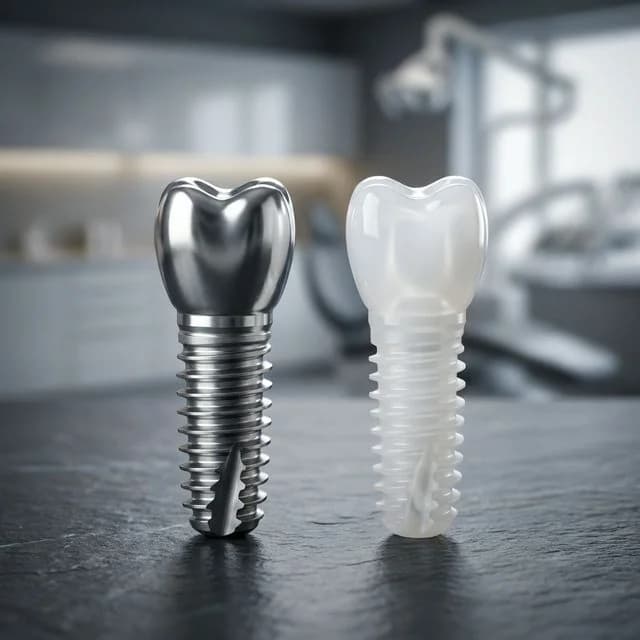
Implant Materials: Titanium vs. Zirconia
Titanium: the proven standard
Titanium has been the backbone of implant dentistry for over 50 years. It was the material Dr. Per-Ingvar Brånemark used when he pioneered modern dental implants in Sweden in the 1960s — and his original patients kept their implants for over 40 years. According to the American Academy of Implant Dentistry, titanium remains the most widely researched and clinically validated implant material available, with more than 3 million implants placed annually in the United States.
What makes titanium remarkable is its behavior at the surface. Exposed to air or body fluids, it instantly forms a thin, biologically inert oxide layer that the immune system does not recognize as foreign. Bone cells (osteoblasts) grow directly onto that surface in a process called osseointegration — a direct structural connection between living bone and the implant, with no soft tissue in between. Modern surface treatments push this further: sandblasted/acid-etched (SLA) surfaces raise bone-to-implant contact from roughly 30% to over 60%, and hydrophilic surfaces can shorten initial healing from 6–8 weeks to 3–4.
Why patients and dentists trust it:
- Decades of evidence. A 10-year follow-up of 511 SLA titanium implants (Buser et al., 2012) showed a 98.8% survival rate; 20-year data (Lekholm et al., 2006) showed 93.3% cumulative survival.
- Two-piece versatility. A separate abutment lets the dentist correct for imperfect bone angulation — critical when anatomy is not ideal.
- Serviceability. If a component needs replacement in 15 years, reputable titanium systems guarantee parts.
- Cost-effective. The titanium fixture itself generally costs less than zirconia.
The main consideration is esthetic: in patients with very thin gum tissue, titanium's gray color can show through as a faint dark shadow — a phenomenon dentists call "graying." More on that below.
Zirconia: the metal-free alternative
Zirconia (zirconium dioxide) is a tooth-colored ceramic adapted from orthopedic implants in the early 2000s. The grade used in dental implants — yttria-stabilized tetragonal zirconia (Y-TZP) — has a flexural strength of roughly 900–1,200 MPa, comparable to titanium alloy and far stronger than the brittle ceramics of the past. It osseointegrates through a different mechanism than titanium but reaches comparable bone contact (60–70%) without any metal.
Where zirconia shines:
- Metal-free and hypoallergenic — the clear choice for patients with confirmed metal sensitivities.
- White color — blends with thin gum tissue, with no risk of gray show-through even if the gum recedes over time.
- Lower plaque affinity — a 2021 study in Clinical Oral Implants Research measured ~40% less biofilm on zirconia versus titanium after 48 hours in vivo, and gum tissue tends to attach closely to it.
- Zero MRI artifact — helpful for patients who need frequent imaging.
The trade-offs: fewer long-term studies (the longest follow-ups are about 10–15 years; a 2023 systematic review by Puchades-Roman et al. of 2,288 zirconia implants reported 95.2% survival at a mean 3.5 years), a usually one-piece design that limits angle correction, and a narrower range of sizes.
Side-by-side
A note on titanium allergy: true reactions are exceedingly rare — a 2019 review in the Journal of Prosthodontic Research estimated prevalence at about 0.6%. If you have a known metal sensitivity or have experienced unexplained failure of a previous titanium implant, Dr. Fatima can order a MELISA blood test before proceeding. No confirmed case of true zirconia allergy has been reported in the dental literature.
Implant Sizes: Standard vs. Mini Dental Implants
Not every ridge has the width for a standard implant, and not every patient wants — or needs — a full surgical procedure. That is where mini dental implants (MDIs) come in.
MDIs are narrow-diameter implants, typically 1.8–3.3mm versus the 3.5–6.0mm of standard implants. They earned FDA clearance for long-term stabilization of lower dentures and for specific narrow-ridge applications. Because they are a single-piece design and so much narrower, they can be placed through a flapless technique — a small pilot hole through the gum, no incision, no sutures — and a set of four lower MDIs often goes in within 30–60 minutes. In many cases the denture is modified and snapped onto the implants the same day, which is a meaningful change for someone who has been fighting a loose lower denture for years.
Who mini implants suit
- Denture wearers seeking stability. This is the primary FDA-cleared use. The 2002 McGill Consensus Statement established that a two-implant overdenture should be the minimum standard of care for a lower edentulous jaw — and MDIs fulfill that role at a lower cost. A full set of four lower MDIs with denture retrofit typically costs less than a conventional implant-supported denture; both are quoted after a consultation. If you're weighing removable options more broadly, see our dentures vs. dental implants comparison.
- Patients with narrow ridges who would otherwise need bone grafting before a standard implant.
- Patients who can't undergo lengthy surgery — some medical conditions or simple apprehension make the shorter, less invasive MDI procedure the sensible path.
Where standard implants are the right call
MDIs are not a universal substitute. Dr. Fatima recommends standard implants when a single tooth in the chewing zone needs replacing (premolars and molars endure 100–250 psi of force, and a narrow MDI placed there carries a higher fracture risk), when a fixed full-arch bridge like All-on-4 is the goal, when there is adequate bone, or when maximum proven longevity is the priority. MDI long-term data is encouraging — a 2018 systematic review in the Journal of Oral Rehabilitation reported 91.4% survival at five years for lower-overdenture stabilization — but it is less mature than the 25- and 30-year data behind standard implants. Importantly, choosing MDIs now rarely closes the door on standard implants later.
How Implants Are Placed: CBCT + Guided Surgery
How an implant is placed matters as much as what it's made of. At Innova Smiles, every implant is planned with 3D cone-beam CT (CBCT) and placed with a custom surgical guide — Dr. Fatima's approach is guided surgery for every case, every time, because there is no implant where less precision produces a better result.
Why a 3D scan changes everything
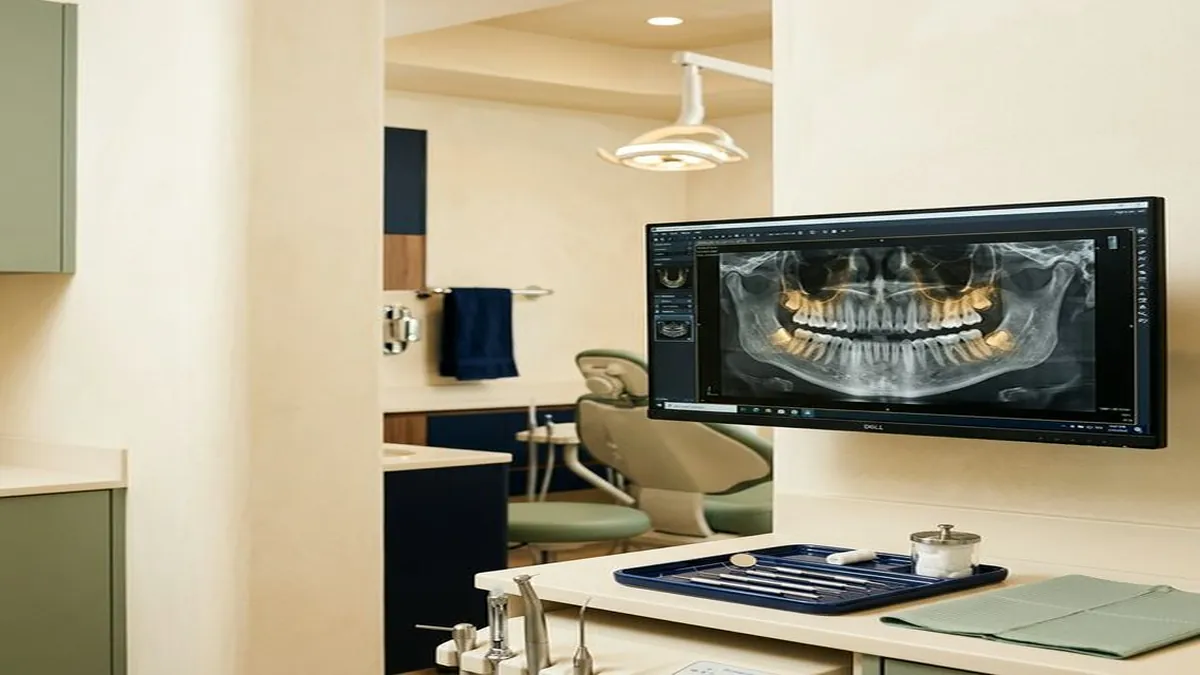
A traditional dental X-ray is a flat, 2D image — like a photograph of a building from the front: you see height and width but have no idea how deep it is. A CBCT scan captures a full 3D view of your jaw, nerves, sinuses, and bone in a single 15-second rotation, then reconstructs it into a model that can be rotated, sliced, and measured to 0.1mm. The American Academy of Oral and Maxillofacial Radiology recommends CBCT for all implant cases, and the dose (about 76 microsieverts) is roughly one to two days of natural background radiation.
That 3D data lets Dr. Fatima measure bone height, width, and density at the exact site; map the inferior alveolar nerve in the lower jaw (damage causes lip and chin numbness); gauge the sinus floor in the upper jaw; and catch hidden infections or anatomical variations — about 35% of patients have mandibular-canal variations invisible on 2D film (Dentomaxillofacial Radiology, 2017).
The precision advantage, in numbers
A 2020 meta-analysis in Clinical Oral Implants Research (3,288 implants) found guided placement averaged just 3.5° of angular deviation and 1.4mm of tip deviation, versus 7.9° and 2.7mm freehand. Translated to patient outcomes:
- Fewer nerve injuries — a 2021 study reported zero permanent nerve injuries across 1,247 guided lower-jaw placements, versus a 0.35% incidence freehand.
- Higher survival — 97.3% at five years guided vs. 95.1% freehand (Journal of Prosthetic Dentistry, 2022).
- Fewer complications — 67% fewer intraoperative events in a 2020 multicenter study.
The plan is prosthetically driven ("crown-down"): the implant is positioned based on where the final tooth needs to be, not simply where bone is easiest. A 2018 study in the Journal of Oral and Maxillofacial Surgery found this improved crown-implant alignment by 42% over bone-driven planning.
Flapless: smaller, more comfortable
Because the guide directs the drill, Dr. Fatima often doesn't need to open a flap of gum to see the bone. Instead, a 4–5mm tissue punch replaces a 20–40mm incision — usually no sutures. Patients report mild soreness typically managed with over-the-counter ibuprofen, and most return to normal activities within 1–2 days rather than 3–5. Not every case qualifies (significant grafting or very thin tissue may still need a flap), and Dr. Fatima reviews your CBCT to decide. The guide protocol adds modestly to the total — and it routinely pays for itself by revealing usable bone that avoids a graft, by preventing complications, and through better long-term survival.
Timeline Options: Same-Day vs. Conventional
"Same-day implants" is used loosely in marketing, so it helps to be precise. Immediate placement means the implant goes in the same appointment the tooth comes out. Immediate loading (also called same-day teeth) means a temporary crown is attached the day the implant is placed, so you leave with a tooth. The permanent crown still comes later, at 3–6 months, once the implant has fused with bone — a distinction patients sometimes miss.
Whether you qualify for same-day loading is decided partly in the planning and partly in the chair:
- Primary stability. The implant must grip enough bone at placement. A 2018 International Team for Implantology consensus set an insertion torque of 35 Ncm or higher for immediately loading a single implant, often confirmed with an ISQ (implant stability quotient) of 65+. If the numbers fall short, Dr. Fatima places a healing cap and lets the implant integrate first — that is judgment, not failure.
- Health factors. Well-controlled diabetes (A1c under 7) is generally fine; poorly controlled diabetes roughly doubles failure rates. Active gum disease must be treated first. Smoking raises failure roughly 2.5× (Clinical Implant Dentistry and Related Research, 2016), and it matters even more under immediate load because the implant bears force before it has integrated.
- Tooth position. Upper front teeth are common same-day candidates — the bone is often dense enough, the esthetic demand is high, and the shearing forces on incisors are gentler than the heavy compression on molars. Heavy grinders may need a night guard first.
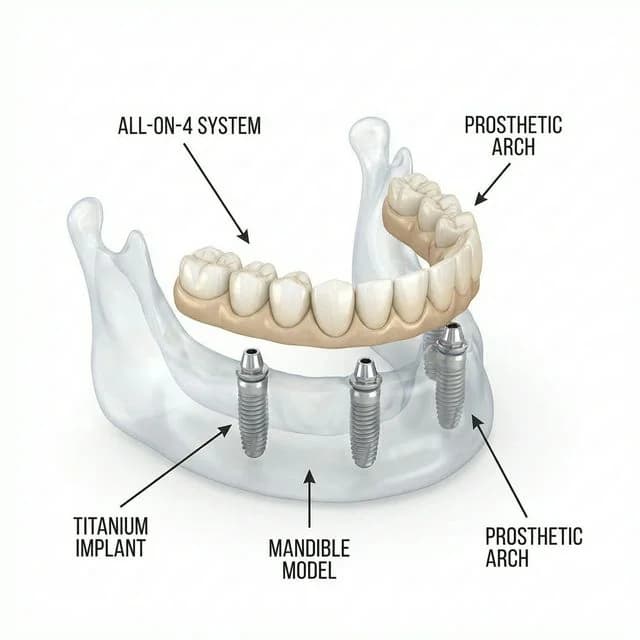
When patients are properly selected, immediately loaded implants perform on par with conventional ones — a 2020 meta-analysis of 23 randomized trials found no significant survival difference between the two protocols. (Full-arch All-on-4 is a different biomechanical approach: the four-to-six implants are splinted together by a fixed bridge, distributing force across the arch, which is why immediate loading succeeds even in moderate bone.) The honest qualifier in every study is "when patients are properly selected" — which is exactly what the CBCT and stability measurements are for.
The Aesthetic Zone: Front-Tooth Implants
Implants in the back of the mouth are judged by function — can you chew comfortably? A front-tooth implant is judged by appearance first, and that makes it the most demanding case in implant dentistry. This is where Dr. Fatima's FAAIP prosthodontic fellowship matters most: the surgery and the esthetic restoration are planned as one.
Several things make the upper front teeth unforgiving:
- Thin buccal bone. The bone on the lip side of an upper front tooth is often paper-thin (sometimes under 1mm). If it's lost during extraction, the gum recedes and exposes a shadow or the implant collar. A socket-preservation graft placed immediately after extraction is the ideal way to keep that bone.
- Gum biotype and the gray problem. Thin gum tissue both recedes more easily and lets a titanium post show through as a dark line — which is precisely why zirconia, or a titanium implant with a ceramic abutment, is often chosen up front.
- Papilla preservation. The little triangles of gum between teeth are very hard to regenerate. Lose them and you get "black triangles." Careful positioning (the implant at least 1.5mm from neighbors) and a provisional-crown protocol guide the tissue back into shape.
- Emergence profile and color. A natural tooth emerges from the gum with a specific contour and is not one flat color — it's translucent at the edge, saturated near the gum. Matching that takes a custom abutment (never a stock one up front), spectrophotometer shade analysis, and a master ceramist. We do a try-in under multiple lighting conditions before anything is cemented.
Why an implant beats a bridge for a front tooth
A traditional bridge requires grinding down the two healthy neighbors into anchors. An implant stands alone:
By maintaining bone volume, the implant also prevents the subtle facial collapse that follows tooth loss — a real long-term advantage where the face depends on the bone underneath. Front-tooth implants carry a 95–98% success rate in experienced hands, take roughly 4–8 months start to finish, and during healing you're never without a tooth: options range from a removable flipper or a clear Essix retainer with a pontic to, in well-stabilized cases, an immediate provisional crown kept out of the bite.
What It Costs
However the details vary, the all-in math is consistent. A complete single-tooth implant at Innova Smiles runs $3,343–$6,685 — the top is our standard fee, the low end what a plan-covered patient typically pays — and that one range bundles the surgical placement, the custom abutment, the permanent crown, and the 3D CBCT imaging and digital planning, so there is no surprise add-on later. The low end reflects a straightforward site; the high end accounts for cases that also need a bone graft or sinus lift. Front-tooth cases that need soft-tissue grafting can reach the upper end of that range; mini-implant denture stabilization sits well below it.
Whether you choose titanium or zirconia, the all-in number lands in a similar range — the material decision is driven by your anatomy and esthetics, not the price. It helps to see this as a one-time investment in a tooth built to last decades rather than a recurring cost. To keep it manageable, Innova Smiles offers flexible financing with 0% APR options through CareCredit and Cherry for qualified patients. Most PPO dental plans contribute roughly $1,000–$1,500 toward an implant, and our team verifies your benefits up front so you know your real number before you decide. For the full breakdown, see the real cost of dental implants in Massachusetts and whether insurance covers implants.
Are You a Candidate? The Factors That Decide
Across every type, candidacy for dental implants comes down to a few things Dr. Fatima evaluates at your implant consultation:
- Bone volume and density — measured on CBCT. Insufficient bone doesn't rule out implants; it may simply mean a bone graft or sinus lift first.
- Gum health — active periodontal disease is treated before any implant is placed.
- Overall health — well-controlled diabetes is generally fine; conditions like uncontrolled diabetes, certain bisphosphonate use, or prior head/neck radiation call for careful, individualized planning.
- Smoking — the single most controllable risk factor; quitting before surgery meaningfully improves your odds.
How Dr. Fatima Chooses the Right Implant for You
Dr. Fatima's FICOI and FAAIP fellowships inform material, size, and timeline choices based on tissue response, biomechanics, and hygiene access. During planning she weighs your bone density and volume (softer bone may favor titanium's proven track record), your gum biotype (thin tissue up front tilts toward zirconia or a ceramic abutment), your bite and grinding habits (heavy grinders benefit from titanium's repairability), the number and location of implants, and your own values — metal-free preference, esthetic priorities, budget, and comfort with a newer versus a time-tested material. She also uses reputable, well-researched implant systems with reliable long-term parts availability, so your implant can be serviced for decades.
The goal is never to sell you one option over another. It is to match the right material, the right size, the right placement, and the right timeline to your specific anatomy, lifestyle, and expectations. Patients from Hudson, Northborough, Shrewsbury, Westborough, Sudbury, Framingham, and Hopkinton come to Innova Smiles specifically because we offer the full range — not one approach for every patient.
Frequently Asked Questions
Which is better, titanium or zirconia? Neither is universally better. Titanium is the proven, versatile standard and the usual choice for back teeth and complex cases; zirconia is the metal-free, tooth-colored option that excels for front teeth with thin gums or for patients with metal sensitivities. Your anatomy decides.
Are mini implants as good as standard implants? For their intended job — stabilizing a lower denture or fitting a narrow ridge — they are an excellent, lower-cost, less-invasive option. For single crowns in the chewing zone or fixed full-arch bridges, standard implants are the right choice because of their load capacity and longer track record.
Can I really get a tooth the same day? In well-selected cases, yes — a temporary crown the same day the implant is placed. The permanent crown follows at 3–6 months, after the implant has fused with bone. Whether you qualify depends on the stability your implant achieves at placement, measured during the procedure.
Is the CBCT scan safe? Yes. The dose is roughly one to two days of natural background radiation — a fraction of a medical CT — and the ADA and AAOMR both endorse CBCT for implant planning.
How long does the whole process take? Guided planning to placement is typically 2–3 weeks; a straightforward implant is restored at 3–6 months, while front-tooth or grafting cases run 4–10 months. Dr. Fatima gives you a realistic timeline after reviewing your scan.
Ready to find out which implant option fits your anatomy and goals? Call (508) 481-0110 or book a consultation. Dr. Fatima will review your CBCT scan with you and walk through every option, candidly.
Related Articles
- Am I a Candidate for Dental Implants?
- The Real Cost of Dental Implants in Massachusetts
- Why Implant Credentials (FICOI & FAAIP) Matter
- Dental Implant vs. Bridge: Best Solution for a Missing Tooth
- All-on-4 Dental Implants: Full-Mouth Restoration
Related Services
How our pricing works
Single dental implant, all-inclusiveOur fee range$3,343–$6,685 per tooth
- Our implant fee covers the full journey from 3D imaging through final crown placement, guided by a fellowship-trained implant dentist using 5D digital technology. Many practices bill the scan, surgical guide, and abutment separately, adding several hundred dollars to the total.
- More PPO plans now contribute toward implant treatment, usually up to the plan's annual maximum. When yours does, the covered portion is billed at the plan's negotiated fee, which is what the low end of this range reflects.
- 0% APR financing through CareCredit or Cherry spreads the cost from about $139/mo with nothing down.*
- No insurance? Our in-house membership plan (from $395/yr) includes your preventive care and takes a flat 20% off our standard fee for this treatment.
- The top of the range is our standard fee; the low end is what a patient whose plan covers the treatment typically pays before their share is applied. A bone graft at the implant site, when needed, is priced separately (see the fee guide); sinus lifts are estimated at your consultation.
- Your exact fee is confirmed in writing at your visit, after your exam and after we have checked your insurance — never a surprise afterward.
- Patients aged 65 and older get 10% off all dental treatments. Mention it when booking and we'll apply it automatically.
*Estimated payment is the lowest published PER-TOOTH fee ÷ 24 months at 0% APR with $0 down, and covers one tooth — a multi-tooth case multiplies it. Financing is provided by third-party lenders (e.g. CareCredit, Cherry), not by Innova Smiles, and is subject to credit approval — not all applicants qualify. Your actual cost, term, and monthly payment depend on your treatment plan and approved offer.
Sources & Further Reading
- 10-year survival of SLA titanium implants (Buser et al.) — Journal of Periodontology / PubMed
- The McGill consensus statement on overdentures — International Journal of Oral and Maxillofacial Implants / PubMed