Featured Answer: What Is Full Mouth Reconstruction and How Much Does It Cost?
Full mouth reconstruction, also called full mouth rehabilitation, is a customized treatment plan that restores function, health, and appearance to all or most of the teeth in both the upper and lower jaws. It is not a single procedure but a coordinated sequence of treatments that may include dental implants, crowns, bridges, veneers, gum therapy, bone grafting, and orthodontics. Cost depends entirely on the scope of work needed: simpler cases involving crowns and a few implants sit at the low end of our $7,500–$60,000 range, while comprehensive rebuilds combining full-arch implant restorations (such as All-on-4), individual crowns, gum therapy, and orthodontics across both jaws reach the top of it. For implant-only full-arch pricing, see our full mouth dental implants cost guide. At Innova Smiles in Marlborough, Dr. Fatima provides complimentary consultations for full mouth reconstruction, using 3D CBCT imaging to develop a treatment plan with clear cost estimates before any work begins.
Full Mouth Reconstruction vs. Smile Makeover
These two terms are often used interchangeably, but they describe fundamentally different types of treatment.
Smile makeover refers to elective cosmetic procedures, veneers, whitening, bonding, gum contouring, performed on teeth that are healthy and functional but aesthetically unsatisfying. The motivation is appearance.
Full mouth reconstruction addresses structural, functional, and health problems that cannot be resolved with cosmetic treatment alone. The motivation is restoring the ability to eat, speak, and live without pain or progressive deterioration. Aesthetics are a benefit, but the primary goals are function and health.
The distinction matters because reconstruction is driven by clinical need, which affects insurance coverage, treatment sequencing, and the types of specialists who may be involved.
Who Needs Full Mouth Reconstruction?
Patients who need reconstruction share a common thread: their existing teeth and/or restorations have deteriorated to a point where piecemeal repairs are no longer sufficient. The mouth needs to be treated as a complete system.
Severe Wear From Bruxism
Years of teeth grinding can wear enamel down to the dentin, shorten teeth by several millimeters, and destroy the vertical dimension of the bite (the height at which upper and lower teeth meet). Once bite height is lost, the jaw joints, muscles, and remaining teeth are all affected. Reconstruction rebuilds the lost vertical dimension and restores proper bite relationships. Patients from Hudson and Shrewsbury with decades of grinding damage are among the most common reconstruction candidates Dr. Fatima sees.
Multiple Missing Teeth
Losing several teeth, whether from decay, gum disease, or trauma, creates a cascade of problems. Adjacent teeth shift into empty spaces. Opposing teeth over-erupt. The bite becomes unstable. Bone resorbs where teeth are missing. Reconstruction replaces the missing teeth and stabilizes the entire arch.
Failed Previous Dental Work
Old crowns, bridges, and fillings do not last forever. A patient with 10 or 15 aging restorations that are cracking, leaking, or developing recurrent decay underneath may reach a tipping point where replacing them one at a time is less efficient, and less predictable, than planning a coordinated reconstruction.
Trauma
A car accident, sports injury, or fall that damages multiple teeth simultaneously often requires reconstruction. Traumatic injuries can affect teeth, bone, and soft tissue at the same time, requiring a multifaceted treatment plan.
Long-Term Neglect
Life circumstances, financial hardship, dental anxiety, lack of access to care, lead some patients to go years or decades without dental treatment. By the time they seek care, decay and gum disease have compromised teeth throughout the mouth. Reconstruction gives these patients a fresh start.
Acid Erosion From GERD
Gastroesophageal reflux disease (GERD) bathes teeth in stomach acid with a pH of 1 to 2, which is extremely erosive to enamel. Chronic GERD over many years can erode the inner surfaces of upper teeth and the biting surfaces of all teeth, requiring full-coverage restorations to rebuild lost tooth structure. A 2015 study in the Journal of the American Dental Association (JADA) found that patients with GERD had significantly more tooth erosion than matched controls, with the palatal surfaces of upper front teeth most severely affected.
The Evaluation Process
Full mouth reconstruction begins with one of the most thorough dental evaluations in dentistry. At Innova Smiles, the initial consultation includes:
Comprehensive Clinical Examination
Every tooth is examined individually, checking for decay, fractures, failing restorations, mobility, and nerve vitality. Gum tissue is evaluated for signs of periodontal disease. The TMJ joints are assessed for pain, clicking, and range of motion. Bite relationships are analyzed with articulating paper and digital occlusal analysis.
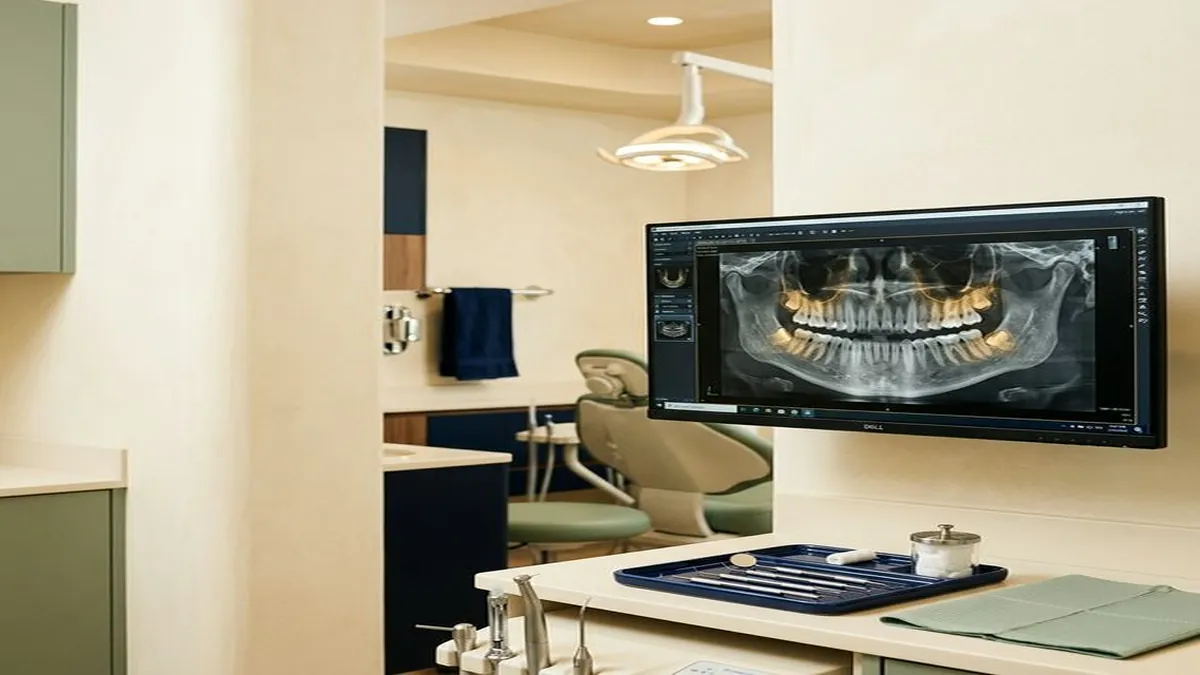
Full-Mouth Radiographs and 3D CBCT Scan
Traditional X-rays show decay and bone levels, but a Cone Beam Computed Tomography (CBCT) scan provides three-dimensional imaging of bone volume, nerve location, sinus proximity, and root anatomy. This information is indispensable for implant planning, it tells Dr. Fatima exactly how much bone is available, whether grafting is needed, and the optimal angle and depth for implant placement.
Clinical Photography and Digital Impressions
High-resolution photographs document the current condition from every angle. Digital impressions captured with the 3Shape TRIOS scanner create precise 3D models of the teeth and gums, no goopy impression material, no gagging. These digital models are used for treatment planning, provisional restorations, and communication with the dental laboratory.
Bite Analysis
Study models are mounted on an articulator, a device that simulates jaw movement, to analyze how the upper and lower teeth come together and how the jaw moves during chewing. In cases where bite height needs to be rebuilt, this step determines exactly how much vertical dimension needs to be restored.
Medical History Review
Systemic health directly affects treatment options. Uncontrolled diabetes impairs healing and increases implant failure risk. Blood thinners require careful surgical planning. Bisphosphonate medications (used for osteoporosis) affect bone metabolism and require protocol modifications. A thorough medical history ensures that the treatment plan is safe and appropriate for the individual patient.
Treatment Options Used in Full Mouth Reconstruction
Reconstruction draws from nearly every discipline in dentistry. Dr. Fatima selects and combines procedures based on what each patient's mouth specifically requires.
Dental Implants
Implants are titanium (or zirconia) posts surgically placed into the jawbone to replace missing tooth roots. After healing (osseointegration takes 3 to 6 months), they support individual crowns, multi-tooth bridges, or full-arch prostheses. Implants are the most-recommended option for replacing missing teeth because they preserve bone, function like natural teeth, and have a documented success rate exceeding 95% over 10 years (according to a 2019 systematic review published in the Journal of Dentistry).
Single implants replace individual missing teeth. Implant-supported bridges span multiple missing teeth using two or more implants as anchors, eliminating the need for an implant at every position. All-on-4 / All-on-6 protocols restore an entire arch of teeth using just four to six strategically placed implants, often with a temporary set of teeth placed on the same day as surgery.
Crowns
Full-coverage crowns, made from porcelain, zirconia, or porcelain-fused-to-metal, cap damaged teeth to restore their shape, strength, and appearance. In reconstruction, crowns are often placed on multiple teeth to rebuild proper bite height and alignment.
Bridges
Traditional bridges replace one or more missing teeth by anchoring to the natural teeth on either side. In reconstruction, bridges are used when implants are not feasible in a particular area or when adjacent teeth already need crowns.
Veneers
Porcelain veneers, thin shells bonded to the front surfaces of teeth, are used in reconstruction when front teeth are structurally sound but worn, chipped, or misshapen. They restore aesthetics without the need for full-coverage crowns.
Bone Grafting and Sinus Lifts
When teeth have been missing for months or years, the jawbone resorbs (shrinks). If insufficient bone remains to support implants, bone grafting adds volume to the ridge using donor bone, synthetic materials, or the patient's own bone from another site. Our guide on bone grafts and sinus lifts for dental implants explains who needs these procedures and what to expect. Upper jaw reconstruction near the back teeth may require a sinus lift, elevating the sinus membrane and placing bone graft material beneath it to create adequate height for implant placement.
Gum Treatment
Active periodontal disease must be controlled before reconstruction begins. This may include scaling and root planing (deep cleaning), antibiotic therapy, or surgical pocket reduction. Proceeding with restorations while gum disease is active risks failure.
Orthodontics
Some reconstruction cases benefit from limited orthodontic treatment (6 to 12 months of clear aligners or braces) to reposition shifted teeth before placing crowns or implants. Moving teeth into better alignment can reduce the number of restorations needed and create a more predictable final result.
The Phased Treatment Approach
Full mouth reconstruction is never completed in a single appointment. Dr. Fatima uses a phased approach that ensures each step builds on a stable foundation:
Phase 1: Stabilization and Emergency Care
Address immediate problems first, relieve pain, treat acute infections, extract teeth that cannot be saved, and place temporary restorations on teeth at risk of fracture. The goal is to get the patient comfortable and stable.
Phase 2: Disease Control
Treat active gum disease with scaling and root planing or surgical periodontal therapy. Manage cavities. Stabilize the oral environment so that restorations placed later will have the best chance of long-term success.
Phase 3: Reconstruction
Place implants (with appropriate healing time), perform bone grafts or sinus lifts as needed, fabricate and place definitive crowns, bridges, veneers, and/or implant-supported prostheses. This is the longest and most involved phase. For patients in Framingham and Westborough who need extensive implant work, Phase 3 may span 6 to 12 months to allow for bone integration.
Phase 4: Maintenance
Once reconstruction is complete, long-term success depends on consistent professional maintenance and home care. Patients transition to a customized recall schedule, typically every 3 to 4 months for the first year, then every 4 to 6 months going forward, to monitor restorations, implants, and gum health.
Cost Breakdown by Approach
One of the most common questions patients ask is "how much will this cost?" The honest answer is: it depends entirely on what your mouth needs. Below are realistic ranges based on typical reconstruction scenarios.
These ranges reflect fees in the Massachusetts market as of 2026. Individual costs depend on the number of implants, type of restorative materials, need for bone grafting, and other clinical factors.
Why the Range Is So Wide
No two reconstruction cases are alike. A patient with good bone volume who needs six implants and 10 crowns will have a very different cost than a patient who needs bone grafting in four sites, a bilateral sinus lift, eight implants, and full-arch zirconia prostheses. The consultation and treatment plan exist precisely to give you a clear, itemized estimate before any work begins.
Insurance and Financing
Dental Insurance
Most dental insurance plans have annual maximums of $1,500 to $2,500, a fraction of reconstruction costs. However, insurance does typically cover portions of the treatment: individual crowns, extractions, bone grafts, and sometimes a percentage of implant placement. For a detailed look at how insurance handles the implant portion specifically, see our guide to dental insurance and implant coverage in Massachusetts. Dr. Fatima's team works with your insurance provider to maximize covered benefits and can phase treatment across calendar years to take advantage of annual maximums multiple times.
Medical Insurance
Some components of reconstruction may qualify for medical insurance coverage, particularly when there is a medical diagnosis involved. Implants placed after traumatic injury, bone grafting procedures, and treatment related to congenital conditions are examples where medical insurance has been successfully billed.
Financing Options
Innova Smiles partners with CareCredit and Cherry to offer monthly payment plans, including 0% interest options for qualified applicants. These plans allow patients to begin treatment immediately and spread the cost over 12 to 60 months. For patients in Northborough and Southborough, financing makes the difference between starting treatment now and continuing to live with failing teeth.
What to Expect: Before and After
Before Reconstruction
Patients seeking full mouth reconstruction often share similar experiences: difficulty eating certain foods, embarrassment about their smile, avoidance of social situations, and ongoing pain or discomfort. Many have been patching problems for years and have reached a point where the patchwork approach is no longer viable.
After Reconstruction
The transformation extends beyond appearance. Patients consistently report:
- Eating foods they had given up. Steak, apples, corn on the cob, foods that require confident biting and chewing become possible again.
- Speaking more clearly. Missing teeth and ill-fitting dentures affect speech. Fixed restorations restore natural speech patterns.
- Reduced pain. Chronic toothaches, jaw pain from bite imbalance, and gum infections resolve.
- Social confidence. Patients who had been hiding their smile for years describe the emotional impact of smiling freely again as profound.
The Emotional Side of Reconstruction
It is worth acknowledging something that clinical descriptions often overlook: many patients seeking full mouth reconstruction carry significant emotional weight. Years of dental problems, and sometimes years of avoiding care due to anxiety, shame, or past negative experiences, take a toll.
Dr. Fatima and the team at Innova Smiles approach reconstruction cases with this in mind. There is no judgment about how a patient arrived at this point. The focus is entirely on where they are going. Comfort options (premium topical numbing) are available for patients with dental anxiety, and treatment is paced at a speed the patient is comfortable with.
Patients from Hopkinton and Sudbury who have avoided the dentist for years find that the hardest part is making the first call. Once they are in the chair and have a clear plan, the anxiety gives way to relief.
Questions to Ask During Your Consultation
If you are considering full mouth reconstruction, bring these questions to your consultation:
- What is the total estimated cost, and can I see an itemized breakdown? A reputable practice will provide a detailed treatment plan with individual line items, no surprises.
- What is the projected timeline from start to finish? Understand how many phases are involved and how long each takes.
- What materials will be used for my restorations? Zirconia, porcelain, and porcelain-fused-to-metal each have different strength, aesthetic, and cost profiles.
- Do I need bone grafting, and if so, where? The CBCT scan answers this question definitively.
- What happens if something goes wrong during treatment? Ask about warranties, redo policies, and complication management.
- What are the comfort options? If dental anxiety has kept you from seeking care, knowing whether premium topical numbing, headphones, weighted blankets, and hand-signal control are available can make the process manageable.
- What will maintenance look like after treatment is complete? Understand the long-term commitment to protecting your investment.
- Can treatment be phased to spread costs across insurance plan years? Strategic phasing can significantly reduce out-of-pocket expenses.
Schedule Your Complimentary Reconstruction Consultation
If you have been living with multiple failing teeth, ongoing dental pain, difficulty eating, or a smile you hide, full mouth reconstruction may be the path to lasting resolution. Dr. Fatima has placed thousands of implants and restored hundreds of complex cases, and she will give you an honest assessment of what your mouth needs, what it will cost, and how long it will take.
Innova Smiles is located at 340 Maple St, Suite 100, Marlborough, MA 01752, serving patients from Framingham, Natick, Hudson, Shrewsbury, and communities throughout MetroWest Massachusetts. Call (508) 481-0110 or request a consultation online.
Ready to explore full mouth reconstruction? Call (508) 481-0110 or book a complimentary consultation.
Related Articles
- What Are All-on-4 Dental Implants?
- Dentures vs. Dental Implants: Understanding Your Options
- Dental Implant vs. Bridge: Best Solution for Missing Teeth
- Types of Dental Implants: Titanium vs. Zirconia
Related Services
How our pricing works
Full-mouth restorationOur fee range$7,500–$60,000
- Full-mouth restoration is a comprehensive treatment plan that Dr. Fatima maps carefully with 3D imaging and phased sequencing. The phased approach spreads treatment over time, making it manageable for both your schedule and your budget. Many patients find that addressing related problems together costs less than fixing one issue at a time over years.
- More PPO plans now contribute toward implant treatment, usually up to the plan's annual maximum. When yours does, the covered portion is billed at the plan's negotiated fee, which is what the low end of this range reflects.
- 0% APR financing through CareCredit or Cherry spreads the cost from about $313/mo with nothing down.*
- No insurance? Our in-house membership plan (from $395/yr) includes your preventive care and takes a flat 20% off our standard fee for this treatment.
- The top of the range is our standard fee; the low end is what a patient whose plan covers the treatment typically pays before their share is applied.
- Your exact fee is confirmed in writing at your visit, after your exam and after we have checked your insurance — never a surprise afterward.
- Patients aged 65 and older get 10% off all dental treatments. Mention it when booking and we'll apply it automatically.
*Estimated payment is the lowest treatment cost ÷ 24 months at 0% APR with $0 down. Financing is provided by third-party lenders (e.g. CareCredit, Cherry), not by Innova Smiles, and is subject to credit approval — not all applicants qualify. Your actual cost, term, and monthly payment depend on your treatment plan and approved offer.