
What Are Dental Sealants?
Dental sealants are thin, protective coatings painted onto the chewing surfaces of back teeth (molars and premolars). They fill in the deep grooves and pits where food particles and bacteria hide, areas that are nearly impossible for a child's toothbrush to reach effectively.
Think of sealants like a raincoat for teeth. The chewing surface of a molar, when viewed under magnification, looks like a landscape of deep valleys and narrow crevices. Some of these grooves are thinner than a single toothbrush bristle. No amount of careful brushing can clean the bottom of a groove that the bristle physically cannot enter. Sealant material flows into these spaces and creates a smooth, sealed barrier that bacteria cannot penetrate.
At Innova Smiles in Marlborough, MA, Dr. Fatima recommends sealants for most children as a safe, comfortable, and highly effective way to prevent cavities. The CDC reports that sealants protect against 80% of cavities in the first two years after application, and continue to protect against 50% of cavities for up to four years. Yet only about 43% of children ages 6–11 have sealants, a gap that results in millions of preventable cavities every year.
To put the effectiveness in concrete terms: a 2016 CDC evidence review found that school-age children without sealants develop three times more cavities in their back teeth compared to children with sealants. That is one of the strongest protective effects of any preventive dental intervention.
When Should Kids Get Dental Sealants? The Age Guide
The ideal timing follows the eruption of permanent molars. Here is the schedule we recommend at Innova Smiles:
Ages 5–7: First permanent molars
The six-year molars (first permanent molars) erupt behind the baby teeth, they do not replace any baby tooth, which means many parents miss them entirely. According to the National Institute of Dental and Craniofacial Research (NIDCR), these are the first permanent teeth to erupt and are immediately vulnerable to decay. We recommend sealing them as soon as they are fully erupted, typically between ages 5 and 7.
These four teeth (two upper, two lower) do the majority of chewing work and have the deepest grooves of any teeth in the mouth. Sealing them early gives your child protection during the years when brushing habits are still developing and sugar exposure from school snacks is high.
Ages 11–14: Second permanent molars
The twelve-year molars (second permanent molars) erupt around ages 11 to 13. Sealing these as soon as they fully emerge extends protection through the cavity-prone teenage years, a period when orthodontic appliances, increased independence with food choices, and inconsistent brushing create a perfect storm for decay.
Ages 9–12: Premolars (case-by-case)
Some children have unusually deep grooves in their premolars (the teeth between canines and molars). If Dr. Fatima identifies deep pits during an exam, she may recommend sealing these teeth as well. This is particularly valuable for children with a history of cavities, weak enamel, or conditions like enamel hypoplasia.
Should baby teeth be sealed?
In certain cases, yes. Baby molars with deep grooves can be sealed in children who are especially cavity-prone. Losing a baby tooth too early to decay can cause alignment problems for permanent teeth, the neighboring teeth drift into the gap, potentially creating crowding that requires orthodontic correction later. Sealing a baby molar costs $30 to $60; treating a cavity costs $145–$564, and managing the orthodontic consequences of premature tooth loss can cost thousands.
How the Sealant Procedure Works: Step by Step
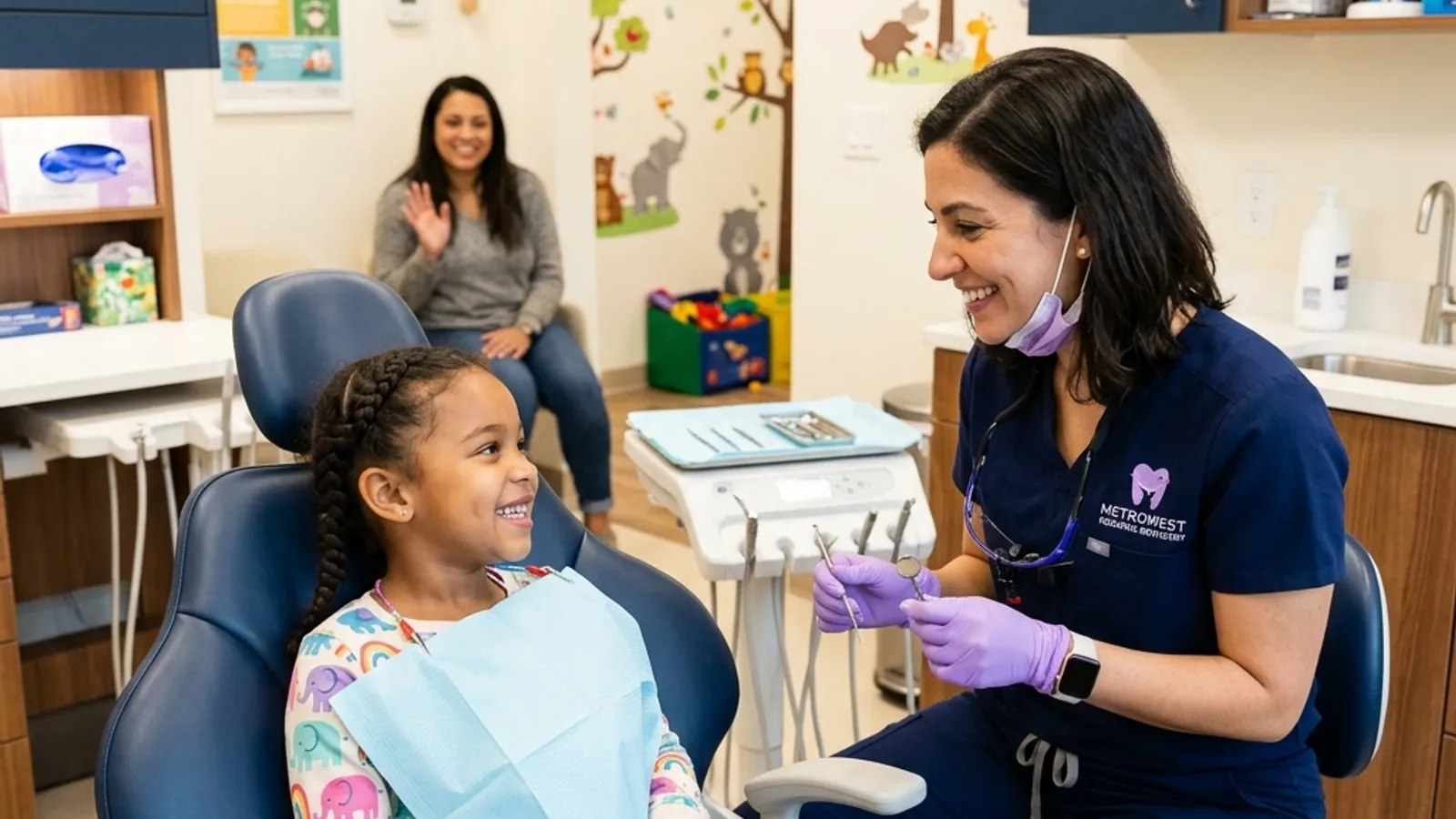
Applying dental sealants for kids is one of the simplest procedures in dentistry: no shots, no drilling, and typically very easy for children to tolerate. Here is exactly what happens at each step:
Step 1: Clean the tooth surface
The hygienist thoroughly cleans the chewing surface using a rotating brush and pumice paste to remove all plaque, food particles, and debris from the grooves. This step is critical, sealant material must bond directly to clean enamel to last.
Step 2: Isolate and dry the tooth
Cotton rolls or a small suction device keep the tooth completely dry. Moisture is the enemy of sealant adhesion. Modern techniques use absorbent materials placed around the tooth to maintain a dry field throughout the procedure.
Step 3: Apply the etching solution
A mild acidic gel (phosphoric acid, typically 35–37%) is applied to the chewing surface for 15 to 30 seconds. This creates a microscopically rough surface, similar to how sandpaper prepares a surface for paint, so the sealant can grip the enamel securely.
Step 4: Rinse and dry again
The acid etch is rinsed off with water and the tooth is dried completely. At this point, the enamel surface appears chalky white under the dental light, which confirms proper etching.
Step 5: Paint the sealant material
The liquid sealant, a BPA-free resin at our office, is carefully painted into the grooves and pits using a small brush or applicator tip. The material flows into every crevice through capillary action, filling spaces that are impossible to clean with a toothbrush.
Step 6: Light-cure to harden
A special blue LED curing light is held over the tooth for 20 to 30 seconds. The light triggers polymerization (hardening) of the resin, creating a durable, smooth surface. Once cured, the sealant is fully set.
Step 7: Check the bite
Dr. Fatima checks the bite using articulating paper (thin colored paper that marks high spots). If the sealant feels slightly high, she polishes it smooth in seconds. Children can eat and drink normally right away.
The entire process takes 2–3 minutes per tooth. Sealing all four first molars takes about 10 to 15 minutes total. Most children describe the experience as boring, not scary, which, for a dental procedure, is the best possible outcome.
Are Dental Sealants Safe? Addressing the BPA Question
Yes. Dental sealants have been used safely for over 50 years, with the first clinical applications dating to the early 1960s. The American Dental Association (ADA), the American Academy of Pediatric Dentistry (AAPD), and the CDC all strongly recommend sealants for children.
The most common question parents ask is about BPA (bisphenol A). Here are the facts:
- Sealant materials contain bis-GMA, a derivative of BPA. During curing, a trace amount of BPA may be released temporarily.
- A 2012 study published in Pediatrics measured the BPA exposure from dental sealants and found it was extremely low, approximately 0.09 nanograms, detectable only for a few hours after placement.
- By comparison, your child receives more BPA exposure from handling a store receipt, drinking from a plastic water bottle, or eating canned food than from a dental sealant.
- At Innova Smiles, we use BPA-free sealant materials as standard practice. We made this choice to give parents complete peace of mind, even though the clinical evidence confirms that conventional sealants are safe.
The bottom line from the ADA: "The benefits of dental sealants far outweigh any potential risk from minimal BPA exposure." The CDC reinforces this position, calling sealants one of the most evidence-supported preventive strategies in pediatric oral health.
Sealants vs. Fluoride: Do You Need Both?
Sealants and fluoride work in different ways and protect different surfaces:
- Fluoride strengthens the entire tooth surface by remineralizing enamel. It protects smooth surfaces, the front, back, and sides of teeth where most fluoride contact occurs during rinsing and brushing.
- Sealants physically block bacteria and food from the deep grooves on chewing surfaces, an area fluoride cannot adequately protect because the grooves are too narrow for fluoride rinse to penetrate consistently.
Together, they provide comprehensive cavity protection, a two-layer defense that the ADA describes as one of the most effective strategies in preventive dentistry for children.
A 2016 Cochrane systematic review examined sealants versus fluoride varnish and found low-quality evidence suggesting resin-based sealants may provide more protection on chewing surfaces than fluoride varnish alone, though the review noted that scarce and clinically diverse data prevented definitive conclusions about which approach is superior. Fluoride varnish, by contrast, helps protect the smooth surfaces of teeth that sealants do not cover. Together, they offer complementary protection on different tooth surfaces, and current evidence supports using both for maximum prevention.
At Innova Smiles, we recommend both, fluoride varnish at every cleaning visit plus sealants on molars when they erupt. For families in Framingham, Sudbury, Westborough, and across MetroWest, this combination approach is the single most effective way to keep your child's permanent teeth cavity-free through childhood and adolescence.
How Long Do Dental Sealants Last?
Sealants typically last 5–10 years with normal wear. Research published in the Journal of the American Dental Association found that sealants retained on teeth after 9 years still provided significant cavity protection, teeth with intact sealants had 73% fewer caries than unsealed teeth at the 9-year mark.
Several factors affect longevity:
- Chewing habits: Children who eat a lot of hard, crunchy, or sticky foods may wear through sealants faster.
- Bruxism: Children who grind their teeth at night can wear down sealant material prematurely. If Dr. Fatima notices grinding patterns, she may recommend more frequent sealant checks.
- Application technique: Proper isolation (keeping the tooth dry during placement) is the single most important factor in sealant retention. This is why we take extra time with the isolation step.
- Material type: Resin-based sealants (which we use) show higher retention rates in clinical studies compared to glass ionomer sealants.
Dr. Fatima checks sealant condition at every routine exam and can reapply them quickly if any have worn thin or chipped. Reapplication takes just 2 minutes per tooth and costs far less than treating a cavity. We proactively monitor sealants at every six-month visit so you never have to wonder about their condition.
Can Adults Get Dental Sealants?
While sealants are most commonly applied to children and teenagers, adults without decay or fillings in their molars can benefit from sealants too. The ADA notes that adults with deep grooves in their back teeth, especially those with a history of cavities or dry mouth, are good candidates for sealant application.
We see several adult patient profiles in our Marlborough office who benefit from sealants:
- Adults with newly erupted wisdom teeth that have deep grooves
- Patients on medications (antidepressants, antihistamines, blood pressure medications) that cause dry mouth, increasing cavity risk
- Patients undergoing cancer treatment where radiation to the head and neck reduces saliva production
- Adults who had sealants as children and want to re-seal teeth where the original sealant has worn away
The procedure is identical for adults and children. Some dental insurance plans cover sealants for adults up to age 18 or 21, while others have no age limit. Ask our team about your specific coverage during your next visit.
Dental Sealant Cost: With and Without Insurance
Dental sealants typically cost $30–$60 per tooth without insurance. Here is what the most common treatment scenarios look like:
Most dental insurance plans cover sealants for children under 14 at 100% as a preventive benefit, meaning no out-of-pocket cost for families with dental coverage. This makes sealants one of the most affordable preventive investments in dentistry.
For perspective on the return on investment: treating a single cavity with a composite filling costs $145–$564. A root canal on a molar costs $929–$1,858. A crown costs $889–$1,977. Sealing all four first molars for a small fraction of any of those is easily the best value in children's dental care.
For families without insurance, our membership plan includes preventive services at significant savings. Contact our office to learn about coverage for your specific plan.
What If My Child Already Has a Small Cavity — Is It Too Late for Sealants?
Not necessarily. Sealants can be placed over very small, early-stage cavities (incipient lesions) to stop them from progressing. A 2016 review published in the Journal of Dental Research found that placing sealants over early non-cavitated lesions arrested caries progression in 71% of cases over a two-year period.
The key distinction is the stage of the cavity:
- White spot lesions or very shallow demineralization: Sealant placement can halt progression and is recommended by the AAPD.
- Cavities that have broken through the enamel surface into dentin: These require a filling, not a sealant.
Dr. Fatima evaluates each tooth individually using magnification and digital X-rays to determine whether a sealant is appropriate or whether a filling is needed instead.
School-Based Sealant Programs vs. Dental Office Application
Massachusetts public health programs offer school-based sealant initiatives, and they do excellent work reaching children who lack access to regular dental care. However, there are meaningful differences between school-based and dental-office sealants:
- Isolation quality: Dental offices use suction, cotton rolls, and sometimes rubber dam isolation, which keeps the tooth drier during placement. Better isolation means stronger sealant bonding and longer retention.
- Diagnostic evaluation: In a dental office, Dr. Fatima examines each tooth with magnification and X-rays before sealing. Teeth with existing decay are identified and treated appropriately rather than sealed over.
- Material selection: We choose our sealant material specifically — BPA-free resin with optimal flow characteristics. School programs may use different materials based on cost and ease of application.
- Follow-up monitoring: We check sealant integrity at every six-month visit and repair or replace as needed. School-based programs typically do not provide ongoing monitoring.
If your child received school-based sealants, we will check their condition at your next visit and supplement with additional sealants where needed.
Sealant Materials: What Goes on Your Child's Teeth
Parents have a right to know exactly what materials are used in their child's dental care. Here is a straightforward breakdown of the sealant materials available and what we use at Innova Smiles.
Resin-based sealants (our standard)
The most widely used and clinically studied sealant type. Resin-based sealants are composed of a methacrylate-based polymer that chemically bonds to etched enamel. They are applied in a liquid state, flow into grooves via capillary action, and are hardened with an LED curing light. Clinical advantages include excellent retention, superior wear resistance, and documented effectiveness over decades of use.
At Innova Smiles, we specifically use BPA-free resin sealants. While conventional resin sealants contain bis-GMA (a BPA derivative) in trace amounts that the ADA deems safe, we chose BPA-free formulations to provide parents with complete peace of mind. The clinical performance is equivalent, no compromise in protection or longevity.
Glass ionomer sealants
These sealants release fluoride over time, which provides an additional protective benefit. Glass ionomer is sometimes used for very young children or teeth that are difficult to keep dry during placement (since glass ionomer is less moisture-sensitive than resin). The trade-off: glass ionomer sealants have lower retention rates, a 2019 Cochrane review found that resin-based sealants remained intact 2.5 times longer than glass ionomer on average. We use glass ionomer selectively for specific situations where its moisture tolerance offers a clinical advantage.
Resin-modified glass ionomer
A hybrid material that combines the fluoride release of glass ionomer with some of the bonding strength of resin. Retention is better than pure glass ionomer but not as high as pure resin-based sealants. We occasionally use this material for partially erupted molars where isolation is challenging, it provides interim protection until the tooth fully emerges and a resin-based sealant can be applied.
The Re-Application Question: When and Why Sealants Need Touch-Ups
Sealants are durable, but they are not indestructible. A chewing surface endures thousands of pounds of force over years of eating, and sealant material gradually wears. Here is what the evidence says about re-application and what we see in practice.
How we monitor sealant condition
At every six-month cleaning and exam, Dr. Fatima checks each sealed tooth under magnification. She is looking for:
- Complete retention, the sealant is intact, covering all grooves. No action needed.
- Partial retention, some sealant has worn away, exposing portions of the groove system. Reapplication recommended to restore full coverage.
- Complete loss, the sealant is gone. If the tooth is still cavity-free, a new sealant is applied. If early demineralization is detected, we evaluate whether a sealant or a conservative filling is more appropriate.
A 2015 study in Pediatric Dentistry followed 1,340 sealed teeth over 7 years and found that sealants required reapplication at an average rate of 5–10% per year. Teeth that were resealed promptly when partial loss was detected had a cavity rate of just 2.6% over the study period, compared to 12.8% for teeth where sealant loss was not addressed.
Re-application protocol
Re-sealing a tooth takes 2 minutes and costs $30 to $60 per tooth, identical to the original application. There is no drilling or anesthesia; the tooth is cleaned, etched, and the new sealant material is applied over the remaining original sealant (no need to remove it first). This is why regular six-month monitoring matters: catching partial sealant loss early and re-sealing promptly helps keep your child's teeth protected.
Factors that accelerate sealant wear
- Hard, crunchy foods, ice, popcorn kernels, hard candy, and nuts place concentrated force on sealant material
- Sticky foods, taffy, caramel, and gummy candy can pull sealant material off the tooth surface
- Teeth grinding (bruxism), nighttime grinding generates enormous sustained pressure on chewing surfaces. If Dr. Fatima identifies grinding patterns in your child, she may recommend a child-sized night guard and more frequent sealant checks
- Sports mouthguards, properly fitted mouthguards protect sealants from impact. If your child plays contact sports in the MetroWest youth leagues, a custom-fitted guard is a worthwhile investment
The Public Health Case for Sealants: What the Data Shows
The evidence supporting dental sealants for kids is among the strongest in preventive medicine. Here are the key statistics that pediatric dental researchers, the CDC, and the ADA cite most frequently:
- 80% cavity reduction in the first two years after placement (CDC, 2016)
- 60% cavity reduction maintained at four years (CDC, 2016)
- Children without sealants have 3x more cavities in permanent molars than children with sealants (CDC Community Preventive Services Task Force)
- Every $1 spent on sealants saves $11 in future dental treatment according to a 2017 cost-effectiveness analysis published in BMC Oral Health
- Only 43% of children ages 6–11 have sealants nationally, despite universal recommendation by the ADA, AAPD, and CDC
- Low-income children are 20% less likely to have sealants than higher-income children, yet they develop 80% more untreated cavities, a disparity that school-based sealant programs are designed to address
Massachusetts ranks above the national average for pediatric sealant coverage, partly due to strong school-based sealant programs in communities across MetroWest and the broader state. Marlborough, Framingham, and Worcester public schools have all hosted dental sealant events in recent years. These programs are excellent first steps, and for families who visit our office, we supplement school-based sealants with comprehensive monitoring, BPA-free materials, and individual attention to each tooth.
Sealants and Orthodontics: Timing Considerations
Many MetroWest families ask about the relationship between sealants and braces or aligners. The timing considerations are straightforward:
Before braces: Ideally, sealants are placed before orthodontic brackets are bonded. Once brackets are on the teeth, accessing the chewing surfaces of molars becomes more difficult (though not impossible). If your child is starting orthodontic treatment, ask about sealants at the exam before braces are placed.
During braces: Sealants on chewing surfaces are not affected by braces, which attach to the front surfaces of teeth. Existing sealants continue to protect normally throughout orthodontic treatment. If a sealant needs reapplication while braces are in place, we can still access the chewing surface without any interference from the brackets or wires.
After braces: When braces come off, Dr. Fatima reassesses all sealed teeth and reapplies sealant where needed. This is also an excellent time to seal any premolars that were not sealed previously, since the enamel is now clean and accessible.
For families in Sudbury, Northborough, Southborough, and Westborough, we coordinate sealant timing with orthodontic treatment plans so your child maintains maximum cavity protection throughout every phase.
Tips for Parents: Making the Sealant Visit Easy
Most children handle sealant appointments without any issues, but here are strategies that help:
- Describe it accurately. Sealants involve no needles and no drilling. Tell your child the dentist will "paint" their teeth with a special coating that protects them from sugar bugs. Avoid words like "shot," "hurt," or "drill."
- Schedule wisely. Book morning appointments when children are rested and cooperative. Avoid scheduling after school when they are tired and hungry.
- Keep it brief. Sealing four molars takes about 15 minutes. For younger children, we can split the appointment into two short visits (upper teeth one day, lower teeth another) if attention span is a concern.
- Positive reinforcement. Praise your child for sitting still and cooperating. Our team gives stickers and lets kids pick a prize from our treasure chest after their visit.
Why MetroWest Families Trust Innova Smiles for Children's Care
Families from Hudson, Northborough, Southborough, Framingham, Sudbury, Shrewsbury, Hopkinton, and throughout MetroWest trust Innova Smiles for children's dental care that is gentle, thorough, and — for most kids — even fun. Our office was designed with families in mind, from the welcoming environment to the patient, unhurried pace that helps children build positive associations with dental care.
Dr. Fatima takes the time to explain every step to both parent and child, answers questions without rushing, and never pushes unnecessary treatment. For sealants specifically, her meticulous isolation technique and careful material application result in sealant retention rates that exceed national averages.
Want to schedule sealants for your child? Contact us or call (508) 481-0110.
Related Articles
- Children's Dental Health Month: Tips for Parents
- Children's Dentist Near Me in Marlborough
- Baby's First Dental Visit: When to Start
- Your Child's First Dental Visit: What to Expect and When to Start
- Back-to-School: Why Your Child Needs a Checkup
Related Services
- Children's Dentistry, fun, fear-free dentistry for kids and teens
- Dental Exams & Cleanings, comprehensive preventive visits with digital diagnostics
- Preventive Dentistry, your complete guide to preventive and family dentistry
Sources & Further Reading
- Dental Sealants — National Institute of Dental and Craniofacial Research (NIDCR)