
Featured Answer: What Are White Spot Lesions?
White spot lesions are chalky, opaque white patches on the enamel where the tooth has lost minerals. They look brighter and more matte than the surrounding enamel because the demineralized area scatters light differently. White spots are most often the first visible sign of early tooth decay, but they can also come from dental fluorosis or enamel hypoplasia. The good news: caught early, many white spot lesions can be reversed, and even established ones can be removed or camouflaged. At Innova Smiles in Marlborough, MA, Dr. Fatima identifies the cause first, then recommends the least invasive treatment that will work.
What Causes White Spots on Teeth?
White spots are a symptom, not a single disease — and the right treatment depends entirely on the cause. There are five common ones.
1. Enamel demineralization (early decay)
This is the most important cause to recognize. When plaque bacteria feed on sugar, they produce acid that pulls calcium and phosphate out of the enamel. The first stage — before any hole forms — is a white spot. According to the NIH, this early demineralization is reversible: if the acid attack stops and minerals are returned to the enamel, the spot can heal. Left unchecked, it progresses into a cavity.
2. Dental fluorosis
Fluorosis happens when a child takes in too much fluoride while the permanent teeth are still forming under the gums (roughly birth to age 8). The CDC notes that most U.S. fluorosis is mild — faint white lacy lines or flecks — and is cosmetic, not harmful. Common sources are swallowed toothpaste in young children and fluoride supplements layered on top of fluoridated water. Fluorosis white spots are built into the enamel, so they do not remineralize away, but they respond well to microabrasion, resin infiltration, and whitening.
3. Enamel hypoplasia
Hypoplasia means the enamel did not form completely, leaving it thinner and more porous in spots. It can result from a childhood high fever, certain illnesses, nutritional deficiency, or premature birth. Hypoplastic enamel looks white or yellow-brown and is weaker than normal enamel, so it both discolors and decays more easily — which is why these teeth often need protective restoration, not just cosmetics.
4. Plaque under braces (post-orthodontic white spots)
When brackets make brushing harder, plaque parks against the enamel around them and demineralizes it. When the braces come off, the protected enamel under the bracket is normal but the ring around it is chalky white. This is one of the most common — and most preventable — causes, and it is covered in detail below.
5. Diet and dry mouth
A diet high in acid (soda, citrus, sports drinks) or chronic dry mouth (which removes saliva's natural buffering) tips the balance toward demineralization, making white spots more likely and slower to heal.
Are White Spots Permanent — or a Cavity?
Two questions patients always ask. First, is it a cavity? A white spot can be the earliest stage of decay — demineralization before a hole forms — and at that stage it is still reversible. But fluorosis and hypoplasia produce white spots that are not infections. Only an exam, sometimes with magnification or a fluorescence device, reliably tells them apart. That is why a new or changing white spot is always worth a look.
Second, is it permanent? It depends on the cause and how early it is caught:
- Early demineralization: often reversible with remineralization.
- Fluorosis, hypoplasia, and long-standing post-braces spots: the enamel structure is altered, so the spot will not fade on its own — but it can be removed or camouflaged cosmetically.
In other words, almost every white spot can be improved; the question is simply which approach your enamel needs.
How to Remove White Spot Lesions: The Treatment Ladder
Good cosmetic dentistry treats white spots from the least invasive option upward, only escalating when needed. Here is the ladder Dr. Fatima works through.
Step 1: Remineralization (for early lesions)
For a fresh demineralized spot, the goal is to put minerals back into the enamel before it becomes a cavity. This means prescription-strength fluoride (toothpaste or in-office varnish), CPP-ACP pastes (such as MI Paste), reduced sugar and acid, and improved plaque control. Many early white spots fade meaningfully over a few months this way. It is the cheapest, gentlest fix — and the only one that truly heals rather than masks.
Step 2: Resin infiltration (Icon)
For established spots that will not remineralize, resin infiltration is often the ideal next step. A low-viscosity resin is drawn into the porous, demineralized enamel, where it fills the microscopic gaps and restores the enamel's natural translucency so the white spot optically disappears. It removes essentially no healthy tooth structure, requires no drilling or anesthesia in most cases, and is done in a single visit. It is especially effective for post-orthodontic and mild fluorosis spots.
Step 3: Enamel microabrasion
Microabrasion gently polishes away a very thin surface layer of discolored enamel using a fine abrasive and mild acid, blending superficial white (and brown) spots into the surrounding tooth. It pairs well with whitening and is a good option for fluorosis that sits at the enamel surface.
Step 4: Professional whitening
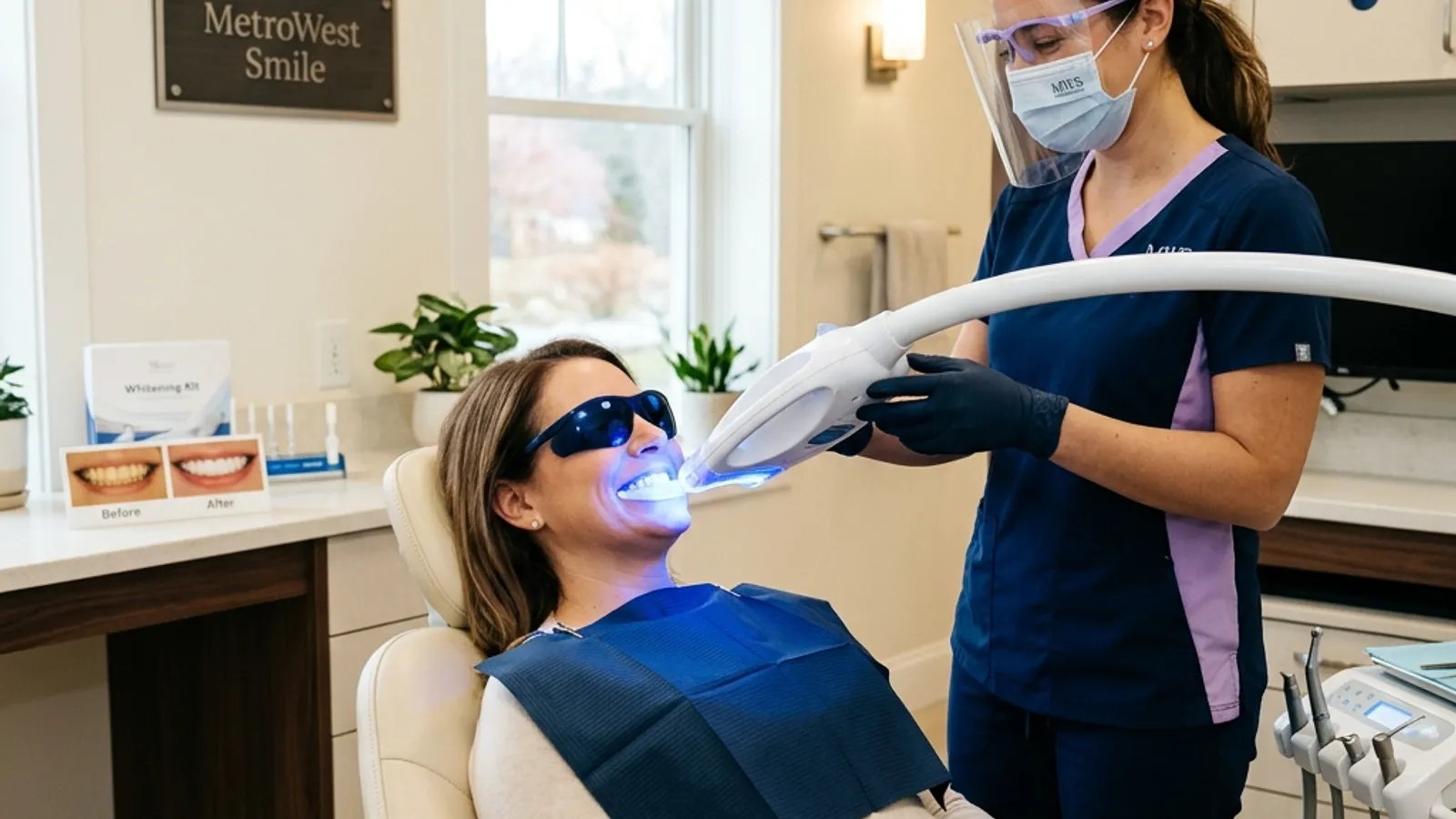
When the issue is mostly contrast — bright spots against slightly darker enamel — professional teeth whitening lightens the whole tooth so the spots blend in. Whitening does not erase the spot, and it can briefly exaggerate it, so Dr. Fatima often combines whitening with infiltration or microabrasion for an even result.
Step 5: Composite bonding
For deeper or more stubborn spots, tooth-colored composite bonding covers the affected area and is sculpted and polished to match the surrounding enamel in a single visit. It is reversible and conservative compared with veneers.
Step 6: Porcelain veneers
When white spots are extensive, combined with other concerns (shape, chips, alignment), or when a patient wants a complete, lasting smile reset, custom porcelain veneers resurface the visible tooth entirely. This is the most involved option and is reserved for cases where the simpler steps will not deliver the result the patient wants — often as part of a smile makeover.
White Spot Treatment Comparison
White Spots After Braces
White spots after braces are common enough to have a name in dentistry — post-orthodontic demineralization — and they are entirely about plaque control. Brackets and wires create dozens of new nooks where plaque hides, and if it sits against the enamel it demineralizes the ring around each bracket. When the braces come off, you see bright white halos where the brackets were.
The first move is typically the gentlest: meticulous brushing and flossing plus a high-fluoride or CPP-ACP toothpaste, which can remineralize the newest spots over a few months. Spots that remain are excellent candidates for resin infiltration, which restores the enamel's translucency without drilling, or microabrasion for surface marks. Deeper marks are bonded. If you are finishing — or about to finish — clear aligner or braces treatment, ask us about white-spot prevention during treatment; clear aligners like Spark and Invisalign make this far easier because they come out for brushing.
White Spots on Children's Teeth
In children, white spots usually mean one of three things: early demineralization (a remineralization-and-hygiene problem we can often reverse), mild fluorosis (cosmetic, from swallowed toothpaste or layered fluoride sources), or enamel hypoplasia (thinner enamel from an early illness or fever). The approach is conservative: identify the cause, protect the tooth, and avoid over-treating cosmetic spots on still-developing teeth. Our children's dental visits include a check for white spots and coaching on fluoride amounts so new ones do not form.
How to Prevent White Spots on Teeth
- Control plaque every day — brush twice and clean between teeth; this is the single biggest factor.
- Limit acid and sugar frequency — it is how often you sip soda, juice, or sports drinks, not just how much, that drives demineralization.
- Use fluoride correctly — enough to strengthen enamel, but for young children only a rice-grain (under 3) or pea-sized (3–6) smear, supervised, to avoid fluorosis.
- Stay hydrated — saliva is your enamel's natural repair system; dry mouth removes that protection.
- Keep up professional cleanings and exams — a routine exam catches a white spot while it is still reversible, before it becomes a cavity.
Frequently Asked Questions About White Spots on Teeth
Q: Are white spot lesions permanent? Not always. A white spot caught early, while it is still surface demineralization, can often be reversed by remineralizing the enamel with fluoride, CPP-ACP (MI Paste), and reduced sugar and acid. Once the enamel structure has been more deeply altered — as with fluorosis or a long-standing post-braces lesion — the spot will not fade on its own, but it can be removed or camouflaged with resin infiltration, microabrasion, whitening, bonding, or veneers.
Q: Do white spots on teeth mean I have a cavity? A white spot can be the very first visible stage of a cavity — early demineralization, before a hole forms — and at that stage the decay is still reversible. Not every white spot is decay, though: fluorosis and enamel hypoplasia also cause white spots and are not infections. Only an exam can tell which you have.
Q: Can teeth whitening remove white spots? Whitening does not remove white spots directly, and it can briefly make them look more obvious because the surrounding enamel lightens first. But whitening the whole tooth often reduces the contrast so the spots blend in, and for many patients that is enough. When it is not, resin infiltration or microabrasion is paired with whitening for an even result.
Q: How do I get rid of white spots after braces? Start with diligent hygiene and a high-fluoride or CPP-ACP toothpaste, which can remineralize the newest spots. Spots that remain are treated with resin infiltration, microabrasion, or, for deeper marks, composite bonding. We assess post-orthodontic white spots at your first visit and recommend the least invasive option that will work.
Q: How much does it cost to fix white spots? It depends on the treatment your enamel needs — remineralization is inexpensive, resin infiltration and microabrasion are moderate per-tooth procedures, and bonding or veneers cost more but also resurface the tooth. At your consultation we identify the cause and give you a written estimate for the simplest effective option first.
Q: What is a cavity between teeth (interproximal cavity)? A cavity between teeth, called an interproximal cavity, forms in the contact area where two teeth touch, a spot a toothbrush cannot reach, which is why flossing matters so much. These cavities often cannot be seen by eye and are usually found on bitewing X-rays or as a faint shadow between the teeth. Caught at the earliest stage, while it is still a white spot, the area can sometimes be remineralized; once decay breaks through the enamel, it needs a filling.
Get Your White Spots Evaluated in Marlborough
If you have noticed white spots on your teeth — or white halos after braces — the most important first step is identifying the cause, because that determines whether they can be reversed or need cosmetic treatment. Innova Smiles is located at 340 Maple St, Suite 100, Marlborough, MA 01752, serving patients from Hudson, Framingham, Northborough, Southborough, Shrewsbury, and Westborough. Call (508) 481-0110 or request a cosmetic consultation online.
Bothered by white spots on your smile? Call (508) 481-0110 or book a cosmetic consultation.
Related Articles
- Cosmetic Bonding vs. Porcelain Veneers
- Professional Teeth Whitening vs. Store-Bought Kits
- Fluoride Treatment: Benefits, Safety & What to Expect
- What Does a Cavity Look Like? Signs, Stages & Fillings
Related Services
Sources & Further Reading
- Tooth Decay (Caries) — Demineralization & Remineralization — National Institute of Dental and Craniofacial Research (NIH)
- Dental Fluorosis — Overview — Centers for Disease Control and Prevention
- White Spot Lesions — Patient Information — American Dental Association (MouthHealthy)