Invisalign vs. Braces: Which Is Right for You?
If you've been researching orthodontic treatment in the Marlborough or MetroWest area, including Sudbury, Westborough, and Hopkinton, you've likely asked yourself the same question hundreds of patients ask us every month: Should I get Invisalign or braces? Both options straighten teeth effectively, but they differ in ways that matter, aesthetics, cost, comfort, diet, and how well they handle specific tooth movements.
This guide gives you a straightforward, clinician-informed comparison so you can walk into your consultation already knowing the right questions to ask.
The Core Difference
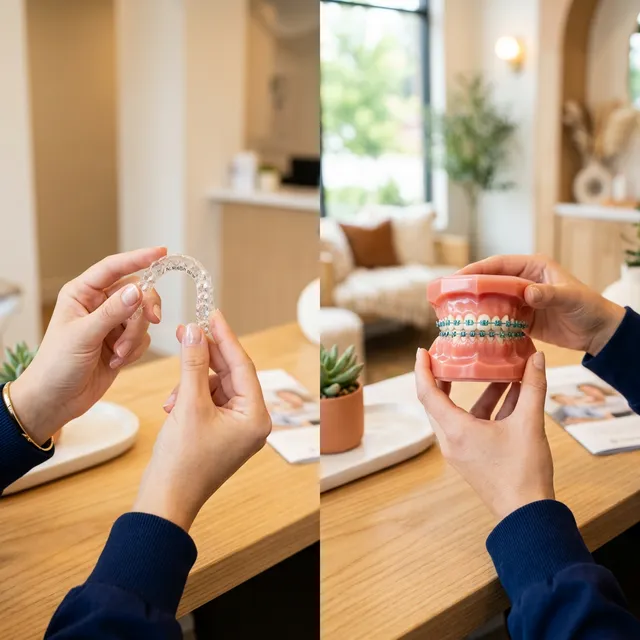
Traditional metal braces use brackets bonded to each tooth, connected by an archwire that your orthodontist tightens at each visit. The wire exerts constant pressure to guide teeth into alignment over time.
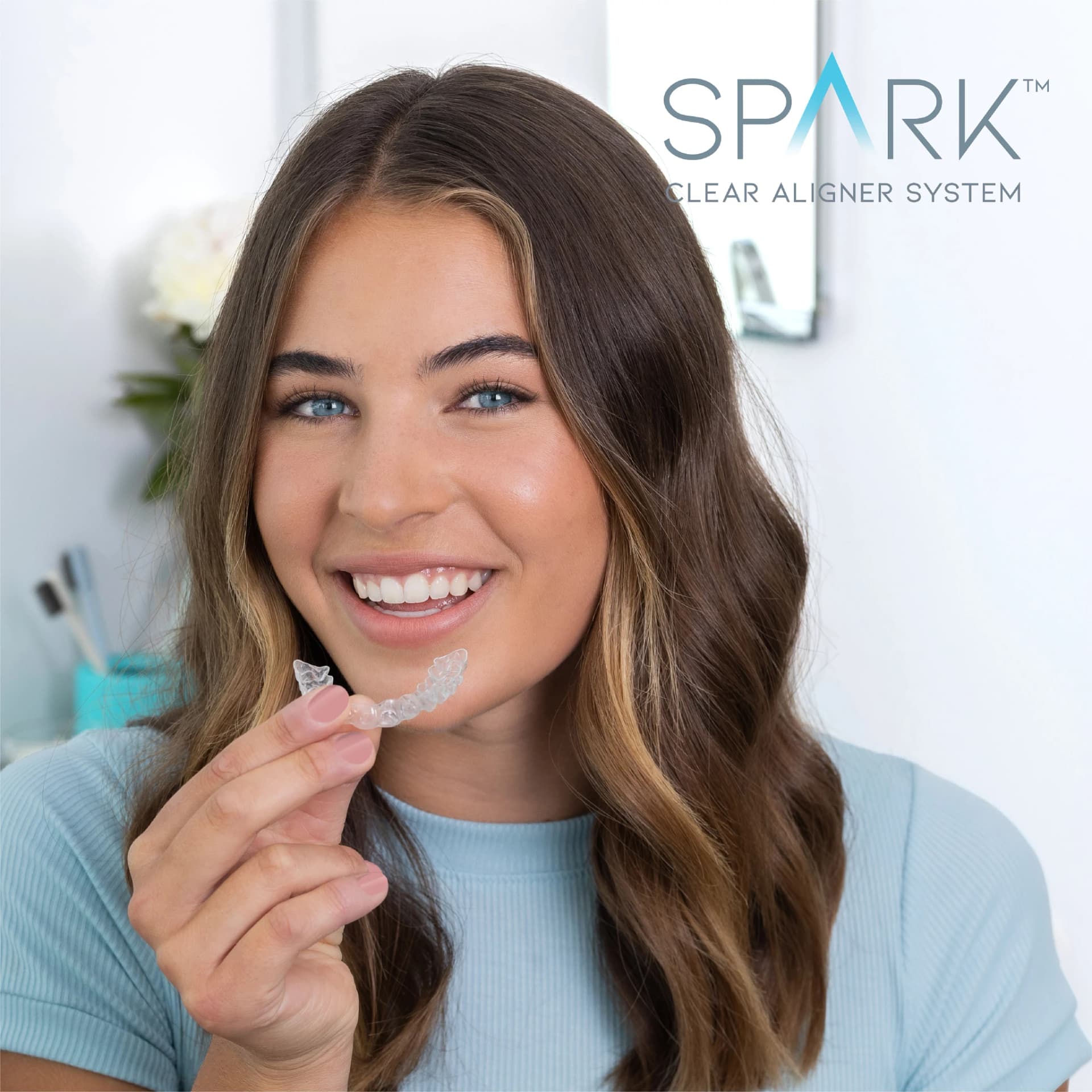
Clear aligners like Invisalign, and the Spark™ system we use at Innova Smiles, are a series of custom-molded plastic trays worn 20–22 hours per day. You swap to a new tray every 1–2 weeks, and each tray moves your teeth incrementally toward the final position. Because they're removable, you take them out to eat, drink anything other than water, and brush your teeth.
Both systems move teeth through the same biological mechanism: sustained pressure that prompts bone remodeling. According to the American Dental Association (ADA), both fixed braces and clear aligners are effective orthodontic treatments when properly supervised by a licensed dental professional. The difference is in how that pressure is delivered, maintained, and experienced by the patient.
Side-by-Side Comparison
| Feature | Invisalign / Spark™ | Traditional Metal Braces |
|---|---|---|
| Visibility | Nearly invisible | Highly visible metal brackets |
| Removability | Removable for eating and hygiene | Fixed, cannot be removed |
| Comfort | Smooth plastic, no sharp wires | Brackets and wires can irritate cheeks |
| Treatment time | 6–18 months (mild to moderate) | 18–36 months (comprehensive) |
| Cost at Innova Smiles (Marlborough) | $2,500–$5,500 | $3,000–$7,000 |
| Food restrictions | None (remove aligners to eat) | No sticky, hard, or crunchy foods |
| Oral hygiene | Easy, brush normally after removing | Requires special flossing tools |
| Office visits | Every 6–8 weeks | Every 4–6 weeks |
| Best for | Mild to moderate cases, adults, teens with discipline | Complex cases, severe crowding, younger teens |
| Insurance coverage | Often partially covered as orthodontic benefit | Often partially covered as orthodontic benefit |
Who Is a Good Candidate for Invisalign?
Clear aligners have come a long way since they were considered suitable only for minor corrections. Today, Invisalign and Spark™ can treat the vast majority of orthodontic cases, including:
- Mild to moderate crowding, teeth that are overlapping or rotated slightly
- Spacing issues, gaps between teeth, including midline diastema
- Overbite, upper front teeth significantly overlapping lower teeth
- Underbite, lower teeth sitting in front of upper teeth (mild to moderate)
- Crossbite, upper and lower teeth not aligning properly side to side
- Open bite, upper and lower front teeth not meeting when biting
Adults and older teenagers are typically the best candidates because compliance matters. If you won't wear the trays 20–22 hours per day, treatment will stall. Patients who are self-motivated and understand the responsibility get excellent results.
Clear aligners are particularly popular with:
- Working professionals who don't want visible hardware during client meetings or presentations
- Adults who had braces as teens and experienced relapse
- Patients who have dental anxiety and prefer the comfort of smooth plastic over metal hardware
- Brides, grooms, or anyone with a major life event in the next 12–18 months
Who Should Consider Traditional Braces Instead?
Braces remain the most-recommended option for certain clinical situations:
- Severe crowding or rotation, teeth that need to be rotated more than 45 degrees respond better to the continuous force of fixed brackets
- Significant vertical corrections, intrusion and extrusion (moving teeth up and down in the socket) are more predictable with braces
- Complex bite correction, skeletal discrepancies or cases requiring jaw repositioning often need braces, sometimes combined with appliances like expanders
- Young teenagers (under 14), compliance with aligner wear is harder to guarantee in younger patients; braces work regardless of cooperation
- Patients with certain dental work, bridges, significant crowns, or implants can complicate aligner treatment but are generally compatible with braces
That said, the gap between what aligners and braces can treat has narrowed significantly in the past decade. When you come in for a consultation at Innova Smiles, we'll scan your teeth, review the movements required, and give you an honest assessment of which system gives you the best outcome for your specific case, not a sales pitch.
Cost Comparison for Massachusetts Patients
Orthodontic costs in Massachusetts vary based on case complexity, the provider's experience, and whether you choose an orthodontist or a general dentist trained in aligner therapy.
Invisalign / Spark™ Clear Aligners at Innova Smiles:
- Mild/limited case: $2,500–$3,200
- Moderate comprehensive case: $3,200–$4,400
- Complex comprehensive case: $4,400–$5,500
Traditional Metal Braces:
- Mild case: $3,000–$4,500
- Moderate case: $4,500–$6,000
- Complex/comprehensive case: $6,000–$7,000+
Ceramic (tooth-colored) braces fall between the two in cost, typically $4,500–$7,000, and offer improved aesthetics without full invisibility. For a more granular cost breakdown by case type and brand, see our clear aligners vs. braces cost comparison for 2026.
Most dental PPO plans include an orthodontic lifetime benefit, typically $1,000–$2,500 per patient. This benefit applies equally to Invisalign and braces, the plan doesn't usually dictate which system you use. At Innova Smiles, our treatment coordinators will verify your specific benefits before your consultation so there are no surprises.
We also offer in-house financing options, CareCredit, and Cherry financing to spread treatment costs into manageable monthly payments.
The Spark™ Clear Aligner Difference at Innova Smiles
While many patients search for Invisalign by name (it's the most widely marketed aligner brand), at Innova Smiles we primarily use Spark™ aligners, a premium clear aligner system that we believe offers meaningful clinical advantages:
- TruGEN™ material: Spark aligners are made from a proprietary plastic that is optically clearer than Invisalign's SmartTrack material and retains that clarity longer throughout wear
- Scalloped edge design: The tray edge follows the natural contour of your gumline rather than cutting straight across, which improves comfort and reduces gum irritation
- Fewer attachments on average: Spark's advanced force engineering often achieves the same tooth movements with fewer tooth-colored composite "buttons," meaning less visible hardware
- Clinical equivalence: Spark is backed by Ormco, one of the most respected orthodontic manufacturers in the world, with published clinical data supporting its outcomes
For patients who are specifically committed to the Invisalign brand, we'll discuss your options openly. Our goal is the best clinical result for your case.
Frequently Asked Questions
Q: Is Invisalign really as effective as braces? For mild to moderate orthodontic cases, clinical outcomes with Invisalign and Spark aligners are equivalent to braces. A 2023 systematic review in the American Journal of Orthodontics and Dentofacial Orthopedics confirmed that clear aligners produce comparable results to braces for mild-to-moderate malocclusions. For very complex movements, particularly severe rotations and significant vertical corrections, braces still have an advantage. Your provider should be honest about this distinction and recommend accordingly.
Q: Can I switch from aligners to braces mid-treatment? Yes, it's possible, though it requires a new treatment plan and typically incurs additional cost. Switching mid-treatment is uncommon if the correct system was chosen at the start. This is why a thorough initial evaluation with digital imaging matters.
Q: Do braces or Invisalign hurt more? Both cause temporary discomfort when new pressure is applied, braces when wires are tightened, aligners when you switch to a new tray. Many patients find aligner discomfort more predictable and easier to manage with over-the-counter pain relief. Braces can also cause cheek and lip irritation from brackets and wires, which aligners do not.
Q: How do I keep my teeth clean with braces vs. aligners? Aligners are removed for brushing and flossing, so oral hygiene is identical to normal. With braces, you need to floss with a threader or orthodontic flosser under each wire, and brush carefully around every bracket. Patients with braces are at higher risk for white spot lesions (early decay marks) if hygiene is inadequate. Good hygiene discipline is non-negotiable with both systems.
Q: My teenager wants clear aligners. Is that realistic? Yes, for the right teenager. Invisalign Teen and Spark Teen are designed for adolescent patients and include compliance indicator dots on each tray (which fade with wear so you can monitor compliance) and replacement trays for lost aligners. The key factor is maturity and self-motivation. We cover this topic in depth in our article on Spark aligners for teens vs. traditional braces. We'll talk through this honestly with you and your teen during the consultation.
The Long-Term Orthodontic Investment: Retention and Relapse Prevention
After any orthodontic treatment, aligners or braces, retention is the most underappreciated phase of care. A 2020 study published in the American Journal of Orthodontics and Dentofacial Orthopedics followed 400 patients for 10 years post-treatment and found that 50% of patients who discontinued retainer wear within the first two years experienced measurable relapse, teeth shifting back toward their pre-treatment positions. The study concluded that indefinite nighttime retainer wear is the only reliable strategy for maintaining long-term results.
At Innova Smiles, we include retainers in the treatment fee for both Spark and Invisalign cases. Our article on why retainers are essential after orthodontic treatment explains the science behind relapse prevention in detail. We provide clear Essix retainers for initial full-time wear (typically the first three to six months after active treatment) and then transition to nighttime-only wear. For patients who want a "set it and forget it" solution, we also offer bonded permanent retainers, a thin wire adhered to the back surfaces of the front teeth that holds alignment without requiring any patient compliance.
Patients who completed braces elsewhere and experience relapse years later are among our most common aligner candidates. A limited Spark or Invisalign case (sometimes called a "touch-up" or "refinement" case) can correct mild relapse in three to six months at a fraction of the cost of full retreatment. If you had braces as a teenager and notice your teeth gradually shifting, an early evaluation at Innova Smiles can prevent the problem from worsening.
Oral Hygiene During Treatment: A Clinical Reality Check
One of the most significant practical differences between aligners and braces is the impact on daily oral hygiene, and the clinical consequences of inadequate care during treatment.
With braces, food debris accumulates around brackets and under wires after every meal. Studies published in the Journal of Clinical Periodontology have documented that orthodontic patients with fixed appliances have 2 to 3 times higher levels of plaque and gingivitis-causing bacteria compared to non-orthodontic patients. White spot lesions, permanent areas of enamel demineralization that appear as chalky white marks, develop in approximately 24% of braces patients, according to a 2019 meta-analysis in the European Journal of Orthodontics. These lesions are cosmetically frustrating and sometimes require treatment with microabrasion or resin infiltration after braces are removed.
Clear aligners eliminate this problem almost entirely because they are removed for eating and brushing. There is no hardware trapping food against the enamel. Patients maintain their normal brushing and flossing routine throughout treatment. For patients with a history of cavities or gum disease, common among adults in the MetroWest area, this hygiene advantage is a meaningful clinical consideration, not just a convenience factor.
Book Your Free Orthodontic Consultation in Marlborough
Still not sure which path is right for you? Take our free smile quiz to get an initial recommendation, or come in for a full consultation. At Innova Smiles, your orthodontic consultation includes a full digital scan of your teeth, a 3D preview of your projected result, and a detailed review of both treatment options, including honest guidance on which system is more appropriate for your case.
Call us at (508) 481-0110 or book now to schedule your consultation. We serve patients from Marlborough, Hudson, Northborough, Westborough, Sudbury, Hopkinton, and throughout the MetroWest area.
Related Articles
- Invisalign vs. Spark Aligners: Cost & Comparison
- How Long Does Invisalign Take?
- Mail-Order Aligners: Risks Without Dentist Supervision