The short answer
Both Invisalign® and Spark™ clear aligners straighten teeth effectively. According to the American Association of Orthodontists, clear aligner therapy can successfully treat a wide range of malocclusions when managed by a trained provider. At Innova Smiles, we are certified providers of both systems, which means we make treatment recommendations based on your specific case—not on which product costs us less or which we have exclusive deals with.
For most adult and teen patients, we recommend Spark™ because of its superior material clarity and edge finishing. But Invisalign's longer clinical track record and specialized protocols (like Teen with compliance indicators) make it the right choice for some cases.
Side-by-side comparison
| Feature | Invisalign® | Spark™ |
|---|---|---|
| Material | SmartTrack thermoplastic | TruGEN/TruGEN XR thermoplastic |
| Clarity | Good initially, may yellow with coffee/tea | Exceptional, stays clearer longer |
| Edge trim | Standard finish | Scalloped edge follows gum line (more comfortable, less visible) |
| Compliance indicators | Available (Invisalign Teen) | Not currently available |
| Attachment count | Often more attachments needed | Fewer attachments for equivalent movement |
| Refinements | Included in comprehensive plans | Included in comprehensive plans |
| Clinical data | 20+ years, 14 million patients | Newer but growing evidence base |
| Provider exclusivity | Available at many offices | Only certified Spark providers |
| Tray change interval | Typically every 1–2 weeks | Typically every 1–2 weeks |
| BPA/mercury-free | Yes | Yes |
| FDA clearance | Yes | Yes |
Cost in Marlborough, MA
Clear aligner costs vary based on case complexity, not which brand you use. At Innova Smiles, pricing is similar for both systems:
| Case Type | Estimated Cost |
|---|---|
| Minor correction (6–12 trays) | $2,500–$3,200 |
| Moderate (comprehensive, 12–24 trays) | $3,200–$4,400 |
| Complex (severe crowding, bite correction) | $4,400–$5,500 |
| Teen aligners | $3,200–$4,400 |
What affects your cost:
- Severity of crowding, spacing, or bite issues
- Number of arches treated (upper only vs. both)
- Whether tooth extractions or interproximal reduction is needed
- Case length (more trays = higher lab costs)
Detailed cost breakdown: where your money goes
Patients often ask what exactly they are paying for when the total reaches $4,000 or $5,000, within the typical $2,500–$5,500 range. Here is a transparent look at the components that make up your aligner fee at our Marlborough office:
| Cost Component | What It Covers |
|---|---|
| Diagnostic records | CBCT scan, digital impressions (TRIOS® 5), photos, smile analysis |
| Treatment planning | ClinCheck or Spark Approver simulation, Dr. Fatima's case design time |
| Aligner fabrication | Lab fee for manufacturing every tray in your series (initial + refinements) |
| Attachments and IPR | Bonding composite buttons, interproximal reduction if needed |
| Office visits (6–10) | Progress checks every 6–8 weeks to track movement |
| Retainers | Post-treatment custom retainers (Vivera or Spark) |
The single largest line item is lab fabrication. Each set of trays is custom-milled from your digital scan data. Complex cases requiring 40+ trays simply cost more to produce than a minor 10-tray correction. For a focused breakdown of Spark-specific pricing tiers, see our Spark aligner cost guide for Massachusetts.
Insurance coverage differences
Most Massachusetts PPO dental plans include an orthodontic benefit, typically a lifetime maximum of $1,000 to $2,500. Our guide to insurance coverage for Invisalign in Massachusetts walks through plan types, HSA/FSA strategies, and how to verify your specific benefits. Here is what you should know:
- Invisalign and Spark are billed the same way. Insurance companies classify both as "clear aligner orthodontic therapy" under CDT code D8040 (comprehensive orthodontic treatment) or D8010 (limited orthodontic treatment). Your benefit amount does not change based on brand.
- Age limits matter. Some plans restrict orthodontic benefits to patients under 19. Others cover adults. We verify your plan details before you start.
- HSA/FSA eligible. Aligners qualify as a medical expense under IRS rules. Patients with a Health Savings Account or Flexible Spending Account can use pre-tax dollars to cover part or all of their treatment.
- Coordination of benefits. If you carry two dental plans (for example, your own employer plan plus coverage under a spouse's plan), we can file both to maximize your reimbursement.
At Innova Smiles, we handle all insurance paperwork. We run your benefits on the spot during your consultation so there are no surprises.
Financing options
Cost should not prevent you from getting a straighter smile. We offer multiple paths to make treatment manageable:
CareCredit: 0% APR for 12–24 months on qualifying cases. A moderate case at $3,800 works out to roughly $158/month over 24 months with zero interest.
Cherry Financing: Another 0% APR option with a simple online application. Approval takes minutes, and there is no hard credit pull for the initial check.
In-house payment plans: For patients who prefer to skip third-party financing, we offer internal payment plans with no interest. A typical arrangement is 25% down at the start and the balance spread over the active treatment period.
Employer dental discount programs: Several MetroWest employers, including companies in the Marlborough and Framingham corporate parks, offer dental discount plans that can be combined with insurance benefits. Ask us and we will check. Whatever financing path you choose, be cautious of budget mail-order aligners that skip in-person monitoring, our article on the risks of mail-order aligners explains why the savings rarely materialize.
For a broader look at all treatment costs, visit our pricing guide.
Material quality: TruGEN vs. SmartTrack
The aligner plastic itself is arguably the most important difference between these two systems. You wear these trays 20–22 hours a day for months. The material directly affects comfort, visibility, and performance.
SmartTrack (Invisalign): Align Technology introduced SmartTrack in 2013. It is a multi-layer thermoplastic designed to apply gentle, constant force. SmartTrack was a significant upgrade over Invisalign's original single-layer material. However, patients who drink coffee, tea, or red wine regularly notice that SmartTrack trays develop a yellowish tint within 5–7 days of wear.
TruGEN (Spark): Ormco's TruGEN material was specifically engineered to address the staining issue. A 2020 study published in the Angle Orthodontist demonstrated that TruGEN maintains superior optical clarity and stain resistance compared to competing aligner plastics, including SmartTrack. In clinical practice, this translates to trays that stay virtually invisible for their full wear cycle. The TruGEN XR variant adds additional stiffness for more aggressive tooth movements in complex cases.
Comfort comparison: Both materials are comfortable to wear, but Spark's scalloped trim line, which follows the natural contour of the gum tissue rather than cutting straight across, reduces gum irritation, especially during the first few days of a new tray. Multiple patients in our Marlborough practice who have used both systems report that Spark trays feel less bulky and cause fewer soft-tissue sore spots.
Treatment timeline comparison
How long each system takes depends on case complexity, not the brand. However, there are some protocol differences worth knowing:
| Factor | Invisalign | Spark |
|---|---|---|
| Tray change interval | 7–14 days (provider discretion) | 7–14 days (provider discretion) |
| Average total treatment (moderate case) | 12–15 months | 12–15 months |
| Refinement sets included | Yes (comprehensive plans) | Yes (comprehensive plans) |
| Digital planning software | ClinCheck | Spark Approver |
| Average number of office visits | 6–10 | 6–10 |
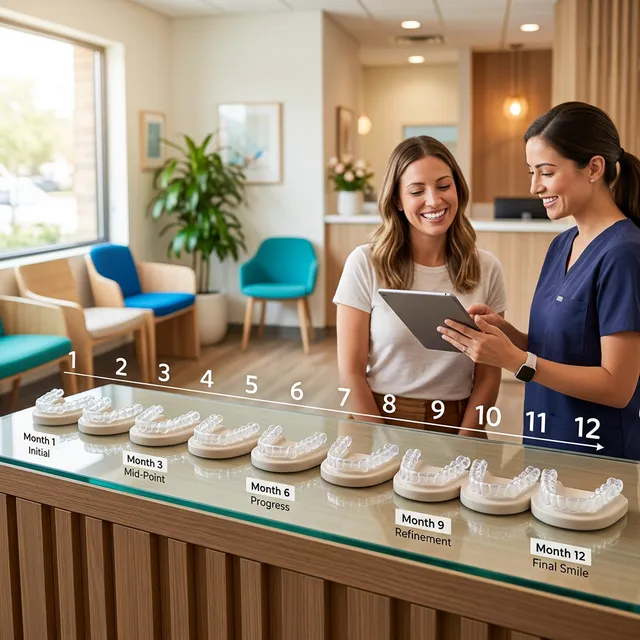
Both systems are digitally planned before the first tray is manufactured. At Innova Smiles, Dr. Fatima spends significant time refining the digital treatment plan, adjusting staging, overcorrections, and attachment placement, regardless of which system you choose.
Which is better for complex cases?
This is where clinical experience matters more than marketing.
Invisalign's advantage in complex cases: With over 14 million patients treated worldwide, Invisalign has the deepest clinical dataset. Their protocols for severe Class II (overbite) and Class III (underbite) corrections have been refined over two decades. For cases involving significant bite correction, especially those requiring elastics, bite ramps, or mandibular advancement — Invisalign's published evidence base is more robust.
Spark's advantage in complex cases: TruGEN XR (the extended-range material) delivers stronger sustained forces for difficult movements like premolar derotation and molar uprighting. The engineering behind Spark attachments often achieves equivalent tooth movement with fewer buttons bonded to the teeth, which matters when treatment involves 40+ trays and every attachment becomes a cleaning challenge.
Our approach: Dr. Fatima evaluates every case individually. For a patient in Northborough with moderate crowding and no bite issues, Spark is almost always the better choice. For a teen in Framingham with a deep overbite who needs compliance tracking, Invisalign Teen may be the smarter recommendation. We never force a patient into one system because of brand loyalty.
Why we chose Spark as our preferred system
Dr. Fatima completed additional certification training to become a Spark provider. The deciding factors:
1. TruGEN material stays clearer. The number one patient complaint about Invisalign is yellowing or haziness from coffee and tea. Spark's TruGEN plastic is significantly more stain-resistant in clinical observations, backed by the Angle Orthodontist study referenced above.
2. Scalloped edge trim. Spark trays are trimmed to follow the natural curve of the gum line rather than cutting straight across. This means less gum irritation, less visible plastic showing above the gum line, and a more comfortable fit overall.
3. Fewer attachments. Spark's engineering allows for equivalent tooth movement with fewer tooth-colored buttons (attachments) bonded to the teeth. Fewer attachments mean easier cleaning and less visible hardware.
4. Comparable movement capability. Spark handles the full range of tooth movements that most adult patients need, including rotations, extrusions, and intrusions.
5. Patient satisfaction data. In our own practice, patients who have tried both systems consistently rate Spark higher for comfort and aesthetics. Families from Hudson, Sudbury, and Southborough who have completed Spark treatment frequently tell us they forgot they were wearing aligners by the second week.
When we might recommend Invisalign instead
- Teens who need compliance tracking: Invisalign Teen has blue compliance indicators that fade when trays are worn the required 20–22 hours. Parents appreciate the visual feedback.
- Very complex bite correction: Invisalign's longer clinical history includes more published protocols for severe Class II and Class III bite cases.
- Patient preference: If a patient has had Invisalign before and is doing a touch-up, we can continue with the same system for consistency.
- Mandibular advancement: Invisalign's mandibular advancement feature is specifically designed for growing teens with Class II malocclusions, a use case Spark does not currently address.
Frequently Asked Questions
Can I switch from Invisalign to Spark mid-treatment? Technically yes, but it requires new records and a new treatment plan, which adds cost and time. We recommend choosing the right system at the start. If you're currently in Invisalign and unhappy with clarity or comfort, Dr. Fatima can evaluate whether switching to Spark is feasible -- a new digital scan and revised plan would be required, but in many cases the switch can be made without significantly extending your overall timeline.
Do Invisalign and Spark work with dental insurance the same way? Yes. Both are billed under the same orthodontic CDT codes -- D8040 (comprehensive) or D8010 (limited). Your insurance company won't differentiate between brands. Most Massachusetts PPO plans include an orthodontic benefit of $1,000 to $2,500 as a lifetime maximum. HSA/FSA funds are eligible for either system. We verify your benefits on the spot during your consultation.
Will my aligners be visible in photos and video calls? Both systems are significantly less visible than metal braces, but Spark's TruGEN material reflects less light and stays clearer through the 7-day wear cycle, making it slightly less detectable in close-up photos and video calls. Invisalign's SmartTrack can develop a slight yellowish tint within 5 to 7 days of wear for coffee, tea, or wine drinkers.
How often do I need to come in for aligner check-ups? Every 6 to 8 weeks for both systems. Appointments are brief -- typically 15 to 20 minutes -- and focus on verifying that teeth are tracking according to plan, distributing your next set of trays, and answering questions. Average total office visits over treatment is 6 to 10.
Is Spark cheaper than Invisalign at Innova Smiles? No -- pricing is essentially the same. Both Spark and Invisalign run $2,500 to $5,500 depending on case complexity at our Marlborough office. The cost depends primarily on the number of trays needed and the duration of treatment, not the brand. The quoted price for either system includes all digital scans, all trays (including refinements), attachments and elastics, all progress-check appointments, and one set of retainers.
Which system is better for severe crowding or significant bite correction? Invisalign has the deeper clinical dataset for severe Class II and Class III bite cases -- over 14 million patients treated worldwide with refined protocols for elastics, bite ramps, and mandibular advancement. Spark's TruGEN XR variant delivers stronger sustained forces for difficult movements like premolar derotation and molar uprighting. Dr. Fatima evaluates every case individually -- for teens needing compliance tracking or growing patients with Class II issues, Invisalign Teen is often the smarter call.
What to expect at your free consultation
- Digital scans: No impressions. Our TRIOS® 5 scanner captures a precise 3D model in minutes.
- ClinCheck or Spark simulation: We show you a digital preview of your projected tooth movement before you commit.
- Case assessment: Dr. Fatima confirms which system is best for your specific crowding/bite pattern and gives you a precise cost estimate.
- Insurance verification: We run your benefits on the spot so you know exactly what you'll pay.
- Financing review: If needed, we walk through CareCredit, Cherry, or in-house options so you leave with a clear monthly payment figure.
The entire consultation takes about 45 minutes and there is no obligation to proceed.
Ready to see what your smile could look like? Book your free aligner consultation at Innova Smiles in Marlborough. Patients from Hudson, Sudbury, and across MetroWest trust us for expert aligner care.
Related Articles
Related Services
- Clear Aligner Therapy (Spark™), our preferred aligner system for adults and teens
- Invisalign®, trusted aligner therapy with 20+ years of clinical data
- Invisalign Teen, aligner therapy designed specifically for teenagers