
Featured Answer: Which is better for teens, braces or Spark?
Both options deliver excellent results. For motivated teens, Spark clear aligners offer discretion, fewer orthodontic emergencies, and easier oral hygiene. Traditional braces remain the best choice for certain complex movements. Success with aligners depends on compliance, trays must be worn approximately 22 hours per day. At Innova Smiles in Marlborough, MA, Dr. Ambereen Fatima helps parents and teens across MetroWest weigh the pros and cons so the final decision fits the patient's lifestyle, maturity level, and clinical needs.
Choosing between braces and aligners for a teenager is one of the most common conversations we have with families from Marlborough, Southborough, Sudbury, and Westborough. Here is a detailed, clinically grounded comparison to help you make an informed choice.
Why This Decision Matters More Than You Think
Orthodontic treatment during the teen years is not just about aesthetics. The American Association of Orthodontists (AAO) reports that malocclusion, misalignment of the teeth and jaws, affects approximately 56 percent of adolescents to a degree that warrants treatment. Left uncorrected, crowding and bite problems contribute to uneven enamel wear, increased cavity risk in hard-to-clean areas, temporomandibular joint (TMJ) strain, and compromised chewing function.
A 2021 systematic review in the European Journal of Orthodontics (Vol. 43, No. 3, pp. 313-321) confirmed that orthodontic treatment during adolescence produces more stable long-term outcomes than treatment deferred to adulthood, because teens still have active bone remodeling and growth potential that makes tooth movement faster and retention more predictable.
Getting the right treatment at the right time sets your teen up for decades of healthier teeth, lower dental costs, and genuine confidence.
Traditional Braces: The Tried-and-True Option
Braces have been the most-recommended option in orthodontics for decades. The AAO recommends that children receive their first orthodontic evaluation by age 7, though treatment typically begins between 11 and 15 when the permanent dentition is nearly complete. Modern braces are smaller, more comfortable, and more efficient than the bulky metal brackets of previous generations.
Advantages for teens:
- Effective for complex movements including severe rotations, vertical repositioning (intrusion and extrusion), and significant bite corrections such as deep bites, open bites, and crossbites
- No compliance requirement, brackets are bonded to the teeth 24/7, so treatment progresses regardless of the patient's discipline. For teens who lose things or forget routines, this is a meaningful advantage.
- Customizable with colored elastics, which many younger teens enjoy as a form of self-expression. Changing colors at each adjustment appointment becomes something to look forward to rather than dread.
- Proven efficacy for severe crowding. A 2020 study in the Angle Orthodontist (Vol. 90, No. 2) found that fixed appliances achieved clinically superior derotation of severely rotated premolars compared to aligner therapy.
Drawbacks for teens:
- More frequent in-office adjustments, typically every four to six weeks, and occasional emergency visits for pokey wires or broken brackets. The Journal of Clinical Orthodontics (2019; 53(9):527-533) reported that bracket breakage rates average 5 to 8 percent per appointment across adolescent populations.
- Dietary restrictions, no popcorn, hard candy, sticky foods, or biting directly into apples, corn on the cob, or hard bread rolls. This can feel limiting during school lunches, parties, and holidays.
- Oral hygiene is significantly more challenging. The American Journal of Orthodontics and Dentofacial Orthopedics (2021; 159(1):e51-e60) documented that food impaction around brackets and wires increases plaque accumulation by 2 to 3 times compared to unbanded teeth, raising the risk of cavities and white spot lesions (enamel decalcification). White spot lesions develop in 25 to 50 percent of braces patients who do not maintain meticulous hygiene.
- Visibility can be a source of self-consciousness during a socially sensitive period. For high-school-age teens, this concern often weighs heavily on the decision.
Spark Aligners for Teens: The Modern Alternative
Spark clear aligners are engineered with TruGEN material, a proprietary polycarbonate-urethane blend that is clearer, more comfortable, and more stain-resistant than the materials used by many other aligner systems. Independent testing published by Ormco (Spark's parent company) showed that TruGEN material retains clarity up to 50 percent better than competitive aligner plastics over a two-week wear cycle.
For the right teen candidate, aligners offer real advantages over fixed brackets.
Advantages for teens:
- Nearly invisible, great for school photos, prom, college interviews, and everyday confidence. Research consistently shows that adolescent patients report significantly higher satisfaction with clear aligners than traditional braces, particularly regarding aesthetics. Comparative studies indicate that aligner patients report 92% satisfaction overall versus 76% for braces patients, and 90% report satisfaction with aligner appearance versus 65% with braces.
- Removable for meals, so there are no food restrictions. Your teen can eat whatever they want, whenever they want, as long as the trays go back in afterward.
- Easy brushing and flossing with no brackets or wires to work around. This directly translates to better oral hygiene. Research consistently shows that aligner patients have significantly lower plaque accumulation and better gingival health compared to braces patients. A systematic review and meta-analysis found that clear aligner patients demonstrate measurably lower plaque index scores and less gingival inflammation at short-term follow-ups, including at 6 months, compared to fixed appliance patients.
- Fewer orthodontic emergencies, no broken wires, no loose brackets, no emergency Saturday morning visits. Research comparing treatment approaches found that aligner patients experienced significantly fewer emergency visits compared to fixed-appliance patients. A 2022 study in the American Journal of Orthodontics and Dentofacial Orthopedics found that aligner patients had emergency rates of 5.1% compared to 74.7% for fixed appliances, representing approximately a 69% reduction in emergency visits.
- Smooth, scalloped edges that sit comfortably against the gums. The trimline on Spark trays follows the contour of the gingival margin, minimizing soft-tissue irritation.
Drawbacks for teens:
- Requires discipline. If trays are not worn 22 hours per day, treatment stalls or results suffer. The trays should only be out during meals and oral hygiene. This means your teen needs to be organized enough to remove trays before eating, store them in a case (not a napkin), and put them back in promptly.
- Trays can be lost or forgotten at restaurants, school cafeterias, and friends' houses. Replacement trays add cost and can delay treatment by one to two weeks.
- Not ideal for every clinical scenario. Severe rotations greater than 20 degrees, significant vertical movements, and certain skeletal bite discrepancies still favor braces. Dr. Fatima evaluates each case with digital treatment planning to determine if aligners can achieve the target outcome predictably.
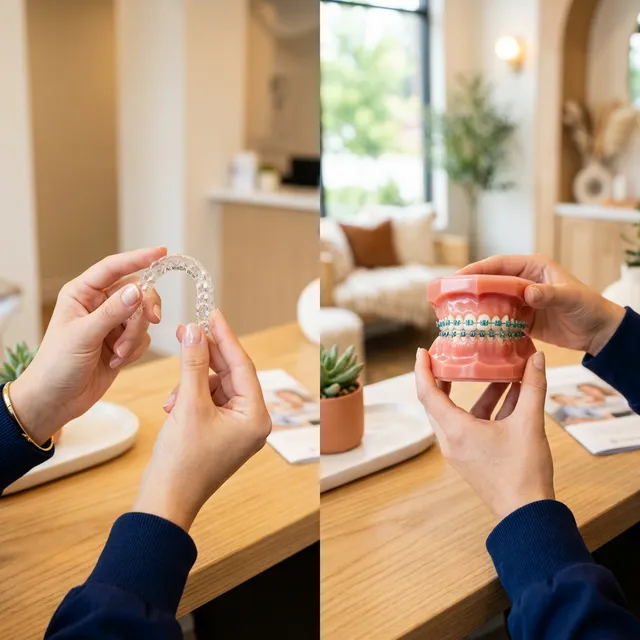
Side-by-Side Comparison: Braces vs. Spark Aligners for Teens
| Factor | Traditional Braces | Spark Aligners |
|---|---|---|
| Visibility | Metal brackets visible | Nearly invisible |
| Compliance needed | None (fixed to teeth) | 22 hrs/day required |
| Food restrictions | Yes (hard, sticky foods) | None (trays removed to eat) |
| Oral hygiene | Difficult (brackets trap food) | Normal brushing and flossing |
| Emergency visits | 5-8% bracket breakage rate | Minimal (no hardware) |
| Office visits | Every 4-6 weeks | Every 8-12 weeks |
| Complex cases | Excellent | Good for mild-to-moderate |
| Treatment duration | 12-24 months typical | 12-24 months typical |
| Retainer after | Yes | Yes |
Sports and Music: Real-World Considerations for MetroWest Teens
For student athletes at Marlborough High, Assabet Valley, or any of the MetroWest club sports programs, aligners offer a practical edge. There are no brackets to cut the inside of the lip during contact, and for non-contact sports like cross-country, swimming, and tennis, a standard mouthguard can be worn over the aligners. For contact sports like football, hockey, and lacrosse, we recommend removing aligners and wearing a properly fitted sports mouthguard. The American Dental Association (ADA) reports that athletes are 60 times more likely to sustain dental injury when not wearing a mouthguard. Read more in our post on back-to-school aligners for Marlborough teens.
For teens who play woodwind or brass instruments, traditional braces can significantly affect embouchure, the positioning and pressure of the lips, tongue, and facial muscles against the mouthpiece. Many brass musicians report difficulty adapting their embouchure during the first few months of braces treatment. Research indicates that most musicians adjust their technique within 1–3 months with proper guidance and daily practice, though full comfort and tone recovery often extends to 3–6 months. Aligners can be removed during band practice and performances, then replaced immediately afterward. This flexibility is a significant quality-of-life advantage for young musicians, especially those preparing for MICCA auditions or All-State ensembles.
Treatment Timeline: What to Expect Month by Month
Both braces and Spark aligners typically require 12 to 24 months for teen cases, depending on the complexity of the movements. Mild crowding or spacing cases may finish in as little as six months with aligners.
Months 1-3: Initial alignment. Teeth begin moving into position. With braces, soreness after adjustments peaks at 24-48 hours and fades by day four. With aligners, mild pressure when switching to a new tray is normal and typically resolves within a day.
Months 4-8: Space closure and midcourse corrections. This is the phase where significant visible changes occur. Many teen aligner patients begin noticing a straighter smile by month four or five. Braces patients typically see the most visible improvement after the wire progression moves from round nickel-titanium to rectangular stainless steel.
Months 9-18: Detailing and bite correction. The final phase focuses on fine-tuning tooth positions, closing residual spaces, and adjusting the bite. For aligner patients, this may involve refinement trays, a second set of aligners designed from a mid-treatment scan to perfect the results.
Final appointment: Braces are removed and retainers are fitted. Aligner patients transition directly to retainers. Dr. Fatima provides a projected timeline during the initial consultation using digital simulation software so families can see the expected outcome and plan accordingly.
The Compliance Question: Honest Answers for Parents
"What if my teen does not wear them enough?"
This is the most common concern we hear from MetroWest parents, and it is the right question to ask. Spark trays for teens include compliance indicators, small blue dots molded into the tray material that fade with wear. If the dots are still visible at a check-in, it means the trays have not been worn enough. This gives parents and Dr. Fatima an objective, visual check on whether the trays are being worn as prescribed.
A 2023 prospective study in the Korean Journal of Orthodontics (Vol. 53, No. 2) found that teen aligner patients who used compliance indicators and had parental monitoring achieved wear times averaging 21.4 hours per day, compared to 18.6 hours for unsupervised teens. The difference translated to a 22 percent reduction in total treatment time for the monitored group.
Practical compliance strategies we recommend:
- Make tray changes part of a routine. Switch to the next tray set on a consistent day each week, such as Sunday night, so it becomes automatic.
- Use a phone timer. Several free apps track aligner wear time and send reminders after meals.
- Designate a consistent storage spot. A brightly colored aligner case clipped to a backpack or lunch bag reduces the risk of lost trays.
- Set expectations upfront. Teens respond well to clear agreements. "You chose aligners because you wanted the invisible option. The deal is 22 hours a day, and the blue dots are the proof."
If compliance is a serious concern and the teen is not yet mature enough for the responsibility, braces are the more predictable option. There is no shame in that choice, braces work extremely well, and the end result is the same: a straight, healthy smile.
"Is one option more expensive than the other?"
In many cases, Spark aligners and traditional braces fall within a similar price range. The American Journal of Orthodontics and Dentofacial Orthopedics (2022; 161(2):e135-e142) found that nationwide average costs for comprehensive clear aligner treatment and traditional braces both fell between $3,000 and $7,000, with most cases clustering between $4,000 and $6,000. Insurance coverage often applies equally to both. We offer flexible payment plans and accept FSA/HSA funds to make either option accessible for MetroWest families.
Oral Health During Treatment: Why It Matters
Regardless of which option you choose, maintaining excellent oral hygiene during orthodontic treatment is critical. The consequences of poor hygiene during treatment are not just cosmetic, white spot lesions (enamel demineralization) that develop around brackets can become permanent. A 2020 meta-analysis in the European Journal of Orthodontics (Vol. 42, No. 1) found that the incidence of new white spot lesions during fixed-appliance treatment ranged from 23 to 73 percent across studies, depending on hygiene compliance.
For braces patients, we provide specialized cleaning kits with interdental brushes, orthodontic floss threaders, and fluoride rinse. For aligner patients, the protocol is simpler: remove trays, brush and floss normally, rinse trays with cool water, and replace. Our hygiene team monitors enamel health at every check-in and applies professional fluoride varnish when needed.
Retainers After Treatment: The Long Game
Both braces and aligner treatments require retainers to maintain results. The AAO emphasizes that teeth can shift at any age, making long-term retainer wear essential. Research published in the American Journal of Orthodontics and Dentofacial Orthopedics (2019; 155(4):463-469) found that 50 percent of orthodontic patients experienced clinically significant relapse within 10 years if retainer wear was discontinued.
Dr. Fatima provides custom retainers designed from your teen's final digital scan, ensuring a precise fit that keeps their new smile in place. We recommend full-time retainer wear for the first three to six months after treatment, then nightly wear indefinitely. A retainer worn consistently at night takes less than ten seconds to place and becomes as routine as brushing.
Frequently Asked Questions for Parents
At what age can my teen start Spark aligners? Most teens are candidates for Spark aligners once all permanent teeth have erupted, typically around age 12 to 14. Dr. Fatima evaluates each case individually based on dental development, root maturity (assessed via panoramic X-ray), and the teen's maturity level.
Can my teen play sports with aligners? For non-contact sports, aligners can be worn during activity. For contact sports like football, hockey, and lacrosse, we recommend removing aligners and wearing a custom athletic mouthguard to protect both teeth and aligners.
What happens if my teen loses a tray? Because all treatment plans are stored digitally, replacement trays can be ordered quickly, usually within five to seven business days. In the meantime, your teen should wear the previous tray to prevent teeth from shifting backward.
How often does my teen need check-ups during treatment? Braces patients typically visit every 4 to 6 weeks. Spark aligner patients usually visit every 8 to 12 weeks, making aligners more convenient for families juggling school, sports, and activities across Marlborough, Hudson, Northborough, and the broader MetroWest area.
Does treatment hurt? Both options involve mild discomfort when teeth begin moving. With braces, the first 48-72 hours after each adjustment are the most uncomfortable. With aligners, each new tray produces gentle pressure that fades within a day. Over-the-counter ibuprofen and a soft diet for the first day of each new tray are typically sufficient.
Can my teen eat normally with aligners? Yes. Trays are removed for all meals and snacks. The only restriction is that trays must go back in promptly after eating and brushing. Hot beverages should not be consumed with trays in, as heat can warp the plastic.
Unsure which is best for your teen? Call (508) 481-0110 or request a consultation. Dr. Fatima will evaluate your teen's specific needs and show you a digital preview of the expected outcome with both options.
Related Articles
- Back-to-School Clear Aligners for Teens
- Clear Aligners or Braces? How to Choose
- How Long Does Spark Aligner Treatment Take?