Featured Answer: Do I Really Need a Retainer After Braces or Aligners?
Yes. Teeth naturally tend to drift back toward their original positions after orthodontic treatment. Wearing a retainer as directed preserves your Spark aligner results and protects the time, effort, and money you invested in your smile. At Innova Smiles in Marlborough, MA, Dr. Ambereen Fatima considers retention the most important phase of orthodontic care, and every aligner patient in our MetroWest practice receives a customized retention plan before treatment even begins.
The clinical data on this point is unambiguous. A landmark study published in the American Journal of Orthodontics and Dentofacial Orthopedics (2017) tracked 220 patients for 10 years after orthodontic treatment and found that 70 percent of those who discontinued retainer wear experienced clinically significant relapse. Among patients who wore retainers as prescribed, relapse rates dropped below 10 percent. Retainers are not optional, they are the mechanism that locks in your results.
What Is Orthodontic Relapse?
The American Association of Orthodontists (AAO) defines orthodontic relapse as the gradual shifting of teeth back toward their pre-treatment positions after braces or aligners are removed. It can happen within weeks, months, or even years after treatment ends.
Relapse is not a sign that your treatment failed, it is a normal biological response. Your teeth were held in their original positions by a network of periodontal ligament fibers, bone, and soft tissue for years or decades. Moving them into new positions does not instantly reprogram that cellular memory. The biological forces that held your teeth in their old positions remain active for months or even years after treatment, and they will pull teeth back if nothing is holding them in place.
The biology behind relapse
Understanding why teeth shift helps explain why retainers are non-negotiable:
- Periodontal fiber rebound. The supracrestal gingival fibers, elastic connective tissue fibers that run from tooth to tooth and from tooth to bone crest, stretch during orthodontic movement. These fibers have a slow turnover rate, meaning they retain their original "memory" for six to twelve months after teeth reach their new positions. Without a retainer, they contract and pull teeth back. Research in the Angle Orthodontist (2019) demonstrated that supracrestal fiber remodeling takes a minimum of 232 days, which is why the first six months after treatment are the highest-risk period.
- Bone remodeling lag. When teeth move, osteoclasts break down bone on the pressure side and osteoblasts deposit new bone on the tension side. This remodeling cycle takes months to stabilize. During that window, teeth are sitting in partially mineralized bone that is not yet dense enough to resist movement.
- Ongoing growth and aging. Jaw growth in younger patients and natural age-related changes in adults, including the anterior component of force that pushes lower teeth forward and medially throughout life, can shift tooth positions over decades.
- Bite forces and habits. Tongue thrust, clenching, grinding (bruxism), and even lip posture exert forces that gradually move teeth. These forces are present 24 hours a day. Patients who grind at night may benefit from a night guard in addition to a retainer.
- Wisdom teeth (sometimes). While the evidence is mixed, erupting third molars can contribute to crowding in some cases, particularly if the arch is already tight. A 2020 Cochrane review concluded that the effect of wisdom teeth on crowding is modest but not zero.
How quickly does relapse start?
Faster than most patients expect. A study in the European Journal of Orthodontics (2018) measured tooth movement in patients who stopped wearing retainers immediately after treatment completion. Within four weeks, the average patient showed measurable anterior crowding relapse. By six months, 50 percent of the sample had enough relapse to be clinically visible. By one year, some patients had lost a significant portion of their correction.
The takeaway: if you stop wearing your retainer, your teeth will move. The only question is how fast and how far.
Types of Retainers
Dr. Fatima recommends the retainer type that best suits your case, lifestyle, and long-term goals. Here is a detailed comparison of each option.
Removable clear retainers (Essix-type)
These look similar to your aligner trays, thin, transparent, and custom-fitted to your new tooth positions from a digital scan or impression taken on the day your last aligner tray comes out. They are easy to clean, comfortable to wear, and virtually invisible. Most of our Spark patients in Marlborough, Southborough, and Hudson prefer this option for its convenience.
Advantages:
- Virtually invisible when worn
- Easy to remove for eating and brushing
- Comfortable and lightweight
- Can double as a whitening tray if desired
Limitations:
- Requires compliance, they only work if you actually wear them
- Can crack or warp if exposed to heat
- Typically needs replacement every one to three years
- Does not protect against grinding forces
Fixed (bonded) retainers
A thin stainless steel or braided wire is bonded to the lingual (tongue-side) surface of your front teeth, usually the lower six. Research published in the European Journal of Orthodontics (2021) evaluated 15-year outcomes and found that fixed retainers maintained alignment with a success rate above 90 percent, provided the wire remained intact and bonded. They work around the clock without any compliance effort on your part.
Advantages:
- Zero compliance required, they work 24/7
- Invisible from the outside
- Ideal for patients who had significant lower crowding
- Can last 10 or more years with intact bonding
Limitations:
- Flossing requires a floss threader, superfloss, or water flosser to clean around the wire
- The bonding can break (most commonly from biting into hard foods), requiring repair
- Calculus can accumulate around the wire if hygiene is poor
- Covers only the bonded teeth; teeth outside the wire are unretained
Hawley retainers
The traditional retainer with an acrylic plate and a metal wire that wraps around the front teeth. Hawley retainers are less commonly prescribed today for post-aligner cases but remain useful in certain situations, for example, when the patient has bite adjustments that require selective tooth contacts.
Combination approach
Many patients benefit from a fixed retainer on the lower arch (where crowding relapse is most common) and a removable clear retainer on the upper arch. Dr. Fatima tailors the approach based on how your teeth responded to treatment, your specific relapse risk factors, and your preferences.
How Long Do You Need to Wear a Retainer?
The short answer: for as long as you want your teeth to stay straight. The current consensus among orthodontic professionals, including the AAO and the British Orthodontic Society, is that retainer wear should be considered a lifelong commitment. Teeth can shift at any age, and there is no point at which the risk drops to zero.
Here is the typical protocol at Innova Smiles:
During the first six months, relapse risk is highest because the periodontal fibers and bone are still remodeling. This is the phase where compliance matters most. Skipping even a few nights during this window can allow measurable tooth movement.
After the first year, Dr. Fatima may taper your retainer schedule further if your teeth are stable at checkups. But she rarely recommends stopping entirely. Think of retainer wear like a gym membership for your smile, consistent, low-effort maintenance that protects your results for life.
If you forget your retainer for a night, do not panic. Put it back in the next night. If it feels tight after a few missed nights, that tightness is your retainer gently nudging teeth back into position, which is exactly what it is designed to do. If you have been without a retainer for weeks or months and it no longer fits, call our office at (508) 481-0110 before forcing it in. We may need to scan for a new retainer or evaluate whether retreatment is necessary.
Retainer Care Tips
Proper care extends the life of your retainer and keeps it hygienic:
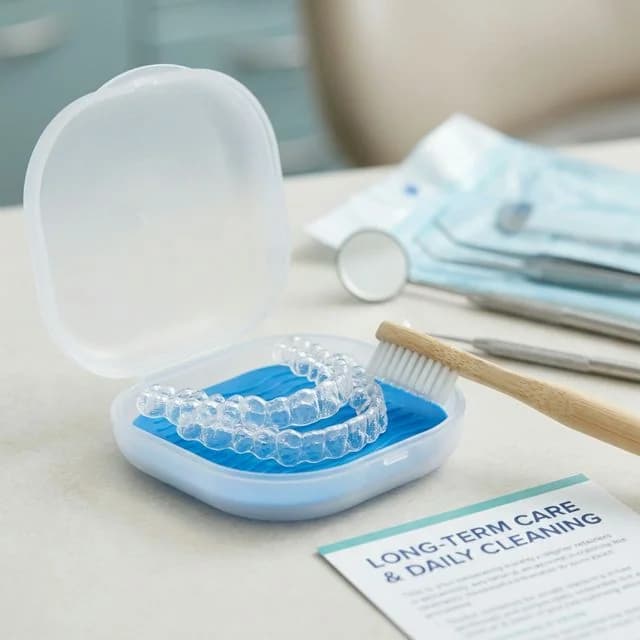
- Rinse every time you remove it. A quick rinse under lukewarm water prevents saliva and plaque from drying on the surface.
- Brush gently with a soft toothbrush and cool water. Never use hot water, which can warp the thermoplastic material and change the fit. Avoid toothpaste, which can scratch the surface and create microscopic grooves where bacteria accumulate.
- Soak once or twice a week. A denture-cleaning tablet (like Retainer Brite or Polident) dissolved in lukewarm water eliminates bacteria and odor without damaging the material.
- Store in the case. Wrapping a retainer in a napkin is the number-one way retainers end up in the trash, we hear this story from MetroWest families multiple times a year.
- Bring it to every dental checkup. Dr. Fatima and the hygiene team will inspect your retainer for wear, cracks, or fit changes during your regular cleaning appointments.
- Replace when necessary. Most removable clear retainers last one to three years with proper care. If yours cracks, yellows significantly, or no longer fits snugly, it is time for a replacement. The cost of a new retainer is far less than retreatment.
What Happens Without a Retainer?
Patients who stop wearing their retainer often notice subtle crowding returning within a few months, especially in the lower front teeth, where the teeth are smaller, the roots are shorter, and the arch is more susceptible to the forward-pushing forces of the tongue and lower lip.
The progression typically looks like this:
- Weeks 1–4: Minor shifting that you may not notice visually but can feel as slight tightness when you put the retainer back in.
- Months 1–6: Visible rotation or crowding begins, particularly in the lower incisors. Your retainer may still fit, but it feels tight and uncomfortable.
- Months 6–12: Crowding becomes noticeable to others. The retainer may no longer fit at all.
- Year 1+: Relapse may be significant enough to require a second round of aligner treatment, additional expense and time that was completely avoidable.
At our Marlborough office, Dr. Fatima sees a steady stream of patients from Northborough, Framingham, Westborough, and across MetroWest who had braces or aligners years ago, stopped wearing retainers, and now need retreatment. In many cases, the correction is straightforward, a short round of Spark aligners can address the relapse in four to six months. But it is an expense and a time commitment that would not have been necessary with consistent retention.
Can Adults Experience Orthodontic Relapse?
Yes — we see it all the time. Many adults who had braces as teenagers and stopped wearing retainers notice crowding returning in their 30s, 40s, or beyond. Age-related changes in bone density, ongoing bite forces, the anterior component of force, and years without retention all contribute to gradual shifting.
The AAO notes that adult teeth can shift at any age, which is why lifetime retainer wear is now the standard recommendation regardless of when orthodontic treatment was completed. A 2021 longitudinal study in the Journal of Dental Research followed adults for 20 years after orthodontic treatment and found that tooth positions continued to change throughout the study period in patients who were not wearing retainers, even two decades after treatment.
If you are an adult who had orthodontic treatment years ago and your teeth have shifted, a consultation with Dr. Fatima can determine whether a short course of clear aligners can restore your alignment, and what retention plan would prevent relapse from recurring.
Retainers and Night Guards: Do You Need Both?
If you grind your teeth at night (bruxism), your retainer alone may not provide sufficient protection. A clear retainer is thin enough to maintain tooth position but not robust enough to absorb heavy grinding forces. A custom night guard is fabricated from thicker, more durable material specifically designed to absorb and distribute clenching and grinding forces, preventing enamel wear, crown fracture, and TMJ strain.
For patients who grind, Dr. Fatima may recommend one of the following approaches:
- Retainer first, then night guard. Wear the retainer nightly during the first six months of intensive retention, then transition to a night guard that is fabricated to fit your corrected tooth positions. The night guard passively holds teeth in place while also protecting against grinding forces.
- Combined retainer-night guard appliance. Some patients benefit from a single appliance that serves both functions, maintaining alignment and providing occlusal protection.
- Alternating schedule. Wear the retainer three to four nights per week and the night guard on the remaining nights, ensuring your teeth get retention while also getting bruxism protection.
Dr. Fatima discusses this at your retention planning appointment so there is no confusion about your nightly routine.
Our Retention Protocol at Innova Smiles
At Innova Smiles, retention planning starts on day one, not as an afterthought when treatment ends. Here is how we approach it for patients across MetroWest MA:
- Before your final tray. We take digital scans or impressions for your retainers while you are still wearing your last set of aligners. This ensures the retainers are ready the moment treatment ends, with zero gap in retention.
- Retainer delivery day. You receive your retainer(s) and we walk you through fit, wear schedule, cleaning, and storage. You leave with written instructions and our direct phone number for questions.
- First retention check (4–6 weeks). Dr. Fatima examines your teeth for stability and confirms the retainer fits properly.
- Ongoing checks. We evaluate retention at your regular six-month cleaning appointments, inspecting retainer fit, checking for tooth movement, and confirming your wear schedule is working.
- Replacement as needed. When your retainer shows signs of wear, cracking, or poor fit, we fabricate a replacement quickly so you are never without protection.
The retainer is included in your aligner treatment plan at Innova Smiles, there is no surprise charge at the end.
The Bottom Line on Retainers After Orthodontic Treatment
Your aligner trays did the hard work of moving teeth into position. Your retainer does the quiet, long-term work of keeping them there. Skipping the retainer phase is like training for a marathon and then not showing up on race day, all that effort, with nothing to show for it.
If you are finishing aligner treatment, starting treatment and want to understand the full process, or dealing with relapse from years without a retainer, call (508) 481-0110 or book a consultation. Dr. Fatima and the team at Innova Smiles in Marlborough will build a retention plan that fits your life and keeps your smile straight for the long term.
Frequently Asked Questions
How long do I need to wear my retainer after Spark Aligner treatment? For as long as you want your teeth to stay straight -- current consensus among orthodontic professionals is that retainer wear should be considered a lifelong commitment. Our protocol: every night during months 1 to 6 (the highest-risk relapse window), 5 to 6 nights/week during months 6 to 12, then 3 to 4 nights per week indefinitely. Skipping even a few nights during the first six months can allow measurable tooth movement.
What happens if I stop wearing my retainer after aligners? Teeth start shifting faster than most patients expect. A 2018 European Journal of Orthodontics study showed measurable anterior crowding relapse within 4 weeks of stopping retainer wear; 50% of patients had clinically visible relapse by 6 months. The progression: weeks 1 to 4 minor shifting you can feel, months 1 to 6 visible rotation/crowding (especially lower incisors), months 6 to 12 retainer no longer fits, year 1+ relapse may require a second round of aligner treatment.
Should I get a removable clear retainer or a bonded wire retainer? Each has trade-offs. Removable clear retainers (Essix-type) are virtually invisible, easy to clean, and can double as whitening trays, but they only work if you wear them consistently and typically need replacement every 1 to 3 years. Bonded wire retainers (thin steel wire glued behind front teeth) work 24/7 with zero compliance effort and can last 10+ years -- but flossing requires a floss threader and the bonding can break from biting hard foods. Many patients benefit from a combined approach: bonded retainer on the lower arch (where relapse is most common) plus a removable clear retainer on the upper.
How do I clean my retainer without damaging it? Rinse with lukewarm water every time you remove it. Brush gently with a soft toothbrush and cool water -- never hot water (warps the thermoplastic material) and avoid toothpaste (too abrasive, creates microscopic grooves where bacteria accumulate). Soak 1 to 2 times per week with a denture-cleaning tablet (Retainer Brite or Polident) in lukewarm water. Always store in the case -- wrapping a retainer in a napkin is the number-one way they end up in the trash.
Can adults who had braces years ago still get retainers if their teeth shifted? Yes. Adult teeth can shift at any age. A 2021 Journal of Dental Research study followed adults for 20 years after orthodontic treatment and found tooth positions continued to change throughout the study period in patients not wearing retainers. If your teeth have shifted, Dr. Fatima can evaluate whether a short course of Spark Aligners (often 4 to 6 months) can restore your alignment, then build a retention plan that prevents relapse from recurring.
Do I need both a retainer AND a night guard if I grind my teeth? Often, yes. A clear retainer is thin enough to maintain tooth position but not robust enough to absorb heavy grinding forces. A custom night guard is fabricated from thicker, more durable material specifically designed to absorb clenching and grinding forces, preventing enamel wear and TMJ strain. Dr. Fatima may recommend: retainer first then transition to night guard after the intensive retention window, a combined retainer-night guard appliance, or an alternating schedule (retainer some nights, night guard others).
Related Articles
- How Long Does Spark Aligner Treatment Take?
- Living with Spark Clear Aligners: Tips & Tricks
- Straight Teeth, Healthier Gums: Benefits of Spark Aligners