Featured Answer: What’s wrong with mail-order aligners?
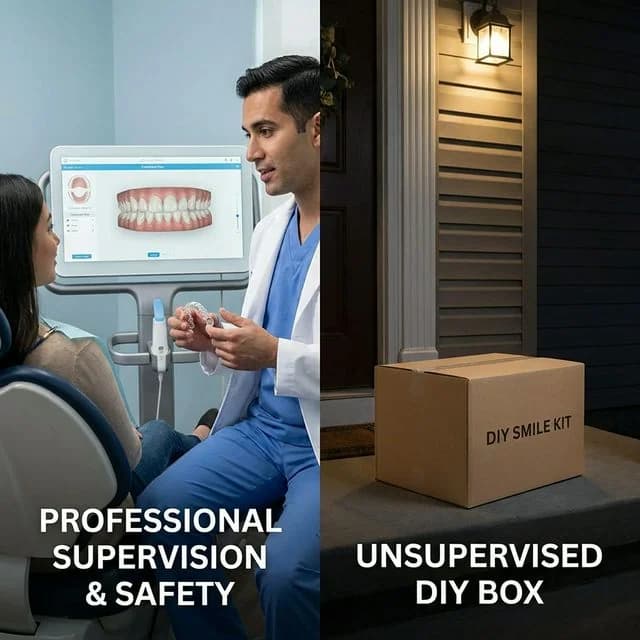
Without an in-person exam, X-rays, and professional oversight, underlying issues go undetected, leading to damage to gums, roots, and your bite. Dentist-supervised care with Spark includes comprehensive diagnostics, customized treatment planning, and regular check-ins for safe, predictable results. At Innova Smiles in Marlborough, MA, Dr. Ambereen Fatima has treated patients from across MetroWest who came to us after mail-order aligner experiences went wrong, and the repairs are almost always more expensive than supervised treatment would have been from the start.
The appeal of mail-order aligners is understandable. They promise straighter teeth at a lower price with no office visits. Companies like SmileDirectClub, byte, and Candid market aggressively to young adults, positioning orthodontic treatment as something you can do from your couch. But dentistry is a healthcare discipline, not a retail product. Moving teeth without proper diagnosis is like taking prescription medication without a doctor’s evaluation, it might work, or it might cause serious harm that cannot be undone.
The Documented Dangers of DIY Aligners
No Comprehensive Exam or X-Rays
Mail-order companies rely on at-home impression kits or brief retail-store scans. Neither approach captures what is happening beneath the gumline. Without full-mouth X-rays and a clinical exam, cavities, gum disease, bone loss, impacted teeth, and root abnormalities go undetected.
This is not a theoretical concern. Research in peer-reviewed orthodontic literature and FDA adverse event data consistently demonstrates that patients who pursue direct-to-consumer aligner treatment without professional oversight frequently have undiagnosed dental conditions—such as active periodontal disease, untreated cavities, and periapical pathology visible only on radiographs—that go undetected because at-home impression kits and virtual assessments cannot capture what is happening beneath the gumline.
Moving teeth through diseased bone or over an undiagnosed infection does not improve your smile, it accelerates damage. Teeth moved through bone with active periodontal disease can experience accelerated attachment loss, meaning you lose the very support structures keeping those teeth in your mouth.
Root Resorption — Permanent Shortening of Your Tooth Roots
Every time a tooth moves through bone, the body naturally remodels the bone around it. This process requires carefully calibrated forces. A 2020 study in the American Journal of Orthodontics and Dentofacial Orthopedics confirmed that when teeth are moved too quickly or with poorly calibrated forces, the roots themselves can shorten, a condition called external root resorption.
Mild root resorption (1 to 2 mm) occurs in most orthodontic treatment and is generally considered clinically insignificant. But moderate to severe resorption, where roots shorten by 3 mm or more, weakens the tooth’s anchor in the bone and can compromise long-term tooth survival. A supervised dentist monitors for resorption with periodic X-rays at 6 and 12 months and adjusts the treatment plan, slowing movement, pausing treatment, or modifying force vectors, if early signs appear. Mail-order companies have no mechanism for this kind of mid-treatment oversight. By the time a patient notices a problem (increased tooth mobility, for example), the damage is often irreversible.
Bite Problems and TMJ Dysfunction
This is the risk that most mail-order patients do not anticipate. Aligning the front teeth for cosmetics without addressing how the upper and lower arches fit together can create entirely new bite problems. The front teeth may look straighter, but the posterior teeth no longer interdigitate properly, creating premature contacts, open bites, crossbites, and uneven force distribution during chewing.
A 2022 survey of AAO member orthodontists (conducted November 2021–January 2022) reported that 77 percent of respondents had treated patients for complications arising from direct-to-consumer aligner treatment, with the most common issues being posterior open bite (teeth that no longer touch when biting), anterior flaring, and new TMJ pain. Patients have reported developing clicking, locking, headaches, and chronic jaw pain after completing mail-order treatment, symptoms they did not have before starting.
The American Dental Association (ADA) and the FDA have both issued formal warnings about the risks of unsupervised orthodontic treatment. The ADA’s official position states that moving teeth without proper diagnosis can cause "irreversible and expensive damage." The FDA issued a safety communication specifically about at-home dental impression kits, warning consumers of risks including tooth loss, gum recession, and bite changes.
Poor Impressions and Ill-Fitting Trays
At-home impression kits are notoriously difficult to use correctly. The material sets quickly, the tray must be positioned precisely, and even a slight error produces a distorted model. Air bubbles, incomplete captures of the gumline, and distortion from premature removal are common. At-home impression kits are notoriously difficult to use correctly, with significant variation in clinical quality and accuracy. Studies have consistently shown that inaccuracies in at-home impressions—including air bubbles, incomplete captures of the gumline, and distortion from improper removal—are common problems that directly affect aligner fit and tooth movement predictability.
An imprecise tray applies uncontrolled forces, which means teeth may move in unintended directions, tip rather than translate (bodily move), or rotate asymmetrically. Patients from Framingham, Hudson, and Northborough have visited our office with trays that were visibly misaligned to the teeth they were supposed to treat. In some cases, the trays were pushing teeth labially (outward) rather than correcting crowding.
Gum Recession — An Irreversible Consequence
When teeth are moved through bone that is too thin or when forces push teeth outside the alveolar bone envelope, the gum tissue can recede permanently. Unlike tooth movement, gum recession cannot be undone with aligners, it requires surgical grafting (a separate surgical procedure, quoted after an exam) or acceptance of permanent gum loss. Research published in Periodontology 2000 (2023) documents that gingival recession is a common complication of orthodontic treatment when lower incisors are proclined (tipped forward), particularly in patients with thin periodontal phenotypes. Mail-order treatment plans frequently employ proclination to create space without extractions, placing patients at significant risk for recession that may require surgical graft repair.
FDA Complaints and Legal Actions
The regulatory and legal landscape around mail-order aligners paints a concerning picture:
FDA adverse event reports: As of 2023, the FDA’s MAUDE database contained over 1,500 adverse event reports related to direct-to-consumer orthodontic products. Reported complications include severe tooth pain, gum infection, tooth loss, bite misalignment, and TMJ dysfunction. The FDA issued a formal safety communication in November 2020 advising consumers that "teeth straightening can involve significant risk" and recommending professional dental involvement in treatment.
SmileDirectClub’s collapse: In December 2023, SmileDirectClub filed for Chapter 11 bankruptcy and ceased operations, leaving thousands of patients mid-treatment with no provider, no refund, and no way to complete their aligner sequences. Patients across Massachusetts, including MetroWest, were left with partially moved teeth and no clinical support. Several of these patients have come to our Marlborough office for rescue treatment.
Class action lawsuits: Multiple class action lawsuits were filed against SmileDirectClub in federal courts alleging that the company misrepresented the safety and efficacy of unsupervised treatment, failed to diagnose contraindicated conditions, and did not adequately disclose risks to consumers. The California Dental Association and dental boards in multiple states also investigated whether the company’s business model constituted unlicensed practice of dentistry.
State dental board actions: Several state dental boards, including those in California, Georgia, and Alabama, have issued cease-and-desist orders or proposed regulations requiring in-person clinical examinations before any orthodontic treatment can begin, even if the aligners themselves are manufactured remotely.
Real Consequences We Have Seen at Innova Smiles
While we cannot share specific patient details, common issues we have encountered in patients who tried mail-order aligners before coming to our Marlborough office include:
- Front teeth that became more flared outward rather than straighter, because the treatment plan used proclination to resolve crowding without addressing the arch length discrepancy
- New gaps opening between teeth that were previously in contact, caused by uncontrolled tipping movements
- Gum recession around lower front teeth that were moved through thin bone without CBCT verification of bone thickness
- Posterior open bite, back teeth that no longer touch when biting down, because the aligner trays acted as a bite splint and intruded the posterior teeth
- Bite discomfort and TMJ clicking that required comprehensive orthodontic retreatment, sometimes including braces
- Wasted investment in a treatment that needed to be started over from scratch, plus the additional cost of corrective treatment
The cost of retreatment after failed mail-order aligners often equals or exceeds what supervised aligner treatment would have cost in the first place.
Supervised vs. Unsupervised: A Direct Comparison
What Proper Aligner Treatment Actually Includes
When you choose supervised care with Spark at our Marlborough office, your treatment includes:
- Full diagnostic workup: Digital X-rays, 3D CBCT scans when indicated, intraoral photos, and a thorough clinical exam of your teeth, gums, and jaw joints. Any active dental disease is treated before orthodontic movement begins.
- Custom treatment planning: Dr. Fatima designs your tooth movements in 3D software, reviewing every stage for biomechanical safety and aesthetic outcomes. She modifies the algorithmically generated plan based on clinical judgment, something a remote technician cannot do.
- Precision attachments and elastics: When your case requires complex movements like rotation, extrusion, or arch expansion, we bond small composite attachments to specific teeth and use elastics to guide jaw positioning. These biomechanical tools are essential for predictable tooth movement and are impossible to deliver through a mail-order model.
- Interproximal reduction (IPR): When needed, Dr. Fatima precisely reduces 0.1 to 0.5 mm of enamel between teeth to create space without proclination. This technique avoids the flaring of front teeth that is common in mail-order plans.
- Regular progress checks: Every six to eight weeks, we verify that your teeth are tracking correctly. If a tooth is not following the predicted path, we intervene immediately, rebonding attachments, adding auxiliaries, or ordering mid-course correction trays.
- Post-treatment retention: A custom-fit retainer and a follow-up schedule to keep your results stable for life. Without a proper retention protocol, teeth begin drifting back toward their original positions within weeks.
For more on how we approach aligner treatment and what sets Spark apart, read our comparison of Spark vs. Invisalign.
When Mail-Order Fails: The Rescue Treatment Process
If you are a MetroWest resident currently in mail-order aligner treatment, or if you completed it and are unhappy with the results, here is what to expect when you come to Innova Smiles for evaluation:
- Comprehensive exam and imaging: We take full-mouth X-rays and a CBCT scan to assess root health, bone levels, and any undiagnosed pathology.
- Damage assessment: Dr. Fatima evaluates what has changed since you started mail-order treatment: root resorption, gum recession, bite changes, and tooth mobility.
- Stabilization: If teeth are mobile or the bite is unstable, we stabilize the situation before beginning corrective treatment.
- New treatment plan: A comprehensive plan is designed to correct the current position and achieve the result you originally wanted. This may involve Spark aligners, braces, or a combination of orthodontics and restorative work.
- Restorative work if needed: Gum grafting for recession, bonding for chipped teeth, or crowns for structurally compromised teeth are addressed as part of the overall plan.
Frequently Asked Questions About Mail-Order Aligners
Q: Are mail-order aligners FDA-approved? The aligner material itself may be FDA-cleared as a Class II medical device, but the FDA does not regulate the clinical treatment plan or the absence of a supervising dentist. The FDA has received over 1,500 adverse event reports about direct-to-consumer orthodontic products and issued a formal safety communication in 2020 recommending professional oversight for any orthodontic treatment.
Q: Can I switch from mail-order aligners to dentist-supervised treatment? Yes, and many patients do. However, correcting damage from unsupervised treatment often requires a new comprehensive treatment plan, additional imaging, and sometimes restorative work (gum grafting, bonding, or crowns) before orthodontics can restart safely. The total cost of correction frequently exceeds what supervised treatment would have cost initially.
Q: Why are mail-order aligners cheaper? They cut costs by eliminating in-person diagnostic exams, X-rays, progress monitoring, and professional guidance. These are not optional luxuries, they are essential clinical safeguards. The lower price reflects the absence of proper diagnosis, mid-treatment monitoring, and biomechanical tools like attachments and elastics that are necessary for safe, predictable tooth movement.
Q: What should I look for in a supervised aligner provider? Look for a provider who takes full-mouth X-rays or CBCT scans, performs a clinical exam of your teeth, gums, and jaw joints, uses 3D treatment planning software, schedules regular in-person progress checks, and offers a clear retention plan after treatment. Ask about their credentials, at Innova Smiles, Dr. Fatima holds both FICOI and FAAIP fellowships and has extensive training in orthodontic biomechanics.
Q: SmileDirectClub went bankrupt. What happens to patients who were mid-treatment? Patients who were in active treatment when SmileDirectClub ceased operations in December 2023 lost access to their remaining aligner trays, their treatment records, and any refund. Many of these patients need corrective treatment from a supervising dentist. If you are in this situation, call our office at (508) 481-0110, we can obtain your records (if available from the bankruptcy trustee) and design a plan to complete your treatment safely.
Q: My mail-order results look fine. Should I still get checked? Yes. Some of the most concerning complications, root resorption, bone loss, and early gum recession, are not visible to the naked eye. A periapical X-ray can detect root shortening, and a clinical exam can identify early mobility or pocket depth changes that signal trouble ahead. A post-treatment evaluation is a small investment in confirming that your results look right AND hold up structurally.
The Bottom Line
Straightening your teeth is a medical procedure that involves moving biological structures through living bone. It requires imaging, diagnosis, treatment planning, and monitoring, the same level of professional oversight as any other healthcare treatment. The few hundred dollars in apparent savings offered by mail-order companies are rarely worth the risk of irreversible root resorption, gum recession, or bite dysfunction, and the cost of fixing these problems nearly always exceeds the cost of doing it right the first time.
Patients throughout MetroWest, from Sudbury and Southborough to Westborough and Shrewsbury, trust Innova Smiles for supervised aligner care that prioritizes long-term dental health over short-term convenience.
Choose supervised aligner care. Call (508) 481-0110 or book now.
Related Articles
- Clear Aligners or Braces? How to Choose
- Am I Too Old for Clear Aligners? Why Adults Choose Spark
- Spark Aligners vs. Braces for Adults
Related Services
How our pricing works
Clear aligners (Spark™) & comprehensive orthodonticsOur fee range$1,250–$6,000
- Your aligner fee includes every tray in your treatment plan and two rounds of refinements. Retainers are not included and are priced separately, so ask for them on your written estimate. Dr. Fatima plans every case herself and uses 5D smile simulation to show your projected results before you commit.
- Many employer plans include an orthodontic lifetime benefit that contributes toward aligner treatment; when yours does, the fee is the plan's negotiated rate. We check your eligibility before you start.
- 0% APR financing through CareCredit or Cherry spreads the cost from about $52/mo with nothing down.*
- No insurance? Our in-house membership plan (from $395/yr) includes your preventive care and takes a flat 20% off our standard fee for this treatment.
- The top of the range is our standard fee; the low end is what a patient whose plan covers the treatment typically pays before their share is applied. Retainers are not included and are priced separately.
- Your exact fee is confirmed in writing at your visit, after your exam and after we have checked your insurance — never a surprise afterward.
- Patients aged 65 and older get 10% off all dental treatments. Mention it when booking and we'll apply it automatically.
*Estimated payment is the lowest treatment cost ÷ 24 months at 0% APR with $0 down. Financing is provided by third-party lenders (e.g. CareCredit, Cherry), not by Innova Smiles, and is subject to credit approval — not all applicants qualify. Your actual cost, term, and monthly payment depend on your treatment plan and approved offer.
Sources & Further Reading
- ADA Policy on Direct-to-Consumer Dental Services — American Dental Association
- Adverse Events Related to Direct-To-Consumer Sequential Aligners—A Study of the MAUDE Database — Dentistry Journal (Basel), University of Michigan School of Dentistry