Featured Answer: What are snap-on dentures and how much do they cost?
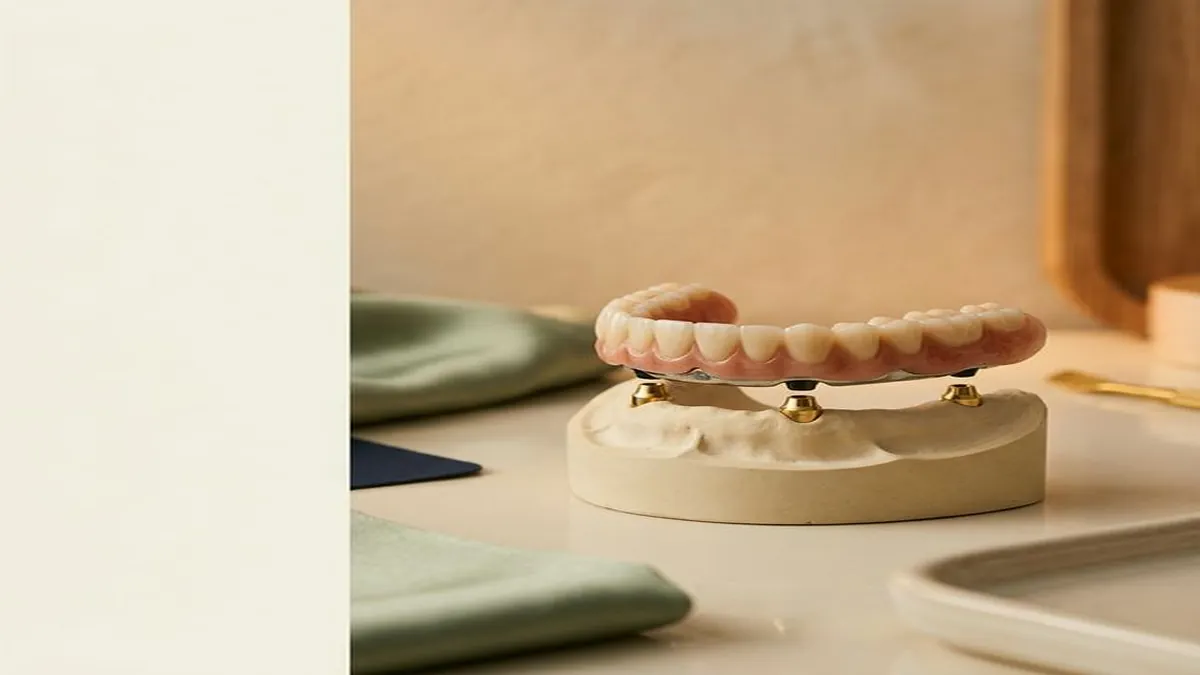
Snap-on dentures, clinically known as implant-retained overdentures, are removable dentures that click onto two to four dental implants embedded in the jawbone. Unlike conventional dentures that rely on suction, adhesive paste, and the shape of the gum ridge for retention, snap-on dentures lock firmly onto implant attachments and stay in place during eating, speaking, and laughing. You remove them at night for cleaning. They cost between $5,000 and $15,000 per arch depending on the number of implants, the attachment system used, and whether a new denture must be fabricated or an existing denture can be retrofitted. This positions them between the low cost of conventional dentures ($1,500 to $3,500) and the higher investment of a fixed All-on-4 bridge ($15,000 to $30,000 per arch).
At Innova Smiles in Marlborough, MA, I place snap-on denture implants regularly for patients from Shrewsbury, Westborough, Hudson, and throughout the MetroWest area. These patients typically share a common story: they have been wearing conventional dentures for years, have tried multiple adhesives, and are tired of the daily frustration of a prosthetic that moves when they eat or talk. Snap-on dentures solve that problem without requiring the surgical complexity or cost of a fixed full-arch bridge.
Snap-In Dentures vs. Snap-On Dentures: Are They the Same Thing?
Yes — "snap-in dentures" and "snap-on dentures" are two names for the exact same treatment: a removable denture that clicks onto dental implants. Patients and dental offices use the terms interchangeably, along with "implant-retained overdenture" and "implant-supported denture." Whether you searched for snap-in dentures or snap-on dentures, everything on this page — how they work, how many implants they need, the cost ranges, and who qualifies — applies to you.
The only distinction is wording: some people say "snap-in" for the everyday feel of snapping the denture in and out each day, while "snap-on" describes the same click-on attachment mechanism. There is no difference in the appliance, the implants, or the cost. At Innova Smiles in Marlborough, MA, Dr. Fatima places snap-in dentures using the same implant-retained approach described below. To estimate your own case, try our dental implant cost calculator or explore dental implants and implant-supported denture options.
How Snap-On Dentures Work
The concept is simple: dental implants provide the retention that adhesive and suction cannot. The implants are placed in the jawbone, and after healing, attachment hardware is added to the top of each implant. The denture has corresponding attachment housings embedded in its base. When you press the denture into place, the attachments click together, similar to how a snap on a jacket works, creating a firm, secure connection.
During normal function (eating, speaking, laughing), the denture stays locked in place. To remove it, you apply a gentle pulling force with your thumbs at the posterior edges, and the attachments release. This daily removal is essential for cleaning the attachments, the implant abutments, and the underlying gum tissue.
Attachment Systems
Three main attachment systems are used for snap-on dentures. Each has distinct advantages, and the choice depends on anatomy, budget, and the number of implants.
Locator Attachments
Locators are the most commonly used attachment system today. They consist of a low-profile titanium male component on the implant abutment and a nylon female insert within the denture housing. Locators are:
- Self-aligning, which makes inserting the denture easy even for patients with limited dexterity
- Tolerant of up to 40 degrees of implant divergence, meaning implants do not need to be perfectly parallel
- Simple to maintain, the nylon inserts come in different retention strengths (color-coded) and are replaced chairside in about 10 minutes when retention decreases
- Compatible with both two-implant and four-implant configurations
Most of the snap-on denture cases I complete at Innova Smiles use the Locator system because of its reliability, ease of use for patients, and uncomplicated maintenance profile.
Bar-Clip Systems
A milled or cast metal bar connects two or more implants, and the denture clips onto the bar using metal or nylon clips embedded in the denture base. Bar systems provide:
- Greater retention than individual locator attachments
- Better load distribution across implants (the bar splints the implants together)
- Increased stability for patients with significant ridge resorption
The trade-off is higher fabrication cost (the custom bar adds $1,500 to $3,000 to the total), slightly more complex hygiene (patients must clean under the bar with floss threaders or specialized brushes), and the need for a minimum of two implants that are far enough apart to support a bar span.
Bar systems are most commonly used in the upper jaw, where bone density is lower and additional retention is needed to compensate for gravity working against the denture.
Ball Attachments
Ball attachments use a spherical metal head on the implant abutment that snaps into a corresponding socket in the denture. They were among the first attachment systems developed for overdentures and are still used in some cases. However, ball attachments are less tolerant of implant angulation than locators and tend to wear more quickly, requiring more frequent maintenance. Most practitioners, myself included, have largely transitioned to locators for new cases.
How Many Implants Do Snap-On Dentures Need?
The number of implants depends on which jaw is being treated and the amount of bone available.
Lower Jaw: 2 to 4 Implants
The lower jaw is where snap-on dentures make the biggest difference, because conventional lower dentures are notoriously unstable. The narrow, horseshoe-shaped lower ridge offers minimal surface area for suction, and the tongue constantly displaces the denture during function.
Two-implant overdenture: The 2002 McGill Consensus Statement, endorsed by prosthodontists worldwide, declared that a two-implant overdenture should be the minimum standard of care for the edentulous lower jaw. Two implants placed in the canine region (the area of the densest lower jaw bone) provide enough retention to eliminate the need for adhesive and dramatically reduce denture movement. This is the most cost-effective implant-supported option.
Four-implant overdenture: Adding two more implants (typically in the premolar region) increases stability, distributes chewing forces more evenly, and allows the use of a bar-clip system. Four lower implants are recommended for patients with significant ridge resorption or higher functional demands.
Upper Jaw: 4 Implants (Minimum)
The upper jaw presents different challenges. Upper bone is less dense than lower bone (the maxilla is predominantly trabecular bone, while the mandible has a thicker cortical layer), and gravity works against an upper denture, it is pulling the denture downward away from the palate rather than helping it stay in place.
For these reasons, upper snap-on dentures typically require a minimum of four implants. In some cases where bone density is marginal, I recommend six implants for the upper arch. The additional implant sites provide more retention points and better force distribution, which compensates for the lower bone density.
An important benefit of an implant-supported upper denture: the palatal coverage can be reduced or eliminated. Conventional upper dentures must cover the entire palate to create suction. This palatal coverage interferes with taste sensation (because taste buds on the palate are blocked), affects speech, and triggers the gag reflex in some patients. With sufficient implant retention, the denture can be designed with an open palate or significantly reduced palatal coverage, a quality-of-life improvement that patients consistently describe as transformative.
Comparison: Traditional Dentures vs. Snap-On vs. Fixed All-on-4
This is the comparison most patients want to see. Each option occupies a different point on the spectrum of cost, stability, and maintenance.
The Snap-On Denture Procedure: Step by Step
Here is how the process unfolds at Innova Smiles, from initial consultation to final delivery.
Step 1: Consultation and CBCT Imaging
During the initial consultation, I take a full 3D cone beam CT scan. This 15-second scan reveals bone width, height, density, and proximity to the inferior alveolar nerve (lower jaw) and maxillary sinus (upper jaw). I use the scan to determine how many implants the bone can support, where they should be positioned, and whether any preparatory procedures, such as bone grafting or tooth extraction, are needed first.
I also evaluate the patient's existing denture. If it fits well and is in good condition, it can often be retrofitted with attachment housings rather than fabricating a new denture from scratch, which saves both time and cost.
Step 2: Implant Placement
Implants for snap-on dentures are placed under local anesthesia with optional . For most lower two-implant cases, the procedure takes 45 to 60 minutes. Four-implant cases typically take 60 to 90 minutes.
In many cases, I use a flapless technique, drilling directly through the gum tissue into the bone without making an incision. This reduces bleeding, swelling, and healing time compared to traditional flap surgery. However, if the bone anatomy requires direct visualization, a small flap is raised and closed with sutures.
Patients from Southborough and Hopkinton are sometimes surprised at how quick the procedure is. The implant placement itself, the actual drilling and threading of the implant into the bone, takes only a few minutes per implant. The rest of the appointment is preparation, positioning, and verification.
Step 3: Healing Period
For standard-diameter implants, the typical healing period is three to four months for the lower jaw and four to six months for the upper jaw. During this time, osseointegration occurs — the bone grows directly onto the titanium implant surface, creating a biological bond strong enough to support full chewing loads for decades. Patients wear their existing conventional denture during this period, though it may need to be adjusted to avoid pressure on the implant sites.
In selected cases with excellent primary stability (measured at placement), I can attach temporary attachments and modify the denture for immediate loading, meaning the patient walks out with a stabilized denture the same day. This is more common with lower two-implant cases and with mini dental implants.
Step 4: Attachment Placement and Denture Modification
Once the implants are fully integrated, the attachment abutments are placed. If locators are being used, the abutments are screwed into the implant platforms and the corresponding housings are picked up directly into the denture base using acrylic at chairside. This "pick-up" appointment typically takes 60 to 90 minutes.
If a new denture is being fabricated (rather than retrofitting the existing one), additional appointments are needed for impressions, bite registration, tooth try-in, and final delivery, typically four to five appointments over three to four weeks.
Step 5: Final Adjustments
After the snap-on denture is delivered, I see the patient for one to two follow-up appointments to fine-tune the bite, adjust any pressure points, and verify that the attachment retention is appropriate. Some patients prefer lighter retention initially and gradually transition to stronger inserts as they become comfortable with the snap-in/snap-out motion.
Cost Breakdown for Snap-On Dentures
Understanding where the money goes helps patients compare options more accurately.
Total estimates by configuration:
- Lower arch, 2 implants + locators + denture retrofit: $5,000–$8,500
- Lower arch, 4 implants + locators + new overdenture: $9,000–$15,000
- Upper arch, 4 implants + bar system + new overdenture: $12,000–$18,000
These ranges reflect typical Massachusetts pricing. I provide itemized cost breakdowns during consultations so every patient knows exactly what each component costs before treatment begins.
Who Is a Good Candidate for Snap-On Dentures?
Snap-on dentures are an excellent option for a specific patient profile. Here is who benefits most:
Current denture wearers frustrated with loose fit. If your lower denture slides when you eat or talk, and adhesive is a daily frustration, snap-on dentures directly address your primary complaint. The improvement in stability is immediate and dramatic.
Patients who want implant support but prefer a removable option. Some patients do not want a fixed (permanent) prosthesis. They like the ability to remove their teeth at night, clean them thoroughly, and have the oral tissue "rest." Snap-on dentures accommodate this preference while still providing implant-level stability during the day.
Patients who cannot afford All-on-4. A fixed full-arch bridge is a $15,000 to $30,000 per arch investment. Snap-on dentures with two lower implants can be completed for $5,000 to $8,500, a meaningful upgrade from conventional dentures at roughly one-quarter the cost of a fixed bridge.
Patients with some bone loss but not extreme atrophy. Snap-on dentures require enough bone to place two to four implants. For patients with moderate ridge resorption, which is most long-term denture wearers, there is typically enough bone remaining, particularly in the anterior (front) region of the lower jaw where bone resorption is slowest.
Patients who want easier cleaning than a fixed bridge. Fixed All-on-4 bridges require water flossers, floss threaders, and professional cleanings every four to six months because the prosthesis cannot be removed. Snap-on dentures are removed nightly and cleaned like a conventional denture, a simpler routine that many patients prefer, especially those with limited dexterity.
Benefits Over Traditional Dentures: What the Research Shows
The clinical evidence for implant-retained overdentures is extensive and unambiguous.
- Bite force: A study in the Journal of Prosthetic Dentistry found that patients with two-implant overdentures generated bite forces 60 to 80 percent of natural dentition, compared to 20 to 25 percent for conventional dentures. Patients from Natick and Framingham who have made this transition consistently tell us that the difference in eating ability was larger than they expected.
- Nutritional improvement: A 2019 study in Clinical Oral Implants Research found that patients who transitioned from conventional dentures to implant overdentures increased their intake of fruits, vegetables, and lean proteins, foods that require effective chewing, within six months of delivery.
- Patient satisfaction: A systematic review in the International Journal of Prosthodontics (2015) analyzed 24 studies and found that patient satisfaction scores were significantly higher for implant overdentures compared to conventional dentures across every measured domain: comfort, stability, chewing ability, speech, appearance, and overall quality of life.
- Bone preservation: While snap-on dentures do not preserve bone as effectively as fixed bridges (because the denture base still rests on and compresses the gum tissue between implants), the implant sites themselves maintain bone volume. A 10-year study in the Journal of Oral Rehabilitation showed that bone loss around overdenture implants averaged only 0.2 to 0.5 mm, clinically negligible and far less than the 0.5 to 1.0 mm per year of ridge resorption seen with conventional dentures.
Maintenance and Long-Term Care
Snap-on dentures require consistent maintenance for long-term success. Here is the routine I recommend:
Daily Care
- Remove the denture every night before bed
- Brush the denture with a denture brush and non-abrasive cleanser (not regular toothpaste, which is too abrasive for denture acrylic)
- Soak overnight in a denture cleaning solution
- Clean the implant abutments and attachment housings with a soft brush
- Gently brush the gum tissue over the ridge with a soft toothbrush to remove bacteria and stimulate circulation
- Rinse the denture thoroughly before reinserting in the morning
Periodic Maintenance
- Attachment inserts (O-rings or nylon caps): Replace every 12 to 18 months, or when retention decreases noticeably. This is a simple chairside procedure — I pop out the old insert and snap in a new one. Cost: $50 to $75 per housing.
- Denture reline: Even with implant support, the gum tissue and bone between implants change shape over time. A reline every two to three years restores the fit of the denture base against the tissue. Cost: $300 to $600.
- Denture replacement: The acrylic denture itself has a finite lifespan, typically five to eight years. The implants last much longer (15 to 25+ years), but the denture component will eventually need replacement due to wear, staining, and acrylic fatigue.
Professional Checkups
I recommend six-month checkups for snap-on denture patients. During these visits, our team:
- Checks implant stability and probes around the implant sites for signs of peri-implant inflammation
- Evaluates attachment retention and replaces inserts if needed
- Examines the denture for cracks, wear, and fit
- Cleans the implant abutments and surrounding tissue professionally
- Takes periodic X-rays to monitor bone levels around the implants
Insurance and Financing
Insurance coverage for implant overdentures varies. Here is the typical picture for MetroWest Massachusetts patients:
- Dental PPO plans often cover a portion of the denture component (50 percent is common) but may or may not cover the implant fixtures. Delta Dental, MetLife, and Cigna PPO plans vary by employer group, we verify benefits before treatment begins.
- Medicare does not cover dental implants or dentures in most cases.
- Medical insurance may cover implant placement if tooth loss resulted from trauma, cancer, or a congenital condition. We assist with medical cross-coding when applicable.
- Financing: We offer third-party financing through CareCredit and Proceed Finance, with plans ranging from 0 percent APR for 12 months to extended terms of 24 to 60 months. For many patients, the monthly payment for a two-implant snap-on denture is less than the monthly cost of denture adhesive, reliners, and replacement dentures over the same period, making it cost-neutral or even cost-saving in the long run.
Frequently Asked Questions
Can my existing denture be converted to a snap-on denture? In many cases, yes. If your current denture fits well and is in good structural condition, I can retrofit it with attachment housings after the implants heal. This saves the cost and time of fabricating a new denture. If the denture is worn, cracked, or poorly fitting, a new overdenture is recommended.
How long do the implants last? The implants themselves, the titanium screws in the bone, are designed for long-term service with proper care. Published studies show survival rates above 95 percent at 10 years for overdenture implants. The denture and attachment components need periodic replacement, but the implants provide a stable foundation.
Is the procedure painful? Most patients report mild to moderate soreness for two to three days after implant placement, similar to having a tooth extracted. Over-the-counter ibuprofen manages the discomfort effectively for most patients. The flapless technique used for many overdenture cases results in less post-operative discomfort than traditional flap surgery.
Can I eat normally with snap-on dentures? You will be able to eat foods that were impossible with conventional dentures, apples, corn on the cob, steak, raw vegetables, and nuts. The only caution is that extremely hard or sticky foods (like hard candy or caramel) should still be avoided to protect both the denture and the attachments.
What if an implant fails? Implant failure rates for overdentures are low (less than 5 percent at 10 years), but if an implant does fail, it can usually be replaced after a healing period. In many cases, the remaining implants can continue to support the denture while the replacement site heals.
Tired of loose dentures? Call Innova Smiles at (508) 481-0110 or schedule a consultation to find out if snap-on dentures are right for you. Dr. Fatima will review your CBCT scan and walk you through every option, from conventional dentures to implant overdentures to fixed full-arch bridges.
Related Articles
- Dentures vs. Implants: Cost, Comfort & Which Is Better
- How Much Do Dentures Cost? Full & Partial Prices
- Dental Implant vs. Bridge: Best Solution for a Missing Tooth
- The Real Cost of Dental Implants in Massachusetts
Related Services
Sources & Further Reading
- The McGill consensus statement on overdentures. Mandibular two-implant overdentures as first choice standard of care for edentulous patients — PubMed/National Center for Biotechnology Information