
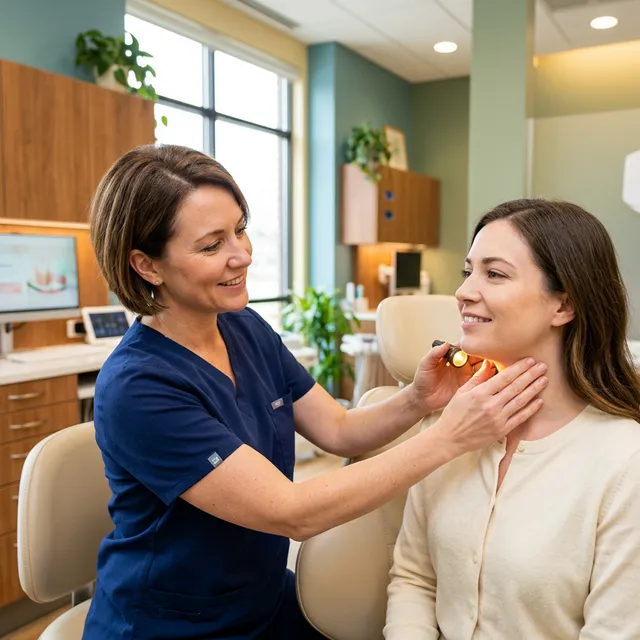
Featured Answer: Are oral cancer screenings really necessary?
Yes. Oral cancer screenings are quick, non-invasive, and built into every routine exam at Innova Smiles in Marlborough, MA. Dr. Fatima checks your lips, cheeks, tongue, floor of mouth, palate, and throat for lesions or tissue changes that warrant closer evaluation. Patients from Westborough, Sudbury, and across MetroWest get this screening at every visit.
Most patients don't realize their dentist is often the first clinician to spot oral cancer. Your physician may examine your throat during an annual physical, but a dentist evaluates every soft-tissue surface in the oral cavity twice a year — making the dental office the front line of detection.
Why Early Detection Matters
When oral cancer is detected at an early, localized stage, outcomes are generally better than when diagnosis is delayed and the cancer has spread. That is the clinical argument for routine screening. Because early-stage oral cancers are often painless and easy to overlook, professional screenings are one practical way to catch changes early enough for timely referral and diagnosis.
The American Cancer Society estimates that approximately 60,480 Americans will be diagnosed with oral cavity or oropharyngeal cancer in 2026. It is not a rare disease, and it does not only affect smokers or heavy drinkers. Awareness, regular dental exams, and prompt evaluation of suspicious changes matter.
The Massachusetts Context
According to data from the Massachusetts Cancer Registry, oral cavity and pharynx cancers account for approximately 3 percent of all new cancer diagnoses in the Commonwealth. MetroWest communities including Marlborough, Framingham, Sudbury, and Westborough have demographic profiles (aging population, moderate alcohol consumption patterns) that make routine screening particularly valuable. Access to care is strong in our region, which means early detection is achievable -- the barrier is simply making sure the screening happens at every dental visit.
Risk Factors for Oral Cancer
While anyone can develop oral cancer, certain factors increase your risk. Understanding these helps you and your dentist determine how closely to monitor specific areas.
- Tobacco use: Cigarettes, cigars, pipes, and smokeless tobacco are the leading risk factors. The National Cancer Institute reports that smokers are 5 to 10 times more likely to develop oral cancer than non-smokers, with risk increasing proportionally to the duration and intensity of use. Smokeless tobacco (chewing tobacco, snuff) concentrates carcinogens directly against the oral mucosa, and the Surgeon General's report identifies it as a cause of cancers of the oral cavity and pancreas.
- Heavy alcohol consumption: Regular heavy drinking significantly increases risk, especially when combined with tobacco. A meta-analysis published in Cancer Epidemiology, Biomarkers & Prevention (Hashibe et al., 2009) found that the combined effect of tobacco and alcohol is multiplicative rather than merely additive -- meaning the two together increase risk far more than either one alone.
- Human papillomavirus (HPV): The CDC reports that HPV is now responsible for approximately 70 percent of oropharyngeal cancers in the United States, primarily HPV-16. HPV-related oropharyngeal cancers have been rising sharply over the past two decades, particularly among men aged 30 to 50 who may have no traditional risk factors (non-smokers, moderate or non-drinkers). A study in the Journal of Clinical Oncology (Chaturvedi et al., 2011) projected that HPV-positive oropharyngeal cancers would surpass cervical cancer incidence by 2020 -- a prediction that has proven accurate.
- Prolonged sun exposure: UV radiation increases the risk of lip cancer, especially the lower lip. Outdoor workers, golfers, and anyone who spends significant time in the sun without lip protection (SPF lip balm) should be aware of this risk. Massachusetts residents who spend time on Cape Cod, at lakes in MetroWest, or on golf courses in the I-495 corridor accumulate meaningful UV exposure over decades.
- Prior cancer history: A previous oral cancer diagnosis increases the likelihood of recurrence or a second primary tumor. The risk of developing a second primary is estimated at 3 to 7 percent per year, according to a review in Head & Neck (Leon et al., 2012).
- Age and gender: Oral cancer is more common in people over 40 and occurs about twice as often in men as in women. However, the HPV-related shift is changing this demographic -- younger patients without traditional risk factors are being diagnosed at increasing rates.
- Poor nutrition: Diets low in fruits and vegetables may contribute to increased risk. Antioxidants and micronutrients in produce (vitamins A, C, E, and folate) appear to play a protective role. A large European cohort study in the International Journal of Cancer (2006) found that high fruit and vegetable intake was associated with a 40 to 50 percent reduction in oral cancer risk.
- Immunosuppression: Patients taking immunosuppressive medications (organ transplant recipients, patients with autoimmune conditions) have a higher incidence of oral malignancies and should be screened with extra vigilance.
- Betel quid and areca nut: While less common in the United States, these are significant risk factors in South Asian, Southeast Asian, and Pacific Islander communities. MetroWest has a diverse population, and Dr. Fatima is familiar with the oral mucosal changes associated with betel quid use.
Even if you have no known risk factors, screening remains important because HPV-related cases are on the rise in otherwise healthy individuals who would never suspect they are at risk.
Oral Cancer Symptoms and Early Warning Signs
Between dental visits, be aware of changes in your mouth that persist for more than two weeks:
- A sore or ulcer that does not heal -- this is the most common early sign. Most canker sores resolve within 7 to 14 days. An ulcer that persists beyond two weeks, especially if painless, warrants professional evaluation.
- Red patches (erythroplakia) or white patches (leukoplakia) on the gums, tongue, or lining of the mouth -- erythroplakia carries the highest risk of malignant transformation. A study in Oral Oncology (Warnakulasuriya et al., 2007) found that erythroplakia has a malignant transformation rate of up to 51 percent, compared to 1 to 18 percent for leukoplakia.
- A persistent sore throat, hoarseness, or feeling that something is caught in the throat -- these symptoms, when lasting more than two weeks without a clear cause like a cold or allergies, can indicate oropharyngeal involvement.
- Difficulty chewing, swallowing, or moving the jaw or tongue -- any new restriction in jaw or tongue mobility is a red flag.
- Numbness or tingling in the lip, tongue, or other areas of the mouth -- sensory changes can indicate nerve involvement by a growing lesion.
- A lump or thickening in the cheek, neck, or floor of the mouth -- palpable masses, even painless ones, should be evaluated promptly.
- Unexplained bleeding in the mouth -- bleeding not associated with brushing, flossing, or gum disease may originate from a vascular tumor or ulcerated lesion.
- Significant unexplained weight loss -- unintentional weight loss of more than 5 percent of body weight over six months can be an early sign of systemic malignancy.
- Ear pain on one side -- referred otalgia (ear pain originating from the throat or tongue base) is an underrecognized symptom of oropharyngeal cancer.
- Loose teeth without obvious dental cause -- a tooth that becomes mobile in the absence of trauma or gum disease may indicate underlying bone destruction by a tumor.
If you notice any of these signs, do not wait for your next scheduled appointment. Contact our office at (508) 481-0110 right away for an evaluation.
What We Look For During Your Oral Cancer Screening
Dr. Fatima performs a systematic oral cancer screening as part of every comprehensive exam at Innova Smiles. Here is what the process involves:
Step 1: Medical History Review
We ask about tobacco and alcohol use (current and past), HPV vaccination status, family history of head and neck cancers, any medications that suppress immune function, and any symptoms you have noticed. This history helps us calibrate the screening -- a patient with multiple risk factors receives the same thorough examination, but findings are interpreted with heightened clinical suspicion.
Step 2: Extraoral Examination
Before looking inside the mouth, Dr. Fatima examines the face, neck, and skin for asymmetry, unusual moles or lesions on the lips and perioral area, and any visible masses. She palpates the cervical lymph nodes (submandibular, jugulodigastric, posterior cervical, supraclavicular) bilaterally, feeling for enlargement, firmness, or fixation. Enlarged lymph nodes can be the first detectable sign of metastatic oral cancer. A node that is hard, fixed, and painless is more concerning than a soft, mobile, tender node (which is more likely reactive or infectious).
Step 3: Intraoral Visual Examination
We carefully inspect all soft tissues of the mouth using adequate lighting and retraction:
- Lips (inner and outer vermilion)
- Buccal mucosa (inner cheeks)
- Gingiva (gums) -- upper and lower, buccal and lingual
- Tongue -- dorsum (top), lateral borders (sides), and ventral surface (underside). The lateral borders and ventral tongue are the most common sites for intraoral squamous cell carcinoma
- Floor of the mouth -- the second most common site for oral cancer
- Hard palate and soft palate
- Oropharynx (back of the throat, tonsils, base of tongue as visible)
- Retromolar trigone (the area behind the last molar)
Dr. Fatima looks for color changes (red, white, or mixed patches), ulcerations, raised lesions, textural changes, and any deviation from the normal pink, smooth, uniform appearance of healthy mucosa.
Step 4: Tactile (Palpation) Examination
We gently feel the tissues of the mouth and neck for lumps, thickening, induration (hardening), or asymmetry. Palpation can detect submucosal masses that are not visible on the surface. The floor of the mouth, tongue, and buccal mucosa are palpated bimanually (one finger inside the mouth, one hand outside) to assess tissue thickness.
Step 5: Adjunctive Screening Technologies
When indicated, we use specialized tools to enhance detection:
- Fluorescence visualization -- devices that use blue-violet light to highlight tissue autofluorescence changes. Abnormal cells absorb fluorescence differently than healthy tissue, causing suspicious areas to appear dark against a bright green background. A systematic review in Oral Oncology (Lingen et al., 2017) found that fluorescence visualization improves sensitivity for detecting dysplastic lesions, though it has a higher false-positive rate than conventional examination alone. We use it as a supplement to, not a replacement for, visual and tactile examination.
- Toluidine blue (vital staining) -- a topical dye that is selectively retained by dysplastic and malignant cells. When suspicious lesions are present, toluidine blue can help delineate their borders and guide biopsy placement.
Step 6: Documentation and Follow-Up
If any area appears suspicious, we document the finding with clinical photographs, measure the lesion, discuss it with you honestly, and arrange for a biopsy or specialist referral promptly. In MetroWest, we have referral relationships with oral and maxillofacial surgeons and head-and-neck oncologists at major Boston medical centers, ensuring rapid access to specialist evaluation when needed.
The entire screening adds only a few minutes to your routine exam and requires no special preparation on your part. As we discuss in our post about the connection between oral health and overall wellness, your dental visit is about far more than just teeth.
How Often Should You Be Screened?
The ADA recommends an oral cancer screening as part of every routine dental exam, which for most adults means at least once every six months. For patients with elevated risk factors -- current or former tobacco users, heavy alcohol consumers, history of HPV-related conditions, prior oral cancer, or immunosuppression -- more frequent monitoring may be appropriate. Dr. Fatima will discuss an individualized screening schedule based on your risk profile.
The HPV Factor: What MetroWest Patients Should Know
Human papillomavirus deserves special attention because it has fundamentally changed the epidemiology of oral cancer over the past two decades. HPV-positive oropharyngeal cancer typically presents in the tonsils or base of the tongue, tends to affect younger patients (30s through 50s), and often lacks the traditional risk factor profile of smoking and drinking. The good news: HPV-positive oropharyngeal cancers generally respond better to treatment and have higher survival rates than HPV-negative cancers, according to data published in the New England Journal of Medicine (Ang et al., 2010).
The HPV vaccine (Gardasil 9) is approved for individuals aged 9 to 45 and covers HPV-16, the strain most commonly associated with oropharyngeal cancer. While vaccination does not eliminate the need for screening, it is a powerful preventive measure. The CDC reports that HPV vaccination has reduced HPV infections by 88 percent in teen girls and 81 percent in young women since the vaccine was introduced. If you have children or young adults in your family, discuss HPV vaccination with their physician.
How to Perform a Monthly Self-Examination
Between dental visits, a simple monthly self-check can help you catch changes early:
- Stand in front of a well-lit mirror. Remove any dentures or removable appliances.
- Examine your face and neck. Look for asymmetry, swelling, or skin changes. Feel both sides of your neck for lumps.
- Pull your lower lip down and upper lip up. Look for sores, color changes, or bumps on the inner lip surfaces and gums.
- Open wide and examine the inside of each cheek. Use a finger to pull the cheek out for a better view. Look for red, white, or dark patches.
- Stick out your tongue. Look at the top surface, then tilt your head back and examine the underside. Use gauze to grip the tongue and pull it gently to each side to examine the lateral borders -- the most common site for oral cancer.
- Feel the floor of your mouth by pressing one finger under your tongue and another under your chin. Check for lumps or hardness.
- Examine the roof of your mouth (tilt head back with mouth open) and the back of your throat.
If anything persists for more than two weeks -- a sore, a patch, a lump, a rough spot -- schedule a dental visit. You do not need to diagnose the problem yourself. You simply need to notice the change and seek evaluation.
Frequently Asked Questions
Q: Does an oral cancer screening hurt? The screening involves a visual and tactile examination of your mouth and neck. There is no special preparation required, and most patients find it very easy to tolerate. The entire screening adds only a few minutes to your routine exam.
Q: What happens if something suspicious is found? If Dr. Fatima identifies an area of concern, she will discuss it with you openly, document the finding with photographs and measurements, and arrange for a biopsy or referral to an oral surgeon or head-and-neck specialist. Most suspicious findings turn out to be benign -- traumatic ulcers, irritation fibroma, lichen planus, or benign keratosis. But early evaluation is always the safest approach. The goal is to rule out malignancy quickly so you have peace of mind or, if needed, to begin treatment at the earliest possible stage.
Q: Should I get screened even if I do not smoke or drink? Yes. The rise of HPV-related oral cancers means that non-smokers and non-drinkers are increasingly being diagnosed. The CDC reports that HPV-related oropharyngeal cancer rates have surpassed cervical cancer rates in the United States. Regular screening is important for everyone regardless of lifestyle risk factors.
Q: Is the oral cancer screening covered by insurance? The visual and tactile screening is part of your comprehensive oral examination, which is covered by virtually all dental insurance plans. Adjunctive screening technologies (fluorescence devices) may carry a small additional fee depending on your plan, but the standard screening itself is included at no extra charge at Innova Smiles.
Q: At what age should oral cancer screening begin? There is no lower age limit for screening -- we examine the oral tissues of every patient, including children and adolescents. However, the risk of oral cancer increases significantly after age 40, and patients with risk factors should be particularly vigilant from that point forward.
Q: Can oral cancer be prevented? You can significantly reduce your risk by avoiding tobacco in all forms, limiting alcohol consumption, using SPF lip balm when outdoors, eating a diet rich in fruits and vegetables, getting vaccinated against HPV (for eligible age groups), and attending regular dental exams where professional screening is performed. No prevention strategy is 100 percent effective, which is why screening remains essential even for low-risk individuals.
Due for your oral cancer screening? Patients from Marlborough, Hudson, Framingham, Northborough, Southborough, Grafton, Shrewsbury, Natick, and across MetroWest MA trust Innova Smiles for thorough, evidence-based screenings. Call (508) 481-0110 or book now.
Related Articles
- Why Dental Cleanings Matter More Than You Think
- The Link Between Oral Health and Overall Wellness
- Are Dental X-Rays Safe? Digital Imaging Benefits
Related Services
Sources & Further Reading
- Cancer Facts & Figures 2024 — American Cancer Society
- Hashibe et al. — Interaction between Tobacco and Alcohol Use and the Risk of Head and Neck Cancer (pooled INHANCE analysis) — Cancer Epidemiology, Biomarkers & Prevention (PubMed)
- Chaturvedi et al. — Human Papillomavirus and Rising Oropharyngeal Cancer Incidence in the United States — Journal of Clinical Oncology (PubMed)
- Ang et al. — Human Papillomavirus and Survival of Patients with Oropharyngeal Cancer — New England Journal of Medicine (PubMed)
- HPV and Oropharyngeal Cancer — CDC — Centers for Disease Control and Prevention