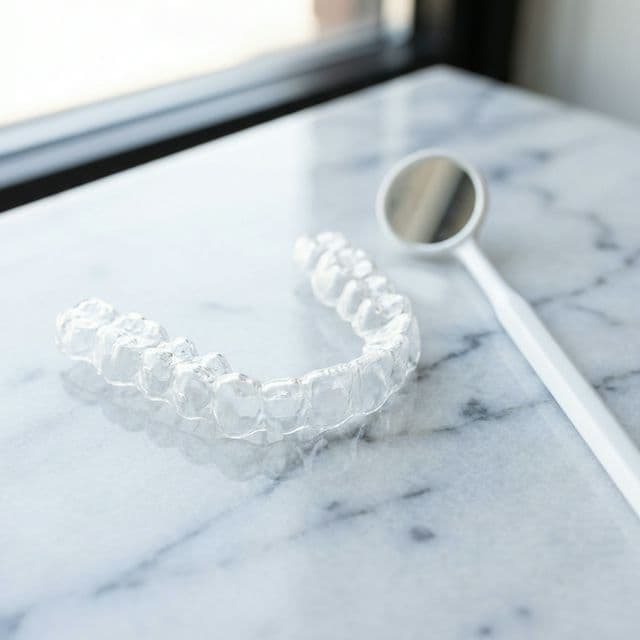

Featured Answer: What is the average Spark timeline?
Many mild cases finish in about 6 to 8 months, moderate cases often take 9 to 14 months, and complex bite corrections may require 15 months or longer. Your exact timeline depends on biology, case complexity, and consistent wear -- about 22 hours per day. At Innova Smiles in Marlborough, we use 3D digital scanning to map out every stage of treatment before your first aligner tray is fabricated, so you will know what to expect from day one.
Treatment Phases: From Consultation to Retainers
Phase 1 -- Consultation and Digital Scanning
Your Spark journey begins with a comprehensive evaluation. Dr. Fatima examines your teeth, gums, and bite, then captures a precise 3D digital scan using a TRIOS intraoral scanner. This scan replaces messy traditional impressions and produces a detailed treatment simulation that shows exactly how your teeth will move at each stage. You will see a preview of your final smile before committing to treatment.
Phase 2 -- Custom Aligner Fabrication
Based on your treatment plan, Spark manufactures a complete series of custom aligner trays using their proprietary TruGEN material. This advanced material is designed to be clearer than many competitors and to maintain its force delivery throughout each wear cycle. Fabrication typically takes two to three weeks from the date of your scan.
Phase 3 -- Active Aligner Wear
Once your aligners arrive, you begin wearing them for 22 hours per day, removing them only to eat, drink anything other than water, and brush your teeth. Each set of trays is worn for approximately one to two weeks before advancing to the next set. Depending on your case, small tooth-colored attachments may be bonded to certain teeth to help guide more complex movements.
Phase 4 -- Refinements
After completing the initial series of trays, your dentist evaluates the results. Most patients need at least one round of refinement aligners to fine-tune the final position of specific teeth. Refinement rounds typically add four to eight weeks to the overall timeline and are included in the cost of treatment at Innova Smiles.
Phase 5 -- Retainers
The American Association of Orthodontists (AAO) emphasizes that once active treatment is complete, retainers are essential to prevent teeth from shifting back toward their original positions. Most patients wear retainers full-time for the first few months, then transition to nighttime-only wear indefinitely. Skipping retainers is the most common reason orthodontic results are lost over time.
Factors That Influence Duration
- Case complexity -- simple spacing or mild crowding resolves faster than deep bites, crossbites, or significant rotations. Cases involving bite correction often require elastics and additional aligner stages.
- Compliance -- this is the single biggest factor within your control. Removing aligners for extended periods slows tooth movement and can push your finish date back by weeks or months.
- Biology -- according to a review in the Angle Orthodontist, bone density and the rate of bone remodeling vary from person to person. Younger patients sometimes respond faster, but adults achieve excellent results as well.
- Oral health -- active gum disease or untreated cavities must be addressed before aligner therapy begins, which can add time to the overall process.
What to Expect Month by Month
- Month 1 -- initial adjustment period. You may notice mild pressure each time you switch to a new tray, which is a sign that teeth are moving. Speech may feel slightly different for the first few days.
- Months 2 to 4 -- front teeth often begin to show visible improvement. Crowding in the front of the mouth tends to resolve before the back teeth are fully aligned.
- Months 5 to 8 -- more significant movement in premolars and molars. If attachments or elastics are part of your plan, they are doing the heavy lifting during this phase.
- Months 9 to 14 (moderate to complex cases) -- bite correction and root positioning continue. Progress may feel slower because the remaining movements are smaller and more precise.
- Final months -- refinement trays address any remaining details, followed by retainer fitting.
Typical Timelines by Case Type
- Mild (minor crowding or spacing): 6 to 8 months, roughly 10 to 16 aligner sets
- Moderate (moderate crowding, rotations, minor bite issues): 9 to 14 months, roughly 18 to 28 aligner sets
- Complex (significant bite correction, extractions, or severe crowding): 15+ months with attachments and elastics as needed
How Spark Compares to Traditional Braces
Traditional metal braces and Spark clear aligners can treat many of the same orthodontic issues, but the experience differs in several ways:
- Aesthetics -- Spark trays are nearly invisible. TruGEN material resists staining better than many older aligner plastics, so the trays stay clear throughout each wear cycle.
- Comfort -- aligners apply gradual, distributed force without the brackets and wires that can irritate cheeks and lips.
- Treatment time -- for mild to moderate cases, Spark and braces often take a similar amount of time. Complex cases requiring significant bite correction may still be faster with braces in certain situations, though Spark continues to expand its clinical capabilities.
- Convenience -- aligners are removable, so there are no dietary restrictions and oral hygiene is straightforward. Braces require more careful cleaning around brackets.
Staying On Track in Marlborough
Professionals along the I-495 corridor — from Hudson and Southborough to Framingham and Westborough — and families across MetroWest benefit from check-in schedules designed to fit busy routines. At Innova Smiles, appointments are typically spaced every six to eight weeks during active treatment. Digital monitoring may reduce in-office visit time where appropriate, and our team is available by phone if any questions arise between appointments.
Ready for a personalized Spark timeline? Call (508) 481-0110 or book now.
Related Articles
- Living with Spark Clear Aligners: Tips & Tricks
- How Much Do Spark Aligners Cost in Massachusetts?
- Why Retainers Are Crucial After Aligner Treatment