Featured Answer: What are an overbite and an underbite, and how do you fix them?
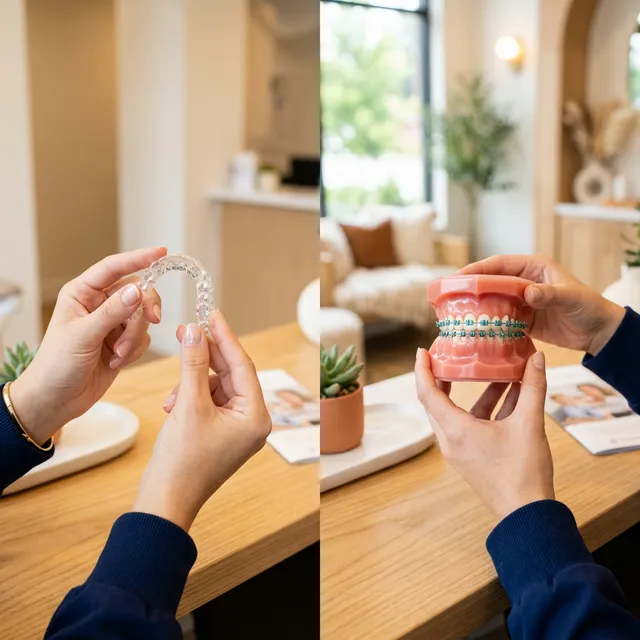
An overbite is when the upper front teeth overlap too far over the lower front teeth; an underbite is the opposite, when the lower teeth sit in front of the uppers. Both are types of malocclusion (a bad bite), and they range from mild and cosmetic to severe and skeletal. Many overbite, underbite, crossbite, and spacing issues can be treated with Spark clear aligners when planned and monitored by a dentist; more severe skeletal cases still benefit from braces or hybrid approaches—your exam determines the best path. At Innova Smiles in Marlborough, MA, Dr. Ambereen Fatima uses digital treatment planning to evaluate whether Spark clear aligners can deliver the correction you need, saving MetroWest patients from unnecessary bracket-and-wire treatment.
Understanding Every Type of Bite Problem
Before discussing solutions, it helps to understand what these terms actually mean. Most patients walk in using words like "crooked" or "off," but bite problems fall into specific clinical categories, each with its own risks and treatment demands. The American Association of Orthodontists classifies malocclusions using the Angle system, developed by Edward Angle in the late 1800s—and that framework still guides treatment decisions today.
- Crossbite: According to the American Association of Orthodontists (AAO), one or more upper teeth sit inside the lower teeth instead of outside them. A crossbite can occur in the front (anterior) or back (posterior) of the mouth. Left untreated, it can lead to uneven jaw growth, gum recession, and excessive wear on tooth enamel. Posterior crossbites are particularly common—a 2020 meta-analysis in the European Journal of Orthodontics found a prevalence of roughly 8 to 16 percent in mixed-dentition populations. What makes crossbites tricky is that they can be dental (the teeth themselves are tipped incorrectly), skeletal (the jaw is too narrow), or a combination of both. The treatment approach is fundamentally different for each type, which is why digital imaging is so critical during diagnosis.
- Overbite (deep bite): The upper front teeth overlap the lower front teeth too much vertically. A 2 to 4 mm overlap is considered normal. Once that number exceeds 4 mm, the lower teeth can bite into the palatal tissue, causing chronic sore spots and accelerated enamel wear. A deep overbite also puts heavy stress on the lower incisors, increasing the odds of chipping or fracture over time. A 2018 study published in the Journal of Orofacial Orthopedics found that patients with deep overbites were 2.4 times more likely to develop TMJ symptoms compared to patients with normal vertical overlap. That statistic is why we take overbite correction seriously—it is a long-term health issue, not just an appearance concern.
- Underbite (Class III malocclusion): The lower jaw protrudes so the lower front teeth sit in front of the upper teeth. This can affect chewing efficiency and speech clarity. Mild dental underbites—where the teeth are tipped rather than the jaw being structurally oversized—respond best to aligner therapy. Skeletal underbites with a significant jaw discrepancy often require combined orthodontic-surgical treatment. The prevalence varies significantly by ethnicity: studies in the Angle Orthodontist report Class III malocclusion rates of approximately 5 percent in Caucasian populations but up to 15 percent in East Asian populations.
- Open bite: The upper and lower front teeth do not touch when the back teeth are fully closed. Open bites can be anterior (front teeth do not meet) or lateral (side teeth do not meet). Common causes include prolonged thumb-sucking in childhood, tongue thrust habits, and TMJ disorders. According to a study in the Angle Orthodontist, anterior open bites affect roughly 3.5 percent of the general population. Open bites are among the more difficult bite problems to treat with any orthodontic method because tongue posture and swallowing habits can work against tooth movement. Successful correction usually requires identifying and addressing the underlying habit as part of the treatment plan.
- Overjet (protruding front teeth): Often confused with overbite, overjet measures how far forward the upper front teeth sit relative to the lower front teeth horizontally. Normal overjet is 2 to 3 mm. Excessive overjet makes front teeth vulnerable to trauma—research in Dental Traumatology found that children with overjet exceeding 6 mm were three times more likely to experience traumatic dental injuries during sports and falls. Overjet can also make it difficult to close the lips comfortably at rest, leading to chronic mouth breathing and dry mouth.
Each of these conditions has its own biomechanical demands. The good news is that Spark clear aligners can address many of them—but the approach differs for each type.
Health Consequences of Untreated Bite Problems
Ignoring a bite issue is not just a cosmetic decision. Research published in the American Journal of Orthodontics and Dentofacial Orthopedics confirms that over time, misaligned bites can cause:
- Chronic jaw pain and TMJ dysfunction, a 2019 systematic review in the Journal of Oral Rehabilitation found that malocclusion is a significant risk factor for temporomandibular disorders
- Uneven enamel wear that leads to cracking or chipping, sometimes requiring crowns or veneers decades earlier than normal
- Gum recession around teeth bearing excess force, which can progress to bone loss if left untreated
- Difficulty cleaning overlapping surfaces, increasing cavity and gum disease risk, the Journal of Dental Research reports that crowded teeth have 30 to 40 percent more plaque accumulation than properly aligned teeth
- Headaches and neck tension from compensatory muscle strain, particularly in patients with deep overbites who clench or grind
- Speech difficulties, especially lisping with open bites or slurred sibilants with underbites
- Accelerated tooth fracture risk, misaligned bites concentrate chewing force on fewer teeth, and those teeth bear loads they were never designed to handle. A single molar in a crossbite can absorb forces 20 to 30 percent higher than the same tooth in proper occlusion
Patients from Framingham, Southborough, and Hudson visit our office specifically because they have been told their bite issues require braces—only to discover that Spark can handle many of these cases effectively.
The Financial Cost of Waiting
Beyond physical symptoms, untreated bite problems have a compounding financial cost. A crossbite that wears down a single molar over ten years can result in a crown ($1,200 to $1,800), followed by a root canal if the wear reaches the nerve ($1,000 to $1,500), followed by a potential extraction and implant ($3,500 to $5,500) if the tooth ultimately fails. The total cost of inaction can easily exceed $6,000 for a single tooth. Compare that to the cost of comprehensive aligner treatment that corrects the bite and protects all of your teeth simultaneously. The math favors early intervention almost every time.
Which Bite Problems Can Aligners Fix vs. Which Need Braces?
This is the question we hear most often. The honest answer depends on severity, the type of movement required, and patient compliance. Clear aligner technology has advanced dramatically since the early days of Invisalign in 1999—modern systems like Spark can handle cases that would have been braces-only just five years ago.
Spark aligners can typically treat:
- Mild to moderate posterior crossbites involving one or two teeth
- Anterior crossbites caused by tooth tipping rather than skeletal discrepancy
- Overbites up to about 5 to 6 mm when combined with attachments and elastics
- Mild open bites, particularly when the cause is dental rather than skeletal
- Overjet up to approximately 6 mm
- Mild underbites caused by tooth positioning rather than jaw growth
- Crowding up to 6 to 8 mm when combined with IPR and arch expansion
- Spacing gaps up to 6 mm
Cases that usually need braces or a hybrid approach:
- Severe skeletal underbites where the lower jaw is significantly oversized
- Deep open bites with a skeletal vertical excess
- Overbites exceeding 6 to 7 mm with significant skeletal component
- Bilateral posterior crossbites requiring palatal expansion in adults (a MARPE expander or surgically assisted expansion is often needed first)
- Teeth that are severely rotated (more than 30 to 40 degrees) or impacted
- Cases requiring significant vertical movement of molars (intrusion or extrusion beyond 2 to 3 mm)
- Patients with severe periodontal disease that compromises tooth mobility
Hybrid approaches are increasingly common. For example, a patient might wear braces for four to six months to handle the most difficult movements, then switch to Spark aligners for the refinement phase. Dr. Fatima evaluates each case individually—there is no one-size-fits-all protocol. A 2022 study in Progress in Orthodontics found that hybrid treatment (braces followed by aligners) achieved comparable outcomes to full fixed-appliance treatment in moderate-to-severe cases, with significantly higher patient satisfaction scores.
Why Spark Over Other Aligner Brands for Bite Correction?
Not all clear aligners are built the same. Spark aligners use TruGEN material, which has been shown in lab testing to maintain its shape and force delivery better over a 14-day wear cycle compared to standard polyurethane trays. For bite correction specifically, this matters because the forces required to move teeth into proper occlusion are sustained over longer periods. Research presented at the 2022 American Association of Orthodontists annual meeting showed TruGEN exhibited less force degradation and staining compared to SmartTrack (the material used by Invisalign). Spark trays are also trimmed closer to the gingival margin, which improves comfort and reduces soft tissue irritation during the extended treatment times that bite correction demands.
How Spark Fixes Crossbites and Overbites
Modern clear aligners have evolved far beyond simple cosmetic tooth straightening. Spark uses several advanced features to address complex movements:
- Precision attachments: Small tooth-colored composite bumps are bonded to specific teeth, giving the aligner trays grip points for controlled tipping, rotation, and bodily movement. For crossbite correction, attachments are typically placed on the affected teeth and their neighbors to create the leverage needed to push a tooth outward into proper arch position. Research in the Korean Journal of Orthodontics (2021) confirmed that optimized attachment designs improve the predictability of crossbite correction with clear aligners by 25 to 35 percent compared to aligners without attachments.
- Elastics (rubber bands): When the upper and lower arches need to move relative to each other—common in overbite correction—small hooks or precision cuts in the aligners anchor elastics that guide jaw positioning. Class II elastics, worn from the lower back molars to the upper canine area, help retract the upper arch and encourage the lower jaw forward. Compliance is critical: elastics need 20-plus hours of daily wear to be effective. Patients who skip them consistently end up with longer treatment times or incomplete correction.
- Digital treatment planning: Every millimeter of movement is mapped in 3D software before your first tray is fabricated. Dr. Fatima reviews and adjusts the plan to ensure each stage is biomechanically sound. This is where experience matters—software can propose a treatment plan, but the dentist needs to override movements that are too aggressive for a single stage or that could cause root resorption.
- Sequential staging: Complex movements are broken into small, predictable steps across dozens of trays, reducing the risk of root resorption or unwanted side effects. A crossbite correction might involve 0.25 mm of buccal movement per tray, staged over 8 to 12 trays, while simultaneously derotating the tooth 2 degrees per stage.
- Interproximal reduction (IPR): In crowded arches, Dr. Fatima may remove a fraction of a millimeter of enamel between specific teeth to create the space needed for alignment. This is comfortable, preserves tooth structure, and eliminates the need for extractions in many cases.
- Bite ramps: Built-in acrylic pads on the palatal surface of the upper aligner behind the front teeth. When you bite down, the lower incisors contact these ramps, which gradually intrude the front teeth and open the bite. Bite ramps are one of the most effective aligner features for overbite correction—they work passively every time you close your mouth, which means they are active during the full 22 hours of daily wear.
- Power ridges: Small pressure ridges molded into the aligner surface that apply torque to specific teeth. Power ridges help control root position during complex movements, which is particularly important when correcting the inclination of teeth involved in a crossbite.
Treatment Timeline by Severity
Not all bite corrections take the same amount of time. Here is a realistic breakdown:
These timelines assume 22 hours of daily aligner wear and consistent elastic use when prescribed. Every patient who walks through our Marlborough office gets a personalized projection based on their specific anatomy and goals.
Patients from Westborough, Northborough, and Shrewsbury often tell us they expected treatment to take much longer than it actually does. Modern digital planning has compressed timelines significantly compared to a decade ago.
Factors That Can Extend or Shorten Treatment
Several variables influence how long your specific case will take:
- Compliance: Wearing aligners fewer than 22 hours per day is the number-one cause of treatment delays. Every hour of missed wear means less tooth movement per tray and potential tracking errors that require additional refinement trays.
- Elastic wear: If your plan includes elastics, wearing them inconsistently can add three to six months to your treatment. This is the single most controllable variable for overbite patients.
- Age: Adult bone is denser than adolescent bone, which means teeth move more slowly. A crossbite correction that takes 6 months in a 15-year-old might take 10 months in a 45-year-old. That said, adults tend to be more compliant with wear schedules, which partially offsets the biological difference.
- Bone density and periodontal health: Patients with healthy bone and gums move teeth more predictably. Active gum disease must be treated before starting aligner therapy.
- Refinement trays: Most bite correction cases require at least one round of refinement trays (additional trays fabricated after the initial set to fine-tune the result). Plan for this in your timeline—it is a normal part of the process, not a sign that something went wrong.
What Happens During Spark Treatment for Bite Correction?
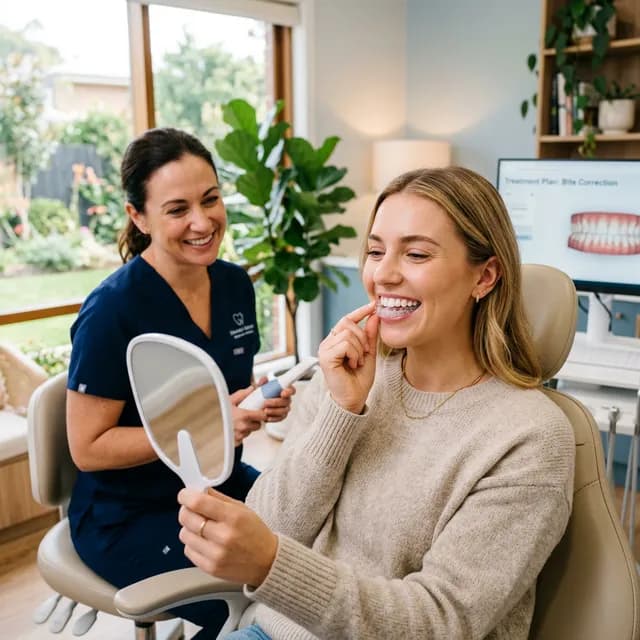
The process begins with a comprehensive evaluation including digital X-rays and a 3D intraoral scan at our Marlborough office. Dr. Fatima reviews the data and creates a customized treatment plan that maps every millimeter of tooth movement. You will see a digital preview of your projected result before committing—this is one of the biggest advantages of digital orthodontics. You can actually watch your teeth move on screen and understand each phase of treatment before your first tray is ever fabricated.
During active treatment, you wear each set of aligners for one to two weeks. Precision attachments, small tooth-colored bumps bonded to specific teeth, provide the grip needed for complex movements like crossbite correction. For overbite cases, elastics may connect upper and lower aligners to guide jaw positioning. Progress checks every six to eight weeks allow Dr. Fatima to make mid-course adjustments as needed.
The Role of Attachments in Bite Correction
Attachments deserve special attention because they are the primary reason modern aligners can handle bite problems that were impossible to treat with clear trays ten years ago. Each attachment is custom-designed in the treatment software—its shape, size, and placement angle are calculated to deliver a specific force vector to the tooth.
For crossbite correction, you might have rectangular attachments on the buccal (cheek-side) surfaces that help the aligner push teeth outward. For overbite intrusion, beveled attachments on the front teeth create a downward force that pushes them upward into the bone. Dr. Fatima places these with precision composite templates, and they are removed at the end of treatment with no damage to enamel.
Most patients have between 8 and 20 attachments. They are tooth-colored and much less visible than brackets. Many of our MetroWest patients tell us their coworkers along the I-495 corridor never noticed them.
The Elastic Protocol for Overbite Treatment
Elastics are the critical second component for overbite correction with aligners. Here is what you need to know about living with them:
Types of elastics used:
- Class II elastics: Run from the lower molars to the upper canine area. These are the most common configuration for overbite correction. They retract the upper arch and guide the lower jaw forward.
- Triangle elastics: Connect three points (typically two on one arch and one on the opposing arch) to fine-tune bite contacts in specific areas.
- Vertical elastics: Used to settle the bite at the end of treatment by pulling upper and lower teeth together in areas where the occlusion has not fully closed.
Wear schedule: Dr. Fatima prescribes elastic wear based on the severity of your overbite. Most patients wear elastics 20 to 22 hours per day, removing them only for meals and brushing. You will go through several bags of elastics during treatment—they lose their elasticity after 12 to 24 hours and should be replaced daily.
The honest truth about elastics: They are the part of treatment that requires the most discipline. Patients who wear them consistently finish on time. Patients who "forget" a few hours here and there often need additional months of treatment. Dr. Fatima checks elastic compliance at every appointment using wear indicators and progress measurements.
Managing Discomfort During Bite Correction
Most patients experience mild pressure for the first day or two after switching to a new aligner tray. This is a normal sign that teeth are moving. Over-the-counter ibuprofen can help if needed. Unlike traditional braces, there are no wires or brackets to irritate cheeks and lips, and you remove aligners to eat and brush, making the entire process more comfortable.
Bite correction cases tend to produce slightly more pressure than simple alignment cases, particularly when elastics are involved. The pressure is still manageable for the vast majority of patients. Switching to a new tray in the evening and taking ibuprofen before bed is a strategy many of our patients find helpful—by morning, the initial tightness has usually subsided.
Tips for managing bite correction discomfort:
- Use dental wax on any attachment that irritates your cheek during the first few days
- Stick to soft foods for the first 24 to 48 hours after switching trays
- Use a chewing exercise tool (like PUL or Movemints) to seat trays fully—a properly seated tray causes less discomfort than one that is not fully engaged
- Cold water or a cold compress on the outside of the jaw can reduce inflammation
- Avoid removing and reinserting aligners frequently during the first day—each removal and reinsertion restarts the adaptation process
Before and After: What Realistic Results Look Like
Setting expectations matters. Here is what you should anticipate at each phase:
Months 1 to 3: Teeth begin to shift, but the bite change is not yet visible. You are building the foundation—creating space, derotating teeth, and leveling the arches. This phase can feel slow because you do not see dramatic results yet. Trust the process. The software shows you exactly where each tooth should be at this stage, and Dr. Fatima verifies tracking at your progress checks.
Months 4 to 8: The crossbite or overbite correction becomes noticeable. Teeth that were locked inside the opposing arch start to clear. Bite contacts begin to feel different when you chew—this is a positive sign. Patients often report that their jaw feels more "settled" and that chewing feels more even. If you have been dealing with chronic jaw tension, this is typically when it starts to improve.
Months 9 to 14: Most of the heavy correction is complete. Refinement trays fine-tune contacts, close any remaining gaps, and settle the bite into its final position. This phase is about precision, not major movement. Dr. Fatima takes new scans and may order one or two sets of refinement trays to perfect the result.
After treatment: A fixed retainer (bonded wire behind the front teeth) or a clear retainer worn nightly is essential. Without retention, teeth will drift back toward their original positions. A study in the American Journal of Orthodontics found that 50 percent of orthodontic patients who did not wear retainers experienced significant relapse within five years. Retainer compliance is not optional—it protects the investment you made in treatment. At Innova Smiles, we include your first set of retainers in the treatment fee and check retainer fit at every routine cleaning appointment.
Spark Aligners for Bite Correction: Real Patient Scenarios
To give you a sense of what bite correction with Spark looks like in practice, here are three common scenarios we treat at our Marlborough office:
Scenario 1: Single-tooth anterior crossbite in an adult. A 34-year-old patient from Ashland had one upper lateral incisor sitting behind the lower teeth. The tooth had been that way since childhood but was now causing localized gum recession and enamel chipping. Treatment involved 18 trays with two attachments on the affected tooth and its neighbors. Total treatment time: 5 months. The crossbite was fully corrected, and the gum recession stabilized.
Scenario 2: Moderate overbite with crowding. A 28-year-old from Natick had a 5 mm deep bite combined with moderate lower crowding. The treatment plan used 52 trays, Class II elastics for 16 weeks, bite ramps, and IPR to create space. Total treatment time: 14 months plus one round of 8 refinement trays. The bite was corrected to a healthy 2.5 mm overlap, and the patient's chronic jaw clicking resolved.
Scenario 3: Posterior crossbite with narrow upper arch. A 41-year-old from Hopkinton had a right-side posterior crossbite that had been causing uneven wear on three molars. The treatment involved 64 trays with sequential arch expansion, precision attachments on the upper premolars and molars, and IPR to manage crowding. Total treatment time: 18 months. The crossbite was resolved, and the patient avoided the three crowns that would have been needed within 5 to 10 years without correction.
Are You a Candidate?
Not every bite issue can be solved with aligners alone. Severe skeletal underbites or cases requiring significant vertical movement may still need braces or a combined orthodontic-surgical approach. The best way to find out is a comprehensive exam that includes digital X-rays and a 3D scan. At Innova Smiles, Dr. Fatima has treated hundreds of bite correction cases across the MetroWest area and can give you an honest assessment of what Spark can and cannot accomplish for your specific situation.
During your consultation, Dr. Fatima will evaluate:
- The type and severity of your bite problem using digital measurements
- Your jaw joint health and any existing TMJ symptoms
- Your periodontal status—healthy gums are a prerequisite for orthodontic treatment
- Your dental history, including existing restorations that may affect aligner fit
- Your lifestyle and compliance capacity—honest conversation about wear commitment matters
Want a quick starting point? Take our free smile quiz to see which treatments may be right for you. For more on how aligners compare to braces for adults, read our guide on Spark aligners vs. braces for adults.
Find out if your bite is a candidate for Spark. Call (508) 481-0110 or book now.
Frequently Asked Questions
Can Spark Aligners actually fix a crossbite? Yes, in many cases. Spark can treat mild to moderate posterior crossbites involving one or two teeth, and anterior crossbites caused by tooth tipping rather than skeletal discrepancy. The aligners use precision attachments to provide leverage and sequential staging (0.25 mm of buccal movement per tray, staged over 8 to 12 trays) to push affected teeth into proper arch position. Bilateral posterior crossbites requiring palatal expansion in adults often still need a MARPE expander or surgical assistance first.
Can Spark fix a deep overbite without braces? Often yes -- Spark can correct overbites up to about 5 to 6 mm when combined with precision attachments and elastics. Built-in bite ramps (acrylic pads on the upper aligner behind the front teeth) gradually intrude the front teeth during the full 22 hours of daily wear. Class II elastics retract the upper arch and encourage the lower jaw forward. Overbites exceeding 6 to 7 mm with significant skeletal component usually need braces or a hybrid approach.
How long does bite correction with Spark Aligners take? Treatment time depends on severity. Single-tooth crossbite: 4 to 8 months (16 to 32 trays). Multi-tooth posterior crossbite: 10 to 16 months (40 to 64 trays). Mild-to-moderate overbite (4 to 5 mm): 10 to 14 months. Deep overbite (5 to 6 mm) with elastics: 14 to 20 months. Combined crossbite plus crowding: 16 to 24 months. Timelines assume 22 hours of daily aligner wear and consistent elastic use when prescribed. Refinements are normal and included.
What are bite ramps and how do they help with overbite correction? Bite ramps are built-in acrylic pads on the palatal surface of the upper aligner, positioned behind the front teeth. When you bite down, the lower incisors contact these ramps, which gradually intrude the front teeth and open the bite. They work passively every time you close your mouth, which means they are active during the full 22 hours of daily wear -- one of the most effective aligner features for overbite correction.
Do I have to wear rubber bands (elastics) with Spark Aligners for overbite? For most overbite cases, yes. Class II elastics (from lower back molars to upper canine area) help retract the upper arch and guide the lower jaw forward. Elastics need 20-plus hours of daily wear to be effective and should be replaced daily (they lose elasticity after 12 to 24 hours). Patients who wear them inconsistently can add 3 to 6 months to treatment -- elastic compliance is the single most controllable variable for overbite patients.
When do I still need braces instead of Spark Aligners? Braces are typically the better call for severe skeletal underbites where the lower jaw is significantly oversized, deep open bites with skeletal vertical excess, overbites exceeding 6 to 7 mm with significant skeletal component, bilateral posterior crossbites requiring palatal expansion in adults, severely rotated teeth (more than 30 to 40 degrees) or impacted teeth, cases requiring significant vertical movement of molars (intrusion or extrusion beyond 2 to 3 mm), and severe periodontal disease. Dr. Fatima evaluates each case individually -- hybrid approaches (braces for 4 to 6 months followed by Spark for refinement) are increasingly common.
What causes an overbite or underbite? Most overbites and underbites are inherited, the size and shape of your jaws are genetic, so a small lower jaw tends to produce an overbite and an oversized lower jaw produces an underbite. Childhood habits make them worse, including prolonged thumb sucking, pacifier or bottle use, and tongue thrusting, which push the teeth and shape the developing jaw. Missing, crowded, or extra teeth can also tip the bite out of alignment. Because the cause can be dental, skeletal, or both, an exam with imaging is what determines whether aligners alone can fix it.
Is an overbite bad for you? A slight overbite is normal and purely cosmetic. A deep or excessive overbite (or underbite) is worth treating because over time it can wear down and crack the enamel of the front teeth, contribute to jaw and TMJ pain, cause gum recession on the teeth taking the extra force, and make chewing or speaking harder. Correcting the bite protects the teeth and joints, not just the appearance of your smile.
Does thumb sucking affect a child's teeth? Yes. Prolonged thumb sucking or pacifier use past about age 3 to 4, while the jaw is still developing, can push the upper front teeth forward and the lower teeth back, narrow the upper arch, and create an open bite or overbite. Most children stop on their own and the bite often self-corrects. If the habit continues as the permanent teeth come in, a dentist can help with gentle reminders, a habit appliance, and orthodontic treatment later if needed.
Related Articles
- Clear Aligners or Braces? How to Choose
- Spark Aligners vs. Braces for Adults
- How Long Does Spark Aligner Treatment Take?
- Spark vs. Invisalign: A Marlborough Dentist Compares
- Clear Aligners vs. Braces: Complete Cost Comparison for 2026
- Braces or Spark Aligners? A Guide for Parents of Teens