Featured Answer: Why are digital impressions better?
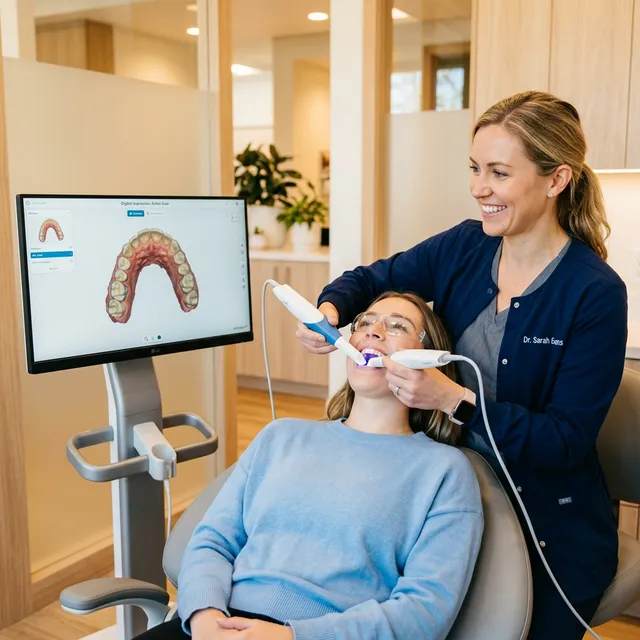
Digital dental impressions replace bulky, gag-inducing putty trays with a compact handheld scanner that captures a precise 3D model of your teeth in two to four minutes. The 3Shape TRIOS scanner at Innova Smiles in Marlborough achieves accuracy within 6.9 microns, far beyond what traditional impressions deliver consistently. There is no material to bite down on, no unpleasant taste, and no gagging. Multiple systematic reviews (2020–2025) have confirmed that digital impressions achieve significantly higher patient satisfaction than conventional impressions, with improvements particularly notable in comfort, anxiety reduction, and perceived procedure time. For patients from Framingham, Westborough, Sudbury, and across MetroWest, this technology has removed one of the biggest barriers to comfortable dental care.
The Problem with Traditional Impressions
If you have had a conventional dental impression at any point in your life, you remember it. A large, horseshoe-shaped tray filled with thick, cold, putty-like material (polyvinyl siloxane or alginate) is loaded up, pressed firmly over your teeth, and held against your palate or lower arch for one to three minutes while the material sets. For many patients, this triggers a strong gag reflex, sometimes violent enough to make the impression unusable.
The gagging is not a sign of weakness or an overreaction. The soft palate and posterior tongue contain dense concentrations of mechanoreceptors that evolved to protect the airway from foreign objects. When a large tray pushes against these areas, the reflex fires automatically. Research published in the British Dental Journal estimates that 10% to 15% of all dental patients have a clinically significant gag reflex that interferes with standard impression procedures. Many patients consistently report that traditional impressions are among the most uncomfortable aspects of restorative treatment, often ranking the experience above the anesthetic injection itself.
Beyond discomfort, traditional impressions carry technical limitations. Even a slight movement during the 60- to 90-second setting time can distort the impression, producing a crown or aligner that does not fit correctly. The material shrinks slightly as it polymerizes. Air bubbles trapped at critical margins create voids that the lab must guess around. And the physical mold must be poured in stone, packed, and shipped to the laboratory, adding 7 to 14 days to the turnaround before your restoration even starts being fabricated.
If you are someone who struggles with dental anxiety, a sensitive gag reflex, or a small mouth, traditional impressions can become a genuine barrier to getting dental work done. Some patients delay necessary crowns, bridges, or orthodontic treatment for years specifically because they dread the impression step.
How Digital Scanning Actually Works
At Innova Smiles, we use the 3Shape TRIOS intraoral scanner, an extensively validated digital impression system widely adopted in modern dental practices. Understanding what happens during the scan helps patients arrive at their appointment without any apprehension.
The Technology
The TRIOS scanner uses confocal microscopy and ultrafast optical scanning to capture the 3D geometry of your teeth and soft tissue. A compact wand, roughly the size of an electric toothbrush head, emits a structured light pattern onto the tooth surfaces. The light reflects back into the wand's optics, and the scanner's software uses the pattern distortion to calculate the exact 3D shape of every surface, cusp, groove, and margin it passes over.
The scanner captures approximately 3,000 2D images per second, stitching them together in real time into a seamless, full-color 3D model displayed on a monitor beside the dental chair. The entire process is passive, there is no radiation, no contact pressure, and no material entering your mouth.
What the Scan Feels Like
Here is what patients experience step by step:
- Preparation. Your teeth are dried briefly with an air syringe. No special coatings or powders are needed (earlier-generation scanners required a dusting of titanium dioxide powder; the TRIOS eliminated that requirement).
- Scanning begins. Dr. Fatima or our dental assistant moves the wand slowly across your teeth, starting on one side and working systematically to the other. The wand hovers a few millimeters above the tooth surfaces, there is light contact with the teeth occasionally, similar to the feel of a toothbrush.
- Real-time display. You can watch the 3D model build on the screen beside you. Patients are often fascinated by seeing their own dental anatomy in high-resolution 3D for the first time. Many patients tell us the screen display is the most interesting part of the visit — a far cry from staring at the ceiling while putty hardens.
- Spot rescans. If the scanner misses a small area, perhaps due to saliva pooling or a slight movement, the operator simply passes the wand over that spot again. The software seamlessly integrates the new data. There is no starting over, no new material, no second round of gagging.
- Completion. A full-arch scan (all upper or all lower teeth) takes two to four minutes. A single-tooth scan for a crown or onlay can be finished in under a minute.
The entire experience is calm, quiet, and over quickly. Patients who have avoided dental work for years because of impression anxiety consistently tell us they wish they had known about this option sooner.
Digital vs. Traditional Impressions: A Detailed Comparison
Accuracy: The Numbers Matter
Accuracy is not an abstract quality metric, it directly affects how your crown, bridge, or aligner fits on the day it is delivered. A crown fabricated from an inaccurate impression may have open margins (gaps at the gumline), poor contact with adjacent teeth, or an incorrect bite that requires chairside adjustment and sometimes a complete remake.
A 2019 systematic review and meta-analysis published in the Journal of Prosthetic Dentistry evaluated 37 studies comparing digital and conventional impression accuracy for fixed prosthodontics. The results were clear: digital impressions demonstrated statistically superior marginal fit for single crowns and 3-unit bridges compared to PVS impressions, with an average marginal gap of 48 microns (digital) versus 74 microns (conventional). For context, marginal gaps under 120 microns are considered clinically acceptable, both methods meet the threshold, but the tighter fit from digital impressions reduces the risk of bacterial microleakage, secondary decay, and premature crown failure.
For full-arch scans, the type used for clear aligner treatment and implant-supported prosthetics, a 2020 study in Clinical Oral Investigations found that the 3Shape TRIOS achieved full-arch trueness of 36.2 microns, compared to 61.4 microns for the best-performing conventional technique. That 25-micron difference may sound negligible, but across an arch of 14 teeth, cumulative error compounds. The digital workflow consistently produces aligner trays that track more precisely and implant frameworks that seat passively without force.
Which Dental Procedures Use Digital Scans?
Digital impressions have replaced conventional impressions for the vast majority of procedures at Innova Smiles. Here is a breakdown of how we use the technology across different treatment categories:
Crowns, Onlays, and Inlays
Every crown and indirect restoration at our office starts with a digital scan. The scan captures the prepared tooth, adjacent teeth, and the opposing arch (for bite registration) in a single appointment. The file is transmitted to the lab within minutes. This eliminates the most common source of remakes, distorted conventional impressions, and reduces our crown remake rate to under 2%, well below the clinical average of 3.8% reported by the National Dental Practice-Based Research Network study of over 3,750 single-unit crowns.
Dental Implant Restorations
Scanning around a dental implant requires capturing the exact position and angulation of the implant abutment relative to adjacent teeth. Traditional impressions around implants used specialized impression copings and open-tray or closed-tray techniques, a multi-step process that was particularly uncomfortable for patients with multiple implants.
With digital scanning, a scan body (a small geometric reference marker) is screwed onto the implant abutment, and the scanner captures its position in the 3D model. The lab software identifies the scan body geometry and calculates the precise implant position in three dimensions. A 2021 study in the International Journal of Oral and Maxillofacial Implants found that digital implant impressions produced implant-supported crowns with significantly better passive fit than conventional impression techniques, reducing screw-loosening complications by 34% over a two-year follow-up.
For patients receiving implant treatment at Innova Smiles, this means fewer appointments, better-fitting restorations, and fewer adjustments on delivery day.
Clear Aligners (Spark)
Orthodontic treatment with clear aligners begins with a full-arch digital scan. The scan data is uploaded directly to the aligner manufacturer's treatment planning software, where Dr. Fatima designs the tooth movement sequence before a single tray is fabricated.
The precision of the initial scan determines how well each aligner tray fits throughout the entire treatment sequence, often 20 to 40+ trays over 6 to 18 months. A 2019 study in the Angle Orthodontist demonstrated that aligners fabricated from digital impressions required 23% fewer mid-course corrections (refinement scans) than those fabricated from conventional impressions, because the initial data was more accurate. Fewer refinements mean faster treatment completion and fewer office visits, a meaningful advantage for busy patients from Hudson, Northborough, and across MetroWest who are balancing orthodontic appointments with work and family schedules.
Night Guards and Occlusal Splints
Custom night guards for bruxism (teeth grinding and clenching) require an accurate model of both arches and the bite relationship. Digital scans capture all three datasets in a single five-minute session. The resulting guard fits precisely, stays in place during sleep, and does not require the multiple adjustment visits that poorly fitting guards from conventional impressions sometimes need.
Bridges and Veneers
Multi-unit restorations like bridges and full-arch veneers demand extreme accuracy across multiple prepared teeth. Traditional impressions of four or more preparations in a row are particularly prone to distortion because the impression material flexes when removed from undercuts. Digital scanning eliminates this variable entirely, the 3D data is mathematically precise regardless of how many teeth are scanned.
Orthodontic Records and Treatment Monitoring
Beyond fabricating appliances, digital scans serve as baseline records and progress monitoring tools. Dr. Fatima can overlay scans taken months apart to visualize exactly how teeth have moved during aligner treatment, verify that treatment is on track, and adjust the plan if needed. This level of quantified monitoring was simply not possible with stone models.
Time Savings: From Scan to Restoration
The time advantage of digital impressions extends well beyond the few minutes saved in the dental chair. The entire workflow is compressed:
Traditional workflow:
- Take impression (5–10 minutes, including retakes)
- Pour stone model in the office or ship impression to lab (same day)
- Ship physical model to dental laboratory (2–5 business days)
- Lab fabricates restoration (5–7 business days)
- Ship completed restoration back to office (2–3 business days)
- Total: 14–21 business days from impression to delivery
Digital workflow:
- Scan teeth (2–4 minutes)
- Transmit file to lab electronically (immediate)
- Lab fabricates restoration using CAD/CAM (5–7 business days)
- Ship completed restoration to office (2–3 business days)
- Total: 7–10 business days from scan to delivery
For patients who need a crown on a visible front tooth and are wearing a temporary in the meantime, shaving a full week off the timeline is a meaningful quality-of-life improvement. For patients traveling from Shrewsbury, Southborough, or Westborough, fewer total appointments also means less driving and less time away from work.
Who Benefits Most from Digital Impressions?
Every patient benefits from the improved accuracy and comfort of digital scanning, but certain groups see an especially dramatic difference:
- Patients with a strong gag reflex. This is the most life-changing application. Patients who have literally been unable to complete a traditional impression, who have gagged so severely that the tray had to be removed before the material set, can complete a full-arch digital scan. We see this regularly at our Marlborough office, and the relief on patients' faces is genuine.
- Patients with dental anxiety. The reduced chair time, absence of foreign material, and ability to pause the scan at any moment all contribute to a calmer experience. Combined with our gentle care options, digital scanning makes comprehensive dental work accessible to patients who have avoided the dentist for years.
- Children and adolescents. Kids and teens do remarkably well with digital scanning. The real-time 3D display on the monitor engages them, the scan is fast enough to hold their attention, and there is no tray to trigger discomfort. For children and teens starting orthodontic treatment with clear aligners, the scan is often their favorite part of the appointment.
- Patients with small mouths or limited opening. Standard impression trays come in sizes, and patients at the smaller end of the spectrum often find that even the smallest tray is uncomfortably large. The scanner wand is narrow enough to navigate comfortably in any mouth.
- Patients with significant dental work in progress. Patients receiving multiple crowns, implant restorations, or full-mouth rehabilitation benefit from the precision of digital scanning at every stage. Each scan builds on the accuracy of the last, ensuring that the final result integrates seamlessly.
- Patients who value their time. Fewer retakes, faster lab turnaround, and better first-time fit mean fewer total appointments. For professionals commuting to Boston or Worcester from MetroWest, that efficiency matters.
Cost: Does Digital Scanning Cost More?
No. Digital impressions do not add any extra cost to your treatment. The scan replaces the traditional impression step, it is not an additional procedure with a separate fee. Your insurance covers the crown, bridge, aligner, or night guard the same way regardless of the impression method used. At Innova Smiles, we invested in this technology because it produces better outcomes and a better patient experience, not because it generates additional revenue.
For patients concerned about treatment costs, our membership plan includes discounts on all restorative and orthodontic procedures, and 0% financing through CareCredit and Cherry is available for larger treatment plans.
Frequently Asked Questions
Is the scanner radiation-free?
Yes. The TRIOS scanner uses visible light and structured light patterns, not X-rays, not lasers, and not ionizing radiation of any kind. It is completely safe for all patients, including pregnant women and children. You can have as many scans as needed without any cumulative exposure concern.
What if I still gag during the scan?
It is extremely rare, but patients with the most severe gag reflexes may feel mild discomfort when the wand reaches the very back of the mouth. Because the scan is continuous rather than all-at-once (like a tray), we can pause at any point, let you rest, and resume exactly where we left off. We can also use a slower scanning pace, breathing breaks, and comfort amenities for patients who want extra support during the scan.
How long does the digital file last?
Indefinitely. Your 3D scan is stored securely in our digital records system and can be accessed years later. If a crown needs replacement five years from now, we may already have the scan data on file, though we will typically rescan to capture any changes in your dental anatomy.
Can I see my scan?
Yes. Dr. Fatima reviews the 3D model with you on screen, pointing out areas of concern, showing you the margins of a preparation, or explaining why a particular tooth needs treatment. Visual understanding helps patients make informed decisions about their care. Many patients tell us that seeing their own teeth in 3D for the first time made their treatment plan "click" in a way that verbal explanations alone had not.
Are there situations where traditional impressions are still used?
In very rare cases, certain full-arch implant protocols or complex removable prosthetics, a conventional impression may still provide advantages. These situations represent less than 5% of the impressions taken at our practice. For the vast majority of crowns, bridges, implant restorations, aligners, night guards, and veneers, digital scanning is the superior choice.
The Bigger Picture: Digital Dentistry at Innova Smiles
Digital impressions are one piece of a fully integrated digital workflow at our Marlborough office. Combined with 3D CBCT imaging for implant planning, digital X-rays for diagnostics, and CAD/CAM design for restorations, the result is dentistry that is more precise, more comfortable, and faster than what was possible even five years ago.
Patients from Marlborough, Framingham, Hudson, Sudbury, Shrewsbury, and throughout MetroWest choose Innova Smiles because we invest in the tools that produce the best possible outcomes. Digital scanning is not a luxury add-on, it is how modern dentistry should work.
Ready to experience gag-free, high-precision dentistry? Call (508) 481-0110 or book your appointment. Your next crown, aligner, or night guard starts with a quick, comfortable scan.