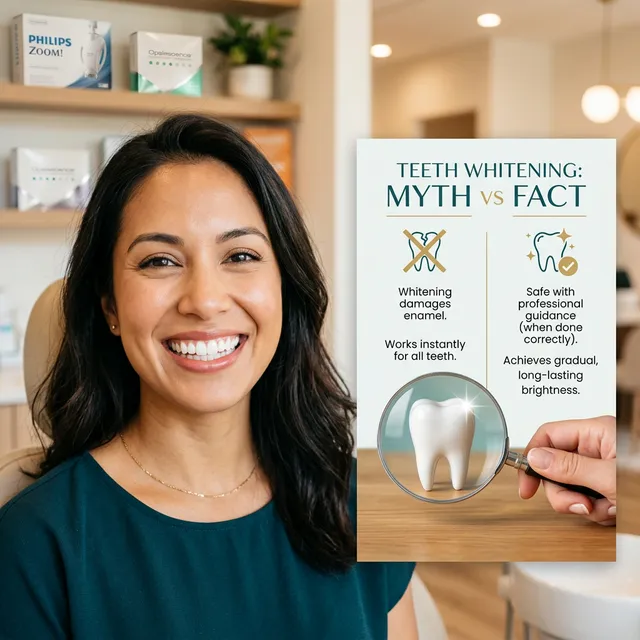

Teeth whitening is one of the most popular cosmetic dental treatments in the United States--the American Academy of Cosmetic Dentistry reports that it is the number one requested cosmetic procedure by patients. Yet misinformation about whitening is everywhere, fueled by social media trends, influencer endorsements, and products that prioritize marketing over science. At Innova Smiles in Marlborough, MA, Dr. Fatima regularly hears concerns from patients across MetroWest, from Westborough to Framingham, that are based on teeth whitening myths rather than clinical evidence. Let us set the record straight so you can make an informed decision about brightening your smile.
Myth 1: Whitening ruins enamel
This is the most persistent teeth whitening myth, and it keeps people from pursuing a treatment that is safe when done correctly. Professional whitening gels work by opening tiny pores in enamel, lifting stains, and then closing the pores again. The structure of your tooth stays intact when you follow the instructions and avoid overuse.
The active ingredients in professional whitening--hydrogen peroxide or carbamide peroxide--have been studied extensively and are considered safe by the American Dental Association (ADA) when used as directed. A 2019 review in the Journal of Evidence-Based Dental Practice confirmed that professionally supervised whitening does not cause permanent enamel damage. A separate 2014 meta-analysis in the Journal of Dentistry examined 25 clinical trials and found no statistically significant reduction in enamel microhardness following professional whitening protocols.
The key is proper concentration and application time, which is exactly what professional supervision ensures. Problems arise when patients use excessively concentrated products without guidance, leave trays in far longer than directed, or whiten too frequently. Under Dr. Fatima's supervision, your enamel is monitored before, during, and after treatment.
What to avoid
- Over-the-counter kits that promise instant whitening without clear instructions
- Leaving trays on overnight without your dentist's guidance
- Mixing baking soda and lemon juice, a popular DIY recipe that erodes enamel rapidly due to the acidic pH (lemon juice has a pH around 2.0, well below the 5.5 critical pH at which enamel begins to dissolve)
- Using whitening products from unregulated overseas sellers--some have been found to contain dangerous concentrations of hydrogen peroxide or unlisted chemicals
Myth 2: All whitening results look fake
The "chiclet teeth" stereotype comes from over-bleaching, not from professional whitening done properly. Custom trays let us control the shade change precisely. We typically aim for two to four shades lighter on the VITA shade guide, enough to brighten your smile noticeably without making it look artificial or fluorescent. The gradual approach of take-home trays also allows you to stop at the exact shade you prefer.
During your consultation, Dr. Fatima evaluates your starting shade, skin tone, and smile goals. A 50-year-old patient seeking a natural refresh has different goals than a 28-year-old preparing for a wedding. Professional whitening accommodates both. The shade result depends on the concentration used, the duration of application, and the number of sessions--all of which we customize.
Whitening should complement your natural skin tone and facial features. Anything beyond that can look artificial.
Myth 3: Sensitivity means damage
Temporary sensitivity is the most common side effect of whitening, affecting roughly 60 to 70 percent of patients to some degree. It occurs because the dentin layer dehydrates slightly during whitening, allowing fluid movement in the microscopic tubules that connect to the nerve. This is a reversible, temporary effect--not damage.
A 2018 randomized clinical trial published in Operative Dentistry found that patients who used a desensitizing toothpaste containing potassium nitrate and fluoride for two weeks before whitening experienced significantly less sensitivity than controls. At Innova Smiles, we recommend this pre-treatment protocol for patients with a history of sensitivity. After treatment, a fluoride varnish or potassium nitrate sensitivity gel applied to the teeth usually calms discomfort within 24 to 48 hours.
For patients with particularly sensitive teeth, Dr. Fatima may recommend:
- Lower-concentration carbamide peroxide (10% instead of 15% or 20%) with longer application times
- Shorter in-office sessions with breaks between applications
- A potassium nitrate gel worn in custom trays for 30 minutes after each whitening session
- Spacing whitening sessions further apart to give teeth time to fully rehydrate
Myth 4: Charcoal toothpaste whitens teeth safely
Does charcoal whiten teeth? This question floods our inbox, and the short answer is: not safely, and not effectively for anything beyond surface stains. Activated charcoal toothpaste has surged in popularity thanks to social media, but the science does not support the hype. The ADA warns that dental professionals urge caution, and the organization has not granted its Seal of Acceptance to any charcoal whitening product.
Charcoal is abrasive enough to scrub surface stains, but that abrasiveness comes at a cost. A 2017 systematic review in the Journal of the American Dental Association evaluated charcoal-based dental products and concluded that there was insufficient clinical evidence to support their whitening claims. Worse, the abrasive particles can wear away enamel over time, leading to increased sensitivity and a yellowish appearance as the darker dentin layer becomes more visible--the exact opposite of what you want.
Most charcoal products also lack fluoride, meaning they offer no cavity protection. Some contain additional ingredients like bentonite clay or coconut oil whose whitening benefits are unsubstantiated. If you are currently using charcoal toothpaste, switch to an ADA-accepted whitening toothpaste that contains fluoride and has been clinically tested.
Myth 5: Strawberries, banana peels, and oil pulling whiten teeth
There is no scientific evidence that rubbing fruit on your teeth or swishing oil in your mouth produces meaningful whitening results. A 2015 study in Operative Dentistry tested the strawberry-and-baking-soda whitening recipe promoted by celebrities and found it did not produce a clinically significant color change compared to commercial whitening products. Strawberries contain citric acid, which can actually erode enamel with repeated use. The malic acid in strawberries may remove some surface debris, but it does not penetrate enamel to break apart deep stain molecules the way hydrogen peroxide does.
Oil pulling (swishing coconut or sesame oil for 15 to 20 minutes) has a long history in Ayurvedic tradition and may support general oral hygiene by reducing bacterial load, but it does not change tooth color. A 2020 review in Complementary Therapies in Medicine found no evidence that oil pulling produces whitening effects.
Banana peels, turmeric paste, apple cider vinegar, and hydrogen peroxide swished straight from the brown bottle are other popular internet remedies. None have clinical evidence supporting their use as whitening agents, and several (particularly apple cider vinegar with a pH of 2.5 to 3.0) can cause significant enamel erosion with repeated application.
Myth 6: Whitening works on all teeth
Whitening is effective on natural tooth enamel with extrinsic stains from food, beverages, tobacco, and aging. However, it does not change the color of crowns, veneers, bonding, or fillings. If you have restorations on your front teeth, whitening your natural teeth may create a color mismatch that requires replacing the restorations to match the new, lighter shade.
Teeth with intrinsic discoloration from medications like tetracycline, fluorosis, or trauma may not respond fully to whitening. Tetracycline stains, which appear as dark gray or brown horizontal bands, are notoriously resistant because the drug molecules bind within the dentin structure during tooth development. While prolonged whitening protocols (6 to 12 months of nightly tray use) can lighten tetracycline stains by several shades, the results are often incomplete.
Dr. Fatima evaluates your specific situation during a consultation to set realistic expectations and may recommend porcelain veneers as an alternative for teeth that whitening cannot improve. Veneers cover the front surface of the tooth entirely, masking any discoloration regardless of its cause.
Myth 7: Is whitening bad for teeth if you have fillings or crowns?
Whitening itself does not damage existing restorations, but it will not change their color either. The peroxide only acts on natural enamel and dentin. If you whiten your natural teeth around older composite fillings, the fillings may appear darker by comparison. Dr. Fatima checks all existing restorations before recommending whitening and discusses whether any may need to be replaced after treatment to ensure a uniform result.
Myth 8: UV or LED lights are the key to faster whitening
Many in-office whitening systems use a curing light (LED or halogen) that is marketed as "activating" the gel. Research on this topic is mixed. A 2016 systematic review in the Journal of Dentistry concluded that light activation did not produce significantly better whitening outcomes than the gel alone in most studies. The peroxide concentration and contact time are the primary drivers of whitening efficacy, not the light source. Some lights may generate heat that increases sensitivity without improving results.
At Innova Smiles, we use evidence-based protocols that prioritize gel formulation, proper concentration, and controlled application time over light-based gimmicks.
The Science Behind Professional Whitening
Professional whitening uses hydrogen peroxide or carbamide peroxide at concentrations higher than what is available over the counter. In-office systems typically use 25 to 40 percent hydrogen peroxide, while take-home trays use 10 to 22 percent carbamide peroxide (which breaks down to approximately 3 to 7 percent hydrogen peroxide).
When applied to the tooth surface, the peroxide breaks down into oxygen radicals that penetrate the enamel and break apart the chromophore molecules responsible for discoloration. These chromophores are large, complex organic molecules that absorb light and create the appearance of staining. The oxygen radicals fragment them into smaller, colorless molecules. The enamel structure itself is not altered. After treatment, the pores in the enamel close naturally within 24 to 48 hours, and fluoride treatments help remineralize the surface.
The carbamide peroxide used in take-home trays breaks down more slowly than hydrogen peroxide, releasing its active ingredient over a longer period. This makes it ideal for the extended wear times (30 to 60 minutes per session) used with custom trays. The gradual release also tends to produce less sensitivity than the higher-concentration, shorter-duration in-office approach.
Safe vs. Unsafe Whitening Products
Safe and effective:
- ADA-accepted professional in-office whitening
- Dentist-prescribed custom take-home trays with professional-grade gel
- ADA-accepted whitening toothpastes for maintenance (look for the ADA Seal on the box)
- Whitening strips from reputable brands with ADA Seal
Use with caution or avoid:
- Charcoal toothpaste (abrasive, no fluoride, no ADA Seal)
- DIY baking soda and lemon juice (erosive)
- Unregulated whitening products ordered online from overseas
- Mall kiosk or salon whitening (no dental supervision, inconsistent results, potential for soft tissue burns)
- UV or LED lights sold as standalone whitening devices without professional-grade gel
- Whitening mouthwashes with high alcohol content (drying to oral tissues)
Choosing Your Approach
| Option | Best for | Treatment time | Longevity | Approximate cost |
|---|---|---|---|---|
| In-office Boost | Fast, dramatic results | 1 visit (60–90 min) | 6–12 months | $300–$600 |
| Custom trays | Gradual, controlled change | 10–14 days | 12+ months with touch-ups | $250–$450 |
| Whitening toothpaste | Daily maintenance | Ongoing | Maintains results | $5–$10/tube |
| OTC strips (ADA Seal) | Budget-conscious, mild stains | 7–14 days | 3–6 months | $30–$60 |
Your starting shade, the type of staining, your sensitivity history, and your timeline all factor into the recommendation. Patients preparing for weddings, reunions, or professional headshots often choose in-office whitening for immediate results, while patients who prefer a more gradual change opt for custom trays.
How Often Can You Whiten Safely?
The ADA recommends following your dentist's guidance on whitening frequency. In-office treatments can typically be repeated every 6 to 12 months. Custom take-home trays allow for periodic touch-ups as needed--usually a few days of use every few months. Over-whitening (more than once every few months with high-concentration products) can lead to enamel weakening and chronic sensitivity. A condition informally called "bleachorexia" describes patients who whiten compulsively, chasing an unnaturally white shade. Dr. Fatima monitors each patient's enamel health at routine visits and advises when another whitening cycle is appropriate.
Whitening During Orthodontic Treatment
If you are currently wearing clear aligners, your trays can double as whitening trays with professional-grade gel. This is a convenient way to brighten your smile while straightening it. Ask Dr. Fatima about combining Spark aligner treatment with whitening during your next visit.
However, patients with traditional braces should wait until brackets are removed to whiten, as the areas under brackets will not be treated, resulting in uneven color when the braces come off. Post-braces whitening is one of the most satisfying treatments we perform--patients see their straight, bright smile for the first time and the reaction is always worth the wait.
Maintaining Your Results
After whitening, a few simple habits help your results last longer:
- Avoid dark-colored beverages (coffee, red wine, dark tea) for 48 hours after treatment. The enamel pores are still open during this window and are more susceptible to re-staining.
- Use a straw for staining beverages when possible--this directs the liquid past the front teeth
- Brush twice daily with a whitening maintenance toothpaste containing fluoride
- Schedule touch-up treatments with your custom trays every six to twelve months
- Keep up with professional cleanings every six months to remove surface stains before they set
- Rinse your mouth with water after consuming coffee, tea, or red wine if brushing is not immediately possible
- Quit smoking or using tobacco products--tobacco is the single fastest staining agent and also poses serious oral health risks
Patients who follow these maintenance steps typically enjoy their whitening results for a year or longer before needing a touch-up.
Ready to separate teeth whitening myths from reality for your own smile? Call (508) 481-0110 or book a consultation at Innova Smiles in Marlborough. Dr. Fatima will evaluate your staining type, enamel health, and smile goals to recommend the safest, most effective whitening approach for you.
Related Articles
- Professional Teeth Whitening in Marlborough
- Professional Whitening vs. Store-Bought Kits
- Valentine's Day Smile Prep: Whitening Tips
Related Services
- Teeth Whitening, professional in-office and take-home whitening options
- Cosmetic Dentistry, full range of smile enhancement treatments
- Porcelain Veneers, a longer-lasting alternative when whitening alone isn't enough