Featured Answer: Is an oral appliance as effective as CPAP for sleep apnea?
For mild to moderate obstructive sleep apnea (AHI of 5 to 30 events per hour), oral appliance therapy is a recognized treatment option by the American Academy of Sleep Medicine. Studies show that custom-fitted mandibular advancement devices can reduce the apnea-hypopnea index in appropriate candidates. While CPAP remains the most-recommended option for severe OSA, its effectiveness depends heavily on consistent use, and 30 to 50 percent of CPAP users abandon the device within a year. Because many patients wear oral appliances more consistently, real-world outcomes can be meaningful despite lower theoretical efficacy.
Understanding CPAP: The Gold Standard with a Compliance Problem
Continuous Positive Airway Pressure — CPAP, has been the primary treatment for obstructive sleep apnea since the early 1980s. The device works by delivering a continuous stream of pressurized air through a mask worn over the nose, mouth, or both. This air pressure acts as a pneumatic splint, physically holding the airway open so that the soft tissue in the throat cannot collapse during sleep.
When used consistently and correctly, CPAP is highly effective. It can reduce the AHI to fewer than 5 events per hour in most patients, regardless of severity. It eliminates snoring, improves oxygen saturation throughout the night, restores normal sleep architecture, and reduces the cardiovascular and neurocognitive risks associated with untreated OSA.
The problem is adherence. CPAP requires wearing a mask connected to a machine via a hose for every minute of every night's sleep, for the rest of your life. For many patients, this is a significant burden.
Published adherence data paints a consistent picture:
- A meta-analysis in the Journal of Clinical Sleep Medicine (2016) found that 29 to 83 percent of patients are non-adherent with CPAP, depending on how adherence is defined.
- The Centers for Medicare & Medicaid Services defines adequate CPAP use as 4 or more hours per night on 70 percent or more of nights. By that fairly generous standard, roughly 50 percent of patients do not meet the threshold.
- A longitudinal study published in Sleep Medicine found that 25 to 50 percent of patients prescribed CPAP stop using it entirely within 1 to 3 years.
The reasons for non-adherence are consistent across studies: mask discomfort and skin irritation, air leaks that disrupt sleep, nasal congestion and dryness, claustrophobia, noise that disturbs bed partners, difficulty traveling with the device, and the psychological burden of being tethered to a machine every night.
This is not a failure of willpower. CPAP is physically uncomfortable for many people, and a treatment that the patient does not use is a treatment that does not work, regardless of its theoretical efficacy.
Understanding Oral Appliance Therapy
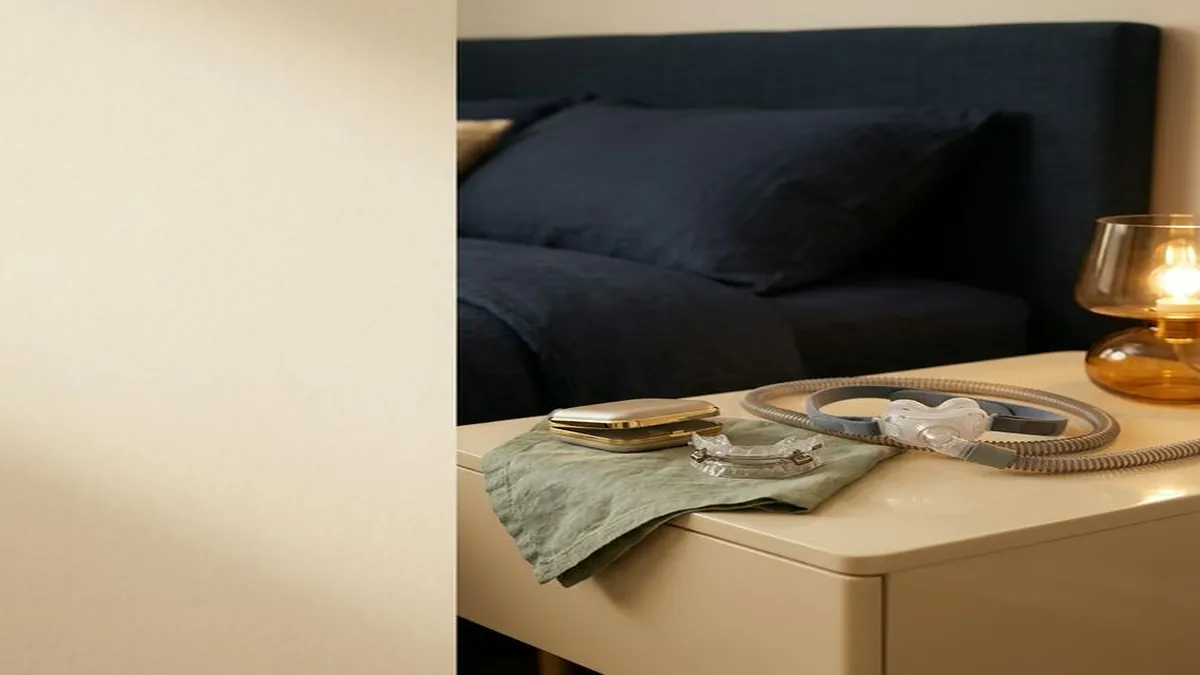
Oral appliance therapy (OAT) uses a custom-fitted dental device, most commonly a mandibular advancement device (MAD), to treat obstructive sleep apnea. The device resembles an athletic mouthguard and is worn only during sleep.
How It Works
A mandibular advancement device consists of two custom-molded trays (one for the upper teeth, one for the lower teeth) connected by a mechanism that holds the lower jaw in a slightly forward position, typically 6 to 10 millimeters ahead of its natural resting point. This forward positioning achieves two things:
- Opens the airway. By advancing the mandible, the device pulls the base of the tongue and the surrounding soft tissues forward, physically increasing the diameter of the airway behind the tongue, the area where obstruction occurs in most OSA patients.
- Increases muscle tone. The repositioned jaw activates the genioglossus muscle (the main tongue muscle), which helps maintain airway patency during sleep.
The result is a wider, more stable airway that resists collapse, the same fundamental goal as CPAP, achieved through mechanical positioning rather than air pressure.
FDA-Cleared Devices
The FDA has cleared over 100 oral appliances for the treatment of snoring and obstructive sleep apnea. These range from boil-and-bite devices available online (which dental professionals generally do not recommend due to poor fit and unverified efficacy) to precision-milled, custom-fitted devices fabricated from digital impressions.
Custom-fitted mandibular advancement devices are typically fabricated from digital scans or impressions of each patient's teeth. Custom fabrication supports proper fit, comfortable retention, and precise titration, the ability to adjust the degree of mandibular advancement in small increments until the optimal therapeutic position is found.
Head-to-Head Comparison: CPAP vs. Oral Appliance
The following table compares the two treatments across the dimensions that matter most to patients and physicians.
The Adherence Equalizer
The most important row in this table is the one about adherence-adjusted outcomes. A landmark study published in JAMA Internal Medicine (2015) randomized patients with moderate to severe OSA to either CPAP or oral appliance therapy and measured real-world health outcomes over time. The study found that despite CPAP's superior AHI reduction in laboratory settings, health outcomes, including blood pressure reduction, daytime sleepiness scores, and quality of life measures, were equivalent between the two treatments.
The reason: patients wore the oral appliance more. Average nightly use was 6.5 hours for the oral appliance group versus 5.2 hours for CPAP. More hours of treatment per night, multiplied over weeks and months, compensated for the lower per-hour efficacy.
This finding has shaped the AASM's current guidelines, which recognize oral appliance therapy as an important treatment option in its own right for appropriate patients.
What the AASM Guidelines Say
The American Academy of Sleep Medicine published updated clinical practice guidelines for oral appliance therapy in 2015, with a reaffirmation in subsequent position papers. The key recommendations:
- Oral appliance therapy is recommended as a treatment option for adults with mild to moderate OSA (AHI 5-30) who prefer an oral appliance to CPAP or who cannot tolerate CPAP.
- For patients with severe OSA (AHI >30) who are CPAP-intolerant, oral appliance therapy is recommended as an alternative rather than no treatment.
- Custom-fitted, titratable devices are recommended over non-custom devices (boil-and-bite, online purchases).
- Follow-up sleep testing is recommended after the oral appliance has been fitted and titrated to verify adequate AHI reduction.
- Ongoing follow-up with a qualified dentist is recommended to monitor for side effects, dental changes, and device condition.
These guidelines explicitly state that oral appliance therapy should be delivered by a qualified dentist, not purchased over the counter.
Who Is a Good Candidate for Oral Appliance Therapy?
Based on the published evidence, the following patients tend to do best with oral appliance therapy:
- Mild to moderate OSA (AHI 5-30). This is the sweet spot where oral appliances perform closest to CPAP.
- CPAP-intolerant patients. If you have tried CPAP and cannot use it consistently, for any reason, an oral appliance is almost always better than no treatment.
- Frequent travelers. Professionals who travel weekly for business, families who vacation regularly, and anyone who simply does not want to pack a CPAP machine find oral appliances dramatically more convenient.
- Positional OSA. Patients whose apnea occurs primarily when sleeping on their back often respond particularly well to mandibular advancement.
- Primary snoring without apnea. Loud snoring that disrupts a bed partner's sleep, even when the snorer's AHI is below 5, may be an indication for oral appliance therapy after evaluation.
- Combination therapy candidates. Some patients with severe OSA use an oral appliance in combination with CPAP, which allows the CPAP pressure to be reduced to a more comfortable level.
Commuters along the Route 495 and Route 9 corridors in MetroWest know the daily toll of poor sleep. Drowsy driving on I-495 during the morning rush from Hopkinton or Westborough into Boston is a genuine safety hazard. An oral appliance that weighs two ounces and fits in a shirt pocket can be the difference between a dangerous commute and an alert one.
Who Still Needs CPAP?
Oral appliance therapy is not appropriate for every patient with sleep apnea. CPAP remains the recommended first-line treatment in these situations:
- Severe OSA (AHI >30) with significant oxygen desaturation. When oxygen levels drop below 80 percent during sleep, the airway obstruction is severe enough that mandibular advancement alone may not provide adequate relief.
- Central sleep apnea or complex sleep apnea. These conditions involve the brain failing to signal the muscles to breathe, rather than physical airway obstruction. Oral appliances address obstruction, not central breathing drive.
- Obesity hypoventilation syndrome. Patients with a BMI over 40 who also have chronic daytime hypercapnia (elevated carbon dioxide) typically need the positive pressure ventilation that CPAP provides.
- Patients who respond well to CPAP and are adherent. If your CPAP works for you and you use it every night, there is no clinical reason to switch.
The decision between CPAP and oral appliance therapy should always be made in consultation with both a sleep physician and a dentist trained in dental sleep medicine.
Side Effects: What to Expect with Each Treatment
Every medical treatment has potential side effects. Understanding them helps set appropriate expectations.
CPAP Side Effects
- Mask discomfort and skin irritation. Pressure marks, strap marks, and skin breakdown on the nose and cheeks are common. Mask fit is personal and often requires trying multiple styles.
- Air leaks. When the mask seal breaks, due to movement, facial hair, or improper fit, pressurized air escapes, reducing treatment effectiveness and causing noise that wakes both the patient and their partner.
- Dry mouth and nasal congestion. Pressurized air dries the nasal passages and oral tissues. Heated humidifiers (built into most modern CPAP machines) help but do not always eliminate the problem.
- Claustrophobia. An estimated 30 to 40 percent of CPAP users report some degree of claustrophobia related to wearing the mask. Nasal pillow masks (which cover only the nostrils) reduce this effect for some patients.
- Aerophagia. Swallowing pressurized air during sleep causes bloating, gas, and abdominal discomfort. This is particularly common at higher pressure settings.
- Noise. Modern CPAP machines are much quieter than older models (typically 25-30 decibels), but the noise is still present. The combination of machine sound, mask hissing from leaks, and hose movement can disturb light-sleeping bed partners.
Oral Appliance Side Effects
- Jaw soreness and stiffness. This is the most common side effect and is typically limited to the first one to three weeks as the jaw muscles adapt to the new position. Morning jaw exercises (opening and closing, side-to-side movement) accelerate adaptation. Most patients report that soreness resolves completely.
- Excessive salivation. Having a device in the mouth triggers increased saliva production in the early days. This normalizes within one to two weeks as the brain adjusts.
- Temporary bite changes in the morning. After removing the appliance, some patients notice that their bite feels slightly different for 15 to 30 minutes. Doing bite exercises (biting on a morning repositioner) restores normal occlusion quickly.
- Potential long-term bite changes. With prolonged use over years, some patients experience gradual changes in tooth position or bite alignment. This is the most significant long-term concern with oral appliance therapy. Regular follow-up with a qualified dentist, which the AASM guidelines explicitly recommend, allows early detection and management of any occlusal changes.
- TMJ symptoms. In rare cases, mandibular advancement can aggravate pre-existing temporomandibular joint (TMJ) problems. However, many patients with OSA also grind their teeth, and the oral appliance can actually reduce grinding-related TMJ pain by stabilizing the jaw position. This is why TMJ health is typically evaluated before an oral appliance is recommended and monitored at follow-up visits.
Cost Comparison and Insurance Coverage
Cost is a practical factor in treatment decisions, and understanding the financial picture helps patients plan.
Insurance Coverage
Both CPAP and oral appliance therapy are covered by medical insurance (not dental insurance) because sleep apnea is a medical diagnosis. Coverage requires:
- A confirmed diagnosis of obstructive sleep apnea from a sleep study (in-lab polysomnography or home sleep apnea test)
- A prescription or referral from a physician (typically a sleep specialist or primary care provider)
- For oral appliances, the device must be FDA-cleared and custom-fitted by a qualified dentist
Medicare and most commercial insurers cover oral appliance therapy for OSA. Coverage details, deductibles, and copays vary by plan, so check with your medical insurer about prior authorization requirements.
What the Fitting Process Usually Involves
If a patient and their sleep physician determine that oral appliance therapy is appropriate for the diagnosis, the fitting process with a qualified dentist generally follows these steps.
Step 1: Consultation and Evaluation
The dentist reviews the sleep study results, medical history, and current symptoms, then performs an oral examination to confirm adequate dentition (enough healthy teeth to support the device), evaluate TMJ health, and assess airway anatomy. This visit usually also covers goals, expectations, and any previous experience with CPAP.
Step 2: Digital Impressions
A precise 3D digital impression (or a conventional impression) of the upper and lower teeth is captured. The resulting model is sent to a dental laboratory that fabricates the custom device.
Step 3: Device Delivery and Initial Fitting
When the oral appliance arrives (often a few weeks after the impressions), the patient returns for a fitting appointment. The dentist verifies the fit on both arches, adjusts the retention, and sets the initial mandibular advancement position, usually a conservative starting point that allows the jaw to acclimate.
Step 4: Titration
Over the following weeks, the degree of mandibular advancement is gradually increased in small increments at brief titration appointments. The goal is to find the "sweet spot", the position that maximally reduces apnea events while remaining comfortable.
Step 5: Follow-Up Sleep Study
Once the optimal position is established, a follow-up sleep study (usually a home test) confirms that the device is adequately reducing the AHI. The AASM guidelines recommend this verification step, and many insurance plans require it.
Step 6: Ongoing Monitoring
Periodic check-ups with the dentist are used to examine the device for wear, check the teeth and TMJ for changes, and confirm that the appliance continues to function properly.
Making the Right Choice for Your Sleep
The decision between CPAP and oral appliance therapy is personal. It depends on your diagnosis severity, your physical comfort, your lifestyle, and your willingness to use the device consistently. The best treatment is the one you will actually use, every night, all night.
If you have been diagnosed with sleep apnea and are struggling with CPAP, ask your sleep physician whether oral appliance therapy could be an option for you.
Oral appliance therapy is coming soon to Innova Smiles; we are not accepting sleep apnea patients yet. If you have symptoms, talk to your physician about a sleep study. Sleep apnea: what to know.
Related Articles
- 7 Warning Signs of Sleep Apnea You Should Not Ignore
- 7 Warning Signs of Sleep Apnea
- TMJ Treatment Options
Related Services
Sources & Further Reading
- Clinical Practice Guideline for the Treatment of Obstructive Sleep Apnea and Snoring with Oral Appliance Therapy: An Update for 2015 — American Academy of Sleep Medicine / Journal of Clinical Sleep Medicine