
What is a dental crown?
A crown is a tooth-shaped cap that fits over an existing tooth, restoring its shape, strength, and appearance. Think of it as a protective helmet for a damaged or weakened tooth. Patients from Westborough, Northborough, and surrounding MetroWest towns visit Innova Smiles for digitally-designed custom porcelain crowns built around precise digital scanning.
Dental crowns are one of the most common restorative procedures in dentistry. The American College of Prosthodontists estimates that over 15 million Americans have crown or bridge replacements each year. The procedure has been refined over decades, and modern materials and digital manufacturing have made crowns stronger, more natural-looking, and faster to deliver than at any point in dental history.
Crowns are indicated when:
- A tooth has a crack that extends toward the root (for detailed diagnosis and treatment options, see our broken tooth repair guide)
- A cavity is too large for a filling to adequately support the remaining tooth structure
- A tooth has been root canal treated (the American Association of Endodontists notes that root-canal-treated teeth become brittle without crown protection)
- An existing large filling has broken down
- A tooth is severely worn from grinding
- You need an anchor for a dental bridge
- A dental implant needs a visible restoration on top
Understanding when a crown is necessary versus when a simpler restoration will suffice is a judgment call that depends on how much healthy tooth structure remains, where the tooth sits in the arch, and what forces it bears during chewing. Dr. Fatima takes a conservative approach--if a filling will predictably last, we place a filling. A crown is recommended only when preserving the tooth long-term demands full-coverage protection.
Crown options at Innova Smiles
Digitally-Designed Porcelain Crowns (most popular)
Research published in the Journal of Prosthetic Dentistry (2017) confirms that CAD/CAM-fabricated crowns deliver accuracy and longevity comparable to traditional lab crowns. Research on CAD/CAM ceramic crowns shows strong clinical performance, with studies reporting 5-year survival rates of 93–96% and 10-year rates of approximately 89–92%. While these results are statistically comparable to conventional lab crowns in many cases, long-term success depends on material selection, preparation design, and patient factors such as bite force and oral hygiene. We use a digital intraoral scanner and CAD/CAM design to capture and shape your restoration with precision, then the final crown is designed and milled from a single block of high-strength ceramic in our own lab. The result is a custom-shaded restoration that matches your natural tooth color.
For patients traveling from Hudson, Framingham, or Shrewsbury, the digital workflow means no messy putty impressions and a precise, well-fitting crown.
Timeline: Two appointments, 2 to 3 weeks apart (prep and scan with a temporary, then cement the custom permanent crown) Material: Lithium disilicate (IPS e.max) or zirconia ceramic Best for: Most back teeth and many front teeth where a custom, shade-matched ceramic crown is needed
How the digital workflow works: After tooth preparation, our TRIOS 5 intraoral scanner captures a precise 3D model. That digital file is loaded into CAD/CAM design software, where Dr. Fatima adjusts contours, contacts with adjacent teeth, and occlusal anatomy on screen. The approved design guides the milling unit, which carves the crown from a solid ceramic block. The crown is then stained and glazed to match surrounding teeth before it is tried in and cemented at your second visit.
Traditional Lab-Fabricated Crown
We scan or take an impression, send it to an outside dental lab, and you wear a temporary crown for 2 to 3 weeks while the lab crafts your permanent restoration.
Timeline: Two appointments, 2 to 3 weeks apart Material: Porcelain-fused-to-metal (PFM), all-ceramic, or full zirconia Best for: Complex esthetic cases where lab artistry is needed (front teeth with unusual color gradients or translucency requirements), very posterior molars under heavy bite force, and cases involving multiple adjacent crowns that require precise color matching across units
The lab process allows a master ceramist to hand-layer porcelain for a level of esthetic detail that goes beyond what milling alone can achieve. For patients who want the absolute most lifelike result on a highly visible front tooth, this option remains valuable.
Crown materials: what goes on your tooth
Not all crown materials are created equal. Here is a closer look at the options and their clinical properties:
Lithium Disilicate (IPS e.max)
This is the most popular ceramic for custom porcelain crowns. Lithium disilicate has a flexural strength of approximately 400 MPa--strong enough for most premolars and many molars, with excellent translucency that mimics natural enamel. A 2020 meta-analysis in the Journal of Dentistry reported a 97.8 percent survival rate for lithium disilicate crowns at five years.
Zirconia
Zirconia crowns are the strongest ceramic option, with flexural strength exceeding 1,000 MPa. They are virtually unbreakable under normal chewing forces, making them the most-recommended option for second molars and patients who grind heavily. Newer multilayer zirconia (such as BruxZir Anterior) combines the strength of zirconia with improved translucency for front teeth. According to the Journal of Prosthetic Dentistry (2021), zirconia crowns showed a 98.3 percent survival rate at five years across 12 clinical studies.
Porcelain-Fused-to-Metal (PFM)
PFM crowns have a metal substructure with a porcelain outer layer. They were the standard for decades and remain a reliable choice. However, the metal margin can show as a dark line at the gumline over time, and if gum recession occurs, the metal becomes visible. PFM crowns are gradually being replaced by all-ceramic options as ceramic technology improves.
Full Gold or Metal Alloy
Gold crowns are the most conservative option in terms of tooth reduction (only 0.5 to 1 mm needed) and they last — some gold crowns are still in service after 40 years. They are rarely requested today for esthetic reasons but remain an excellent functional choice for hidden back molars in patients with very heavy bite forces.
Step-by-step: what happens during crown treatment
Step 1 — Examination and X-rays (30 minutes)
We verify the tooth is a good candidate for a crown. This includes checking the nerve health with cold testing and electric pulp testing (to see if a root canal is needed first), assessing surrounding bone on X-rays, and measuring the amount of remaining healthy tooth structure. If the tooth has a fracture extending below the gumline, we evaluate whether crown lengthening surgery is needed to expose adequate tooth structure for a stable crown margin.
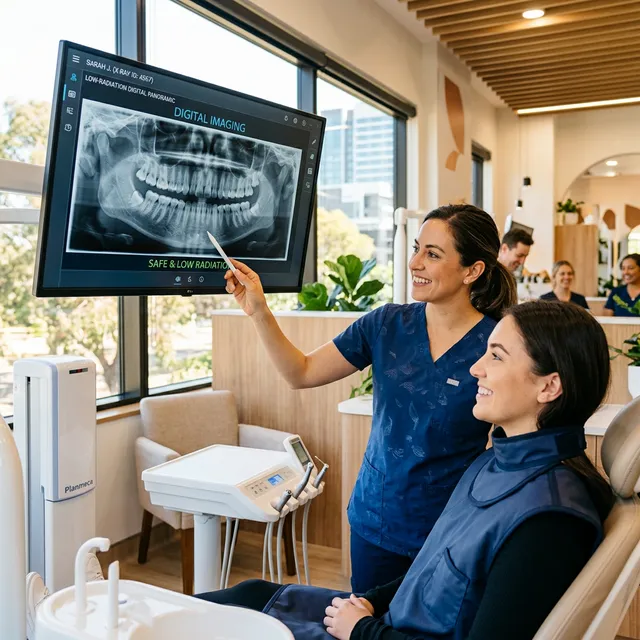
For complex cases, we use our 5D CBCT imaging to get a three-dimensional view of the tooth, surrounding bone, and adjacent structures. This is particularly important when a crown is being placed on an implant or when we suspect a vertical root fracture that standard X-rays might miss.
Step 2 — Anesthesia and tooth preparation (45 to 60 minutes)
We numb the tooth and surrounding area thoroughly. The tooth is shaped to create space for the crown--typically removing 1 to 2 mm around the entire circumference and from the top. The preparation design depends on the crown material: all-ceramic crowns require a smooth, rounded shoulder margin, while PFM crowns use a slightly different chamfer preparation.
If you are particularly anxious, we also offer premium topical numbing before the injection and comfort amenities such as noise-canceling headphones and a hand signal to pause at any time.
Step 3 — Digital scan (10 minutes)
Our TRIOS 5 intraoral scanner takes thousands of micro-images per second, building a precise 3D map of your prepared tooth and the opposing arch. No putty impressions. The scanner also captures shade data, helping us select the ceramic block that best matches your surrounding teeth. A study in the International Journal of Prosthodontics (2020) found that digital impressions were significantly more accurate than conventional alginate or polyvinyl siloxane impressions for single-unit crowns.
Step 4 — Temporary crown and crown design
We place a well-fitting temporary crown to protect the prepared tooth while your permanent restoration is made. Your restoration is designed from the digital scan on-screen: the CAD/CAM software uses biogeneric algorithms based on the anatomy of tens of thousands of teeth to propose an optimal crown shape, which Dr. Fatima then adjusts to match your specific bite and esthetic needs. The approved design guides milling of the crown from a ceramic block.
You wear the temporary crown for 2 to 3 weeks while the custom permanent crown is finished, stained, and glazed to match your surrounding teeth.
Step 5 — Try-in, cementation, and bite check (20 to 30 minutes, second visit)
At your second visit, the temporary is removed and the permanent crown is tried in to verify fit, contacts with adjacent teeth, and esthetics. We check the bite with articulating paper and refine any high spots. Once everything looks and feels right, the internal surface of the crown is etched and treated with silane coupling agent (for lithium disilicate) or primed (for zirconia), and bonded permanently with a dual-cure resin cement.
You leave with a fully functioning, custom permanent tooth.
How long does a crown last?
According to the ADA, with proper care, ceramic crowns last 10 to 25+ years. A landmark study published in the Journal of Dental Research (2015) followed over 2,300 crowns and found a median survival time of 19.3 years for all-ceramic crowns and 21.1 years for PFM crowns. The key factors affecting longevity are:
- Bite forces, heavy grinders benefit from a night guard to protect crowns from excessive wear. Bruxism generates forces of 500 to 700 psi, compared to normal chewing forces of 150 to 250 psi--that extra load significantly shortens restoration lifespan.
- Oral hygiene, decay at the crown margin (where crown meets tooth) is the most common failure reason. The crown itself cannot decay, but the natural tooth structure beneath and around it is still vulnerable to cavity-causing bacteria.
- Flossing technique, slide floss out to the side rather than "snapping" it, which can loosen cement over years
- Regular exams, we check margins and integrity at every hygiene visit. Catching a small gap or chip early means a simple repair instead of a full replacement.
- Diet, biting ice, hard candies, or non-food objects (pen caps, fingernails) dramatically increases fracture risk for any restoration.
Crown vs. Filling: Which Do I Need?
When in doubt, it is better to crown a tooth than to watch a large filling fail and risk losing the tooth entirely. Clinical research consistently shows that teeth with large composite fillings—particularly those covering more than two-thirds of the biting surface—have significantly higher fracture risk than crowned teeth. For molars, 5-year fracture survival rates are approximately 81.6% for composite restorations versus 92.7% for crowns, demonstrating the protective advantage of full-coverage crowns. That fracture often runs vertically through the root, making the tooth unrestorable and requiring extraction.
Crown vs. Veneer: What Is the Difference?
Patients often ask whether they need a dental crown or a veneer. Although both are custom-fabricated restorations, they serve different purposes and cover different amounts of tooth structure.
Choose a crown when the tooth has structural damage--a large cavity, a crack, or a root canal--and needs full reinforcement to withstand biting forces. Choose a veneer when the tooth is essentially healthy but you want to improve its shape, color, or alignment for cosmetic reasons. In some cases, Dr. Fatima may recommend veneers on front teeth and crowns on back teeth as part of a comprehensive smile makeover.
For a comparison of veneers with cosmetic bonding, see our guide on bonding vs. porcelain veneers.
What does a crown cost in Marlborough, MA?
Crown costs vary based on material and complexity:
- Porcelain, all-ceramic, zirconia or PFM crown: $889–$1,977 — the material is chosen for the tooth, not the price; the top is our standard fee, the low end what a plan-covered patient typically pays
Insurance: Most PPO plans cover crowns under "major restorative" at 50 percent after deductible, typically capping at $1,500 to $2,000 per year. CDT procedure codes for crowns include D2740 (porcelain/ceramic substrate), D2750 (porcelain fused to high noble metal), and D2392 (resin-based composite, four or more surfaces). We verify your specific benefits before treatment begins so there are no surprises.
Financing: CareCredit and Cherry financing are available for 0 percent APR periods of 6 to 24 months. Our treatment coordinators can run the numbers for your plan during your consultation visit. For patients without insurance, our in-house membership plan provides a meaningful discount on all restorative procedures including crowns.
Cost comparison perspective: A single crown ($889–$1,977) protects a tooth for 10 to 25 years. The alternative--delaying treatment until the tooth fractures or becomes infected--typically means a root canal, build-up and crown ($656–$1,858 plus $226–$451 plus $889–$1,977), or an extraction and dental implant ($167–$693 plus $3,343–$6,685). Early intervention with a crown is almost always the most affordable long-term choice.
After your crown: what to expect
- Mild sensitivity for 1 to 4 weeks is normal, especially to temperature. This occurs because the tooth preparation exposes dentin tubules near the nerve. As the cement fully sets and the tooth recovers, sensitivity resolves for the vast majority of patients. A study in Operative Dentistry (2018) found that 94 percent of patients reported complete resolution of post-cementation sensitivity within 30 days.
- Bite feels high, call us right away and we will adjust it (takes 5 minutes, no charge). A high bite puts excessive force on the crowned tooth and can cause persistent soreness or even crack the restoration.
- Temporary crown (if you have one): avoid sticky foods like caramel that can pull it off. Do not chew gum on that side. If it comes loose, save it and call us--we can re-cement it the same day in most cases.
- Permanent crown: brush and floss normally. Use a water flosser if flossing around it feels awkward. Pay particular attention to the gumline, where plaque accumulates at the crown margin.
Long-term crown care tips
- Use a soft-bristled toothbrush and non-abrasive toothpaste to avoid scratching the glaze on ceramic crowns
- If you grind your teeth at night, invest in a custom night guard--this single step can double the lifespan of your crown
- Avoid using teeth as tools (opening packages, biting nails, chewing ice)
- Keep your six-month hygiene appointments so we can check the crown margins, cement integrity, and surrounding gum health
- If you notice a rough edge, a change in how your bite feels, or new sensitivity around a crowned tooth, call us promptly--catching problems early makes the difference between a minor fix and a full replacement
Frequently Asked Questions About Dental Crowns
Does getting a crown hurt? The tooth and surrounding gum tissue are thoroughly numbed before any preparation begins. Most patients report feeling pressure rather than sharp pain during the procedure. Premium topical numbing gel is applied before the injection.
Can a crowned tooth still get a cavity? The crown itself cannot decay, but the natural tooth underneath can. Bacteria can enter at the margin where the crown meets the tooth if oral hygiene is neglected. This is why brushing, flossing, and regular dental exams remain essential after crown placement.
What happens if my crown falls off? Save the crown and call us immediately at (508) 481-0110. In most cases, we can re-cement the original crown the same day. Do not try to glue it back with household adhesive. If you cannot get to our office right away, a small dab of denture adhesive or toothpaste inside the crown can temporarily hold it in place.
Do I need a crown after every root canal? Almost always for back teeth (premolars and molars), which bear significant chewing forces. For front teeth that have minimal structural loss, a crown may not be immediately necessary, but Dr. Fatima will assess the remaining tooth structure and make a recommendation based on fracture risk. Clinical research has demonstrated that root-canal-treated molars without crown protection have significantly higher fracture rates than those restored with crowns. A registry study (Salvi et al., 2007) found roughly six-fold higher failure rates in uncrowned versus crowned molars over 9–10 years, and systematic reviews confirm 5-year survival rates of 81.6% without crowns versus 92.7% with crowns.
If you think you may need a crown, or if you have been told by another dentist that you do, call Innova Smiles at (508) 481-0110 or book an evaluation online. We will confirm whether a crown is the right choice and show you exactly what it would look like using our digital smile design tools. Patients from Grafton, Sudbury, and throughout the I-495 corridor trust our Marlborough office for digitally-designed custom porcelain crowns built around precise digital scanning and a comfortable temporary while your permanent crown is crafted.
Related Articles
- Root Canal Myths: Debunking and Pain Relief
- How Long Does a Root Canal Take? The Complete Timeline
- Cracked Tooth? What to Do in Marlborough
- Tooth Extraction: What to Expect
Related Services
- All Implants & Restorations, crowns, bridges, implants, and all restorative options
- Restorative Dentistry, crowns, bridges, fillings, and complete restorations
- Our Crown Technology, see how we use digital scanning and CAD/CAM design to craft custom porcelain crowns
- Dental Exams & Cleanings, regular check-ups to catch problems before crowns become necessary
How our pricing works
Porcelain crownOur fee range$889–$1,977 per unit
- We use digital impressions and work with a trusted dental lab to craft crowns that look and feel like your natural teeth. Our fee covers shade-matching, temporary crowns, and post-placement adjustment visits.
- If you have dental insurance, your plan pays us a negotiated fee for covered treatment — typically about half of our standard fee — and you pay your share of that lower amount. Once you've booked your appointment and returned your forms, we'll verify your insurance benefits and call you with a breakdown within three business days.
- 0% APR financing through CareCredit or Cherry spreads the cost from about $37/mo with nothing down.*
- No insurance? Our in-house membership plan (from $395/yr) includes your preventive care and takes a flat 20% off our standard fee for this treatment.
- The top of the range is our standard fee; the low end is what a patient whose plan covers the treatment typically pays before their share is applied. A core build-up, when the tooth needs one, is estimated separately.
- Your exact fee is confirmed in writing at your visit, after your exam and after we have checked your insurance — never a surprise afterward.
- Patients aged 65 and older get 10% off all dental treatments. Mention it when booking and we'll apply it automatically.
*Estimated payment is the lowest published PER-TOOTH fee ÷ 24 months at 0% APR with $0 down, and covers one tooth — a multi-tooth case multiplies it. Financing is provided by third-party lenders (e.g. CareCredit, Cherry), not by Innova Smiles, and is subject to credit approval — not all applicants qualify. Your actual cost, term, and monthly payment depend on your treatment plan and approved offer.