The Panic of a Dental Emergency
When a toothache strikes at 2 AM or you chip a tooth over the weekend in Marlborough, MA, your first instinct might be to rush to the nearest Emergency Room. MetroWest Medical Center in Framingham, Marlborough Hospital, and UMass Memorial in Worcester all have ERs, but for most dental issues, the ER is not the best place to go.
Understanding the difference between an emergency dentist and an ER visit can save you time, money, and unnecessary suffering, whether you live in Marlborough, Hudson, Framingham, Shrewsbury, or anywhere in MetroWest.
Why the ER Cannot Fix Your Tooth
The American Dental Association reports that over 2 million emergency room visits per year in the U.S. are for dental problems, most of which would be better treated in a dental office. A landmark 2015 study published in the Journal of the American Dental Association (JADA) analyzed over 42 million dental-related ER visits across two decades and found that these visits rarely result in definitive treatment. The study concluded that "emergency departments are not designed to provide dental care" and that patients who visit the ER for dental problems are significantly more likely to return within 72 hours with the same complaint.
Emergency rooms are equipped for life-threatening medical situations, chest pains, broken bones, severe infections, but not for dental care.
No Dentists on Staff
Most ERs do not employ dentists. ER physicians receive approximately four hours of dental education during their entire medical school training, according to a 2017 survey published in the Journal of Dental Education. They can identify gross pathology like a facial abscess, but they are not trained to perform root canals, extract teeth, or repair fractured crowns.
Limited Treatment Options
ER physicians can typically offer only two things for dental pain: antibiotics for suspected infection and pain medication for temporary relief. They cannot pull teeth, perform root canals, or fix broken crowns. You will be sent home with prescriptions and told to follow up with your dentist, often still in pain.
A 2018 study in Health Affairs found that 79 percent of dental-related ER visits resulted in a prescription only, with no procedural intervention. The patient leaves with the exact same dental problem, plus a bill.
High Cost for No Resolution
ER visits for dental issues average $800 to $1,500 or more, compared to $150 to $400 for an emergency dental appointment. The Annals of Emergency Medicine reported in 2020 that the average dental-related ER visit costs approximately $1,043 when including facility fees, physician charges, and imaging, for a visit that provides no definitive dental treatment.
Long Wait Times
Dental issues are triaged as low priority in the ER under the Emergency Severity Index (ESI) triage system. A toothache is typically assigned a level 4 or 5 (out of 5), which means you may wait four to eight hours while patients with chest pain, fractures, stroke symptoms, and other medical emergencies are seen first. During flu season and holiday weekends, wait times at MetroWest area hospitals can stretch even longer.
The Decision Tree: ER or Emergency Dentist?
When dental pain strikes, use this framework to decide where to go:
Go to the Emergency Room if:
- Severe facial swelling that is closing your eye, spreading to your neck, or making it hard to breathe or swallow, this can indicate Ludwig's angina or a deep space infection, both of which are medical emergencies
- Trauma to the face or jaw from a car accident, fall, or sports injury, especially if you suspect a broken jaw or multiple broken teeth
- Uncontrolled bleeding that does not stop after 15 to 20 minutes of firm, direct pressure with gauze
- High fever (over 101 degrees F) combined with facial swelling, which may indicate a spreading infection requiring IV antibiotics
- Loss of consciousness or concussion symptoms along with dental injury
Go to your emergency dentist if:
- Severe toothache keeping you awake, but no fever or spreading swelling
- Cracked, chipped, or broken tooth
- Lost crown or filling
- Knocked-out tooth (time-sensitive, see below)
- Dental abscess with localized gum swelling
- Broken denture, retainer, or orthodontic wire
- Post-extraction dry socket or bleeding
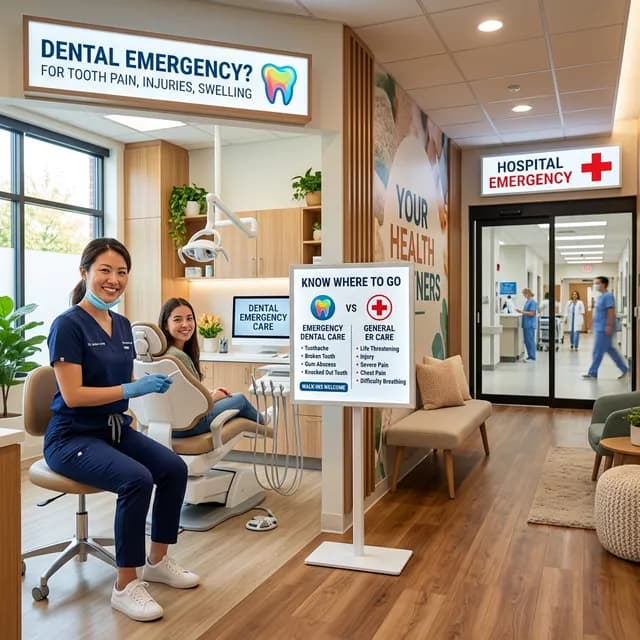
The critical distinction: if the emergency involves soft tissue, airway, or systemic infection, the ER is appropriate. If the emergency involves a tooth itself, a dentist is the only provider who can actually fix it.
What the ER Can and Cannot Do — Side by Side
| Emergency Room | Emergency Dentist | |
|---|---|---|
| Diagnose the problem | Basic visual exam, possible panoramic X-ray | Periapical X-rays, 3D CBCT scans, comprehensive clinical exam |
| Extract a tooth | No, no dental instruments or training | Yes, same-day extractions |
| Perform a root canal | No | Yes, pain relief and infection removal in one visit |
| Repair a cracked tooth | No | Yes, bonding, crowns, or onlays |
| Re-cement a crown | No | Yes, in about 30 minutes |
| Drain an abscess | Sometimes (incision and drainage for large abscesses) | Yes, with follow-up root canal or extraction |
| Prescribe antibiotics | Yes | Yes |
| Prescribe pain medication | Yes | Yes |
| Provide follow-up care | No, refers you to a dentist | Yes, complete treatment plan and follow-up visits |
| Average cost | $800 to $1,500+ | $150 to $400 |
| Average wait time | 4 to 8 hours | Under 1 hour (with same-day appointment) |
The Real Cost Comparison
The financial gap between ER and dental office treatment is substantial and well-documented. Here is what the research shows:
ER Visit for Dental Pain:
- Facility fee: $400 to $800
- Physician charge: $200 to $400
- X-ray (if taken): $100 to $200
- Prescriptions: $20 to $80
- Total: $800 to $1,500+
- Outcome: Temporary pain relief only. You still need to see a dentist.
Emergency Dental Visit at Innova Smiles:
- Exam and X-ray: $50 to $150
- Extraction (if needed): $150 to $350
- Root canal (if needed): $1,200 to $1,800
- Crown re-cementation: $100 to $250
- Outcome: Definitive treatment, the problem is resolved.
The American Journal of Emergency Medicine published a 2019 analysis showing that patients who visited the ER for dental complaints spent an average of 2.7 times more than those who visited a dental office for the same complaint, and were 4.3 times more likely to require a follow-up visit within 30 days because the underlying problem was never addressed.
For patients without dental insurance, the math is even more stark. Medical insurance may cover part of the ER visit but will not cover the subsequent dental treatment you still need. You end up paying twice.
Insurance: How Coverage Differs
The way dental emergencies are billed depends entirely on where you seek treatment, and the differences catch many patients off guard:
At the ER: The visit is billed under your medical insurance. Medical copays and deductibles are typically higher than dental copays, often $150 to $500 for an ER visit. If you have medical insurance but no dental insurance, your medical plan may cover the ER visit but not the follow-up dental work. If you have a high-deductible health plan (common in MetroWest employer-sponsored plans), you could owe the full $800 to $1,500 out of pocket.
At the dentist: The visit is billed under your dental insurance. Most dental plans cover emergency exams at 80 to 100 percent and basic procedures like extractions at 70 to 80 percent. Even major procedures like root canals and crowns receive 50 percent coverage under most PPO plans. Our office accepts most dental insurance plans and files claims directly for you.
Uninsured patients: At Innova Smiles, we offer transparent pricing and flexible financing through CareCredit and Sunbit. An emergency dental visit without insurance is still significantly less expensive than an ER visit without medical insurance.
Common Dental Emergencies and What to Do Before Your Appointment
Knowing what qualifies as a dental emergency, and how to manage it in the short term, helps you respond calmly:
Severe Toothache
Rinse with warm salt water, floss gently to remove any trapped food, and take 400 to 600 mg of ibuprofen (Advil, Motrin). Ibuprofen is more effective than acetaminophen for dental pain because it reduces inflammation at the source. Call your dentist for a same-day appointment.
Knocked-Out Permanent Tooth
This is the most time-sensitive dental emergency. The American Association of Endodontists advises handling the tooth by the crown only, never touch the root. Rinse gently if dirty, but do not scrub or remove tissue fragments. Try to reinsert it into the socket with gentle finger pressure. If that is not possible, place it in a container of cold whole milk (the proteins and pH help preserve the root cells) and seek dental care immediately. Reimplantation success rates are best if the tooth is replanted within 5 minutes, but success rates of around 70 percent can still be achieved if replanted within 30 minutes. Success drops significantly after 1 hour, when periodontal ligament cells become irreversibly damaged. This is one scenario where minutes literally decide whether the tooth survives.
Cracked or Broken Tooth
Rinse with warm water, apply a cold compress to reduce swelling, and save any fragments. Avoid chewing on that side. If there is a sharp edge cutting your tongue or cheek, cover it with dental wax or sugar-free gum as a temporary buffer.
Lost Filling or Crown
Apply temporary dental cement from a pharmacy (brands like Dentemp or Recapit are available at CVS and Walgreens) to protect the tooth until your visit. Avoid sticky foods. Read our full guide on what to do when you lose a crown.
Dental Abscess
A pimple-like swelling on the gums, often with a bad taste in your mouth, signals a localized infection. Do not pop it or attempt to drain it yourself. Warm salt water rinses can help draw the infection toward the surface. This requires prompt professional treatment — Dr. Fatima will drain the abscess, prescribe targeted antibiotics, and schedule the definitive treatment (root canal or extraction) to eliminate the source of infection.
If you have experienced a holiday dental emergency, the same principles apply, call your dentist first.
The Hidden Cost of Delaying Dental Emergencies
Many patients try to wait out a dental emergency, hoping the pain will subside on its own. This rarely ends well. The American Association of Endodontists warns that dental infections do not resolve without treatment. A tooth abscess can spread to surrounding tissue, the jaw, and in severe cases, the bloodstream, a potentially life-threatening condition called sepsis. A 2022 case series published in the Journal of Oral and Maxillofacial Surgery documented 13 patients in Massachusetts hospitals admitted to the ICU for dental infections that had spread to the deep neck spaces, all of whom had delayed seeking dental care for more than a week.
Even non-infectious emergencies worsen with delay. A cracked tooth that could be saved with a crown today may require extraction and an implant in a few weeks if the crack propagates below the gumline. A lost filling left unprotected allows bacteria to reach the inner tooth, turning a $200 restoration into a $1,200 root canal. The cost difference between early and delayed treatment can range from hundreds to thousands of dollars.
After-Hours Dental Emergency Options in MetroWest
Dental emergencies do not keep office hours. Here is how to handle after-hours situations in the MetroWest area:
During business hours: Call Innova Smiles at (508) 481-0110. We reserve same-day appointments specifically for emergencies and can typically see you within hours.
After hours and weekends: Call our main number. Our voicemail provides detailed guidance on immediate self-care steps and instructions for reaching us. For true dental emergencies, Dr. Fatima arranges after-hours care.
What to avoid: Urgent care centers (MinuteClinic, AFC Urgent Care) are in the same situation as ERs, they have no dental instruments or training and can only prescribe medications. Save yourself the copay and manage symptoms at home until your dental appointment.
Our "See You Today" Promise
We reserve time in our schedule every business day specifically for dental emergencies. Patients from Southborough, Westborough, Sudbury, Northborough, and surrounding communities rely on our same-day availability. When you call, let our team know it is urgent, we will work you into the schedule, often within the hour.
Do not suffer in an ER waiting room for six hours only to be sent home with the same toothache and a $1,200 bill. Call us for fast, definitive treatment that actually solves the problem.
Dental emergency? Skip the ER wait. Call Innova Smiles at (508) 481-0110 for same-day treatment in Marlborough.
Related Articles
- Dental Emergency Guide for Marlborough
- Handling Dental Emergencies During the Holidays
- Cracked Tooth? What to Do in Marlborough
- Tooth Infection & Abscess: Symptoms, Dangers & Treatment
- Urgent Dental Care Near Hopkinton MA