
Featured Answer: How can I manage dental anxiety?
Dental anxiety is best managed through a combination of communication with your dentist, cognitive behavioral techniques (deep breathing, progressive muscle relaxation, guided imagery), and — when needed — sedation options ranging from nitrous oxide to oral sedation. The most important first step is telling your dental team about your fear so they can tailor every aspect of your visit to your comfort level.
If the thought of sitting in a dental chair makes your palms sweat, you are far from alone. A 2023 meta-analysis published in the International Dental Journal found that approximately 36% of adults experience clinically significant dental anxiety, while roughly 12% meet the threshold for dental phobia — a level of fear so intense it leads to complete avoidance of care. At Innova Smiles in Marlborough, Dr. Ambereen Fatima and the entire clinical team understand that fear is not a character flaw; it is a deeply rooted physiological response that deserves respect and evidence-based solutions.
Why Dental Anxiety Matters More Than You Think
Dental anxiety is not simply about discomfort during a procedure. Research from the Journal of Dental Research demonstrates that patients who avoid dental care due to anxiety have significantly higher rates of untreated decay, periodontal disease, and tooth loss. The cycle is predictable and devastating: fear leads to avoidance, avoidance leads to worsening problems, and worsening problems lead to more invasive treatments — which fuel even greater fear.
According to the American Dental Association (ADA), patients who skip routine preventive visits are three times more likely to need emergency dental treatment. Emergency visits are inherently more stressful, more expensive, and more likely to involve pain — reinforcing the very anxiety that caused the avoidance in the first place. Breaking this cycle is possible, and it starts with understanding where the fear comes from.
Common Causes of Dental Anxiety
Understanding the root cause of your anxiety can help you and your dentist develop the most effective coping strategy. The most common triggers include:
Past Negative Experiences
A painful or traumatic dental visit — especially during childhood — is the single most common origin of dental anxiety. A 2022 study in BMC Oral Health found that 68% of adults with dental phobia could trace their fear to a specific negative experience before age 12. The memory becomes encoded as a threat, and subsequent dental environments trigger a fight-or-flight response even when no actual danger is present.
Fear of Pain
Despite enormous advances in anesthesia and technique, many patients carry an outdated expectation that dental treatment will hurt. This fear is often perpetuated by media portrayals and secondhand stories. In reality, modern local anesthetics are highly effective, and technologies like DentalVibe vibration anesthesia can virtually eliminate injection discomfort.
Loss of Control
Lying back in a dental chair with your mouth open and instruments inside it places you in an inherently vulnerable position. For patients with a history of trauma, PTSD, or generalized anxiety disorder, this loss of control can be profoundly distressing. Research published in Behaviour Research and Therapy identifies perceived lack of control as a stronger predictor of dental anxiety than the expectation of pain.
Sensory Triggers
The sounds of a dental handpiece, the smell of clinical materials, or even the overhead light can activate anxiety through sensory association. These triggers operate below conscious awareness and can produce a stress response before you even realize what is happening.
Fear of Judgment
Patients who have avoided dental care for years often feel deep shame about the condition of their teeth. They worry about being lectured, criticized, or embarrassed. At Innova Smiles, Dr. Fatima maintains a strict no-judgment policy — the clinical team is trained to focus on solutions, not blame, regardless of how long it has been since your last visit.
Cognitive Behavioral Techniques That Work
You do not need medication to begin managing dental anxiety. Cognitive behavioral therapy (CBT) techniques have strong clinical evidence supporting their effectiveness for dental fear. A randomized controlled trial published in the British Dental Journal found that patients who used CBT-based coping strategies reported a 40–60% reduction in anxiety scores during dental procedures.
Deep Breathing (Diaphragmatic Breathing)
Slow, deep breathing activates the parasympathetic nervous system — the body's built-in calming mechanism. Before and during your appointment, try the 4-7-8 technique: inhale through your nose for 4 seconds, hold for 7 seconds, and exhale slowly through your mouth for 8 seconds. This shifts your nervous system from fight-or-flight to rest-and-digest mode within 2–3 cycles.
Progressive Muscle Relaxation (PMR)
Systematically tensing and releasing muscle groups — starting from your toes and working up to your forehead — reduces the physical tension that accompanies anxiety. Practicing PMR at home for one week before your appointment makes the technique more automatic when you need it in the chair.
Guided Imagery and Distraction
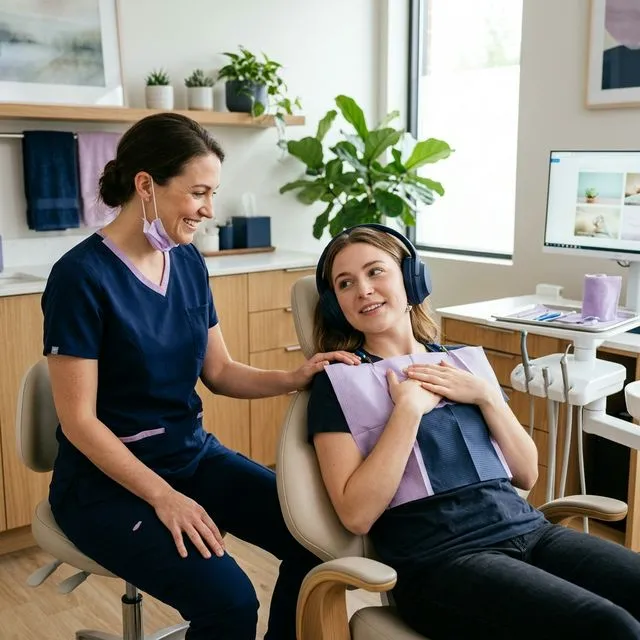
Visualizing a peaceful, detailed scene (a beach, a forest, a favorite memory) engages the brain's attention networks and reduces the processing of threat-related stimuli. Many patients at Innova Smiles use noise-canceling headphones with music, podcasts, or audiobooks during treatment — a simple but remarkably effective distraction tool.
Cognitive Reframing
Anxiety thrives on catastrophic thinking: "This is going to be terrible," "I can't handle this," "Something will go wrong." Cognitive reframing involves identifying these automatic thoughts and replacing them with more balanced alternatives: "I have a skilled dentist who will stop if I ask," "Millions of people get through this every day," "The discomfort is temporary and the benefit is lasting." Writing these reframed thoughts on a card and reading them in the waiting room can meaningfully lower pre-appointment anxiety.
The Stop Signal
Establishing a stop signal with your dentist before the procedure begins — such as raising your left hand — gives you a concrete sense of control. Knowing that you can pause the treatment at any moment dramatically reduces helplessness. Dr. Fatima introduces this protocol at the start of every appointment with anxious patients.
What to Tell Your Dentist
Many anxious patients try to white-knuckle their way through appointments without disclosing their fear. This is counterproductive. When your dentist knows about your anxiety, they can adjust their approach in dozens of meaningful ways: explaining each step before it happens, moving at a slower pace, checking in frequently, using gentler language, and offering sedation options proactively.
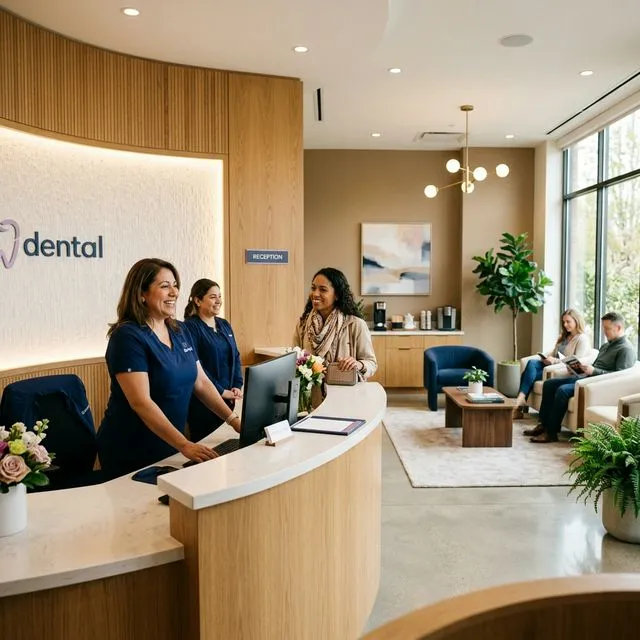
Before your first visit to Innova Smiles, you are welcome to call (508) 481-0110 and let the front desk know about your concerns. We also offer a no-treatment "get to know you" consultation where you can meet Dr. Fatima, tour the office, sit in the chair without any instruments, and discuss your concerns at length. Patients from Sudbury, Hudson, Northborough, and throughout MetroWest have found that this initial visit transforms their entire relationship with dental care.
Sedation Options: A Tiered Approach
When behavioral techniques alone are not enough, sedation dentistry provides a pharmacological safety net. The goal is not to eliminate all awareness, but to bring your anxiety down to a level where you can comfortably receive care. Innova Smiles offers several tiers, and Dr. Fatima matches the approach to your anxiety level, medical history, and the complexity of the planned treatment.
Tier 1: Nitrous Oxide (Laughing Gas)
Nitrous oxide is the mildest and most widely used form of dental sedation. Delivered through a small nasal mask, it takes effect within 3–5 minutes and produces a feeling of calm euphoria. You remain fully conscious and responsive. The sedation depth is adjustable in real time — your dentist can increase or decrease the concentration as needed. Once the mask is removed, the effects wear off within 5–10 minutes, and you can drive yourself home.
The ADA considers nitrous oxide one of the safest sedation modalities in dentistry, with adverse effects being exceedingly rare. It is appropriate for patients with mild to moderate anxiety and for shorter procedures like cleanings, fillings, and simple extractions.
Tier 2: Oral Sedation
For patients with moderate to severe anxiety, oral sedation involves taking a prescription medication (typically a benzodiazepine such as triazolam) approximately one hour before your appointment. You remain conscious but in a deeply relaxed, semi-drowsy state. Many patients report feeling as though the appointment passed in minutes and have limited memory of the procedure — a phenomenon called anterograde amnesia.
Oral sedation requires a responsible driver to bring you to and from the appointment, and you should plan to rest for the remainder of the day. Dr. Fatima reviews your complete medical history, current medications, and any history of substance use before prescribing oral sedation to ensure safety.
Tier 3: IV Sedation
Intravenous sedation is the deepest level of conscious sedation available in a dental office. Medication is delivered directly into the bloodstream, allowing precise, rapid adjustment of sedation depth. IV sedation is typically reserved for patients with severe dental phobia, those undergoing lengthy or complex procedures (such as dental implant placement or full mouth restoration), or patients for whom oral sedation has been insufficient in the past.
IV sedation requires NPO (nothing by mouth) status for 6–8 hours before the appointment, a responsible driver, and post-procedure monitoring until discharge criteria are met. Vital signs are monitored continuously throughout the procedure.
DentalVibe Vibration Anesthesia
While not a sedation method in the traditional sense, DentalVibe deserves mention because fear of needles is one of the most common components of dental anxiety. This FDA-cleared device delivers gentle vibration to the injection site, effectively blocking pain signals based on the gate control theory of pain. Most patients report feeling only pressure — no sharp sting. It is available for every injection at Innova Smiles at no additional charge.
How Innova Smiles Handles Anxious Patients
Our approach to dental anxiety goes beyond offering sedation. Every element of the patient experience at our Marlborough office has been designed with anxious patients in mind:
- Unhurried scheduling — Anxious patients are never rushed. We build extra time into appointments so you can take breaks, ask questions, and move at your own pace.
- Tell-show-do method — Before any instrument enters your mouth, we explain what it is, show it to you, and describe what you will feel. Surprises fuel anxiety; predictability reduces it.
- Warm blankets and comfort amenities — Small comforts like a warm blanket, a pillow, and a choice of music or TV make the clinical environment feel less clinical.
- Consistent provider — Seeing the same dentist and hygienist at every visit builds trust and reduces the anxiety of the unknown. Dr. Fatima personally manages care for her most anxious patients across every appointment.
- Post-visit check-in calls — After complex procedures, a member of our team calls you the next day to check on your comfort and answer questions. This reduces post-treatment anxiety and builds confidence for future visits.
If you have been avoiding the dentist because of fear, our dedicated page for nervous patients explains our full approach in detail.
When Anxiety Becomes a Barrier to Health
Dental anxiety is not just an inconvenience — for some patients, it becomes a genuine health crisis. Untreated decay can progress to infection, abscess, and even systemic sepsis. Advanced periodontal disease has been linked to cardiovascular disease, diabetes complications, and adverse pregnancy outcomes. The American Academy of Periodontology reports that patients who avoid regular dental care are at significantly improved risk for these systemic consequences.
If you have not been to a dentist in years — whether it has been two years or twenty — you are welcome at Innova Smiles. Patients from Framingham, Westborough, Hopkinton, and across the MetroWest region come to us specifically because they have heard about our gentle, judgment-free approach. We have helped patients who had not seen a dentist in over a decade take that first step back.
Building Long-Term Dental Confidence
Overcoming dental anxiety is rarely a single event — it is a gradual process. Each positive dental experience rewrites the fear memory and builds confidence for the next visit. Research in Clinical Psychology Review shows that repeated exposure to feared stimuli in a safe, controlled context is the most effective long-term treatment for specific phobias, including dental phobia.
Your roadmap might look like this:
- Phone call — Discuss your concerns with our team before booking.
- Get-to-know-you visit — Meet Dr. Fatima, tour the office, no treatment.
- Simple preventive visit — A cleaning with nitrous oxide and headphones.
- Treatment visit — Address needed work with appropriate sedation.
- Ongoing maintenance — Regular visits become routine as confidence grows.
Each step builds on the last. There is no timeline pressure and no judgment.
You deserve dental care that respects your feelings and your health. Call (508) 481-0110 or book a consultation to take the first step.
Related Articles
Related Services
- Sedation Dentistry -- nitrous oxide, oral sedation, and DentalVibe for anxiety-free care
- Dentist for Nervous Patients -- our complete approach to compassionate, judgment-free dentistry
- Dental Exams & Cleanings -- gentle preventive care tailored to anxious patients