Featured Answer: Does my child or athlete need a sports mouthguard?
Yes for any contact or high-speed sport. The American Dental Association recommends a properly fitted mouthguard for football, hockey, basketball, lacrosse, soccer, baseball/softball, wrestling, martial arts, skateboarding, BMX, skiing, snowboarding, and gymnastics. A custom-fitted mouthguard cushions impact, protects teeth from fractures, and reduces the risk of soft tissue injuries during falls and collisions.
Sports Season Runs Year-Round in MetroWest
Youth and adult sports do not stop with the seasons in Marlborough and surrounding towns. Fall brings football, soccer, and field hockey. Winter is hockey at Navin Arena, public skating at the New England Sports Center, and skiing at Nashoba Valley Ski Area in Westford or Wachusett Mountain. Spring is lacrosse, baseball, and softball at fields across MetroWest. Summer is skateboarding, BMX at the Marlborough park, and travel basketball.
Families from Hudson, Southborough, Framingham, and surrounding MetroWest towns participate in some combination of these activities almost every week of the year, and dental injuries follow the same calendar. Many of those injuries are preventable with the right protective equipment.
Dental injury statistics: the numbers are real
The American Dental Association estimates that more than 5 million teeth are knocked out each year in the United States, with sports being a leading cause. Winter sports carry specific risks that are worth understanding:
- Ice hockey accounts for more dental injuries than any other winter sport. A 2018 study in the Dental Traumatology journal found that hockey players who did not wear mouthguards were 60 times more likely to sustain dental injuries than those who did.
- Skiing and snowboarding injuries to the face represent approximately 5–7% of all ski-related injuries according to peer-reviewed epidemiological studies. Collisions with other skiers, trees, and lift equipment are the primary causes.
- Ice skating injuries frequently involve falls backward or forward onto the ice surface, with the chin and front teeth taking the initial impact.
- Sledding and tubing, often overlooked, send roughly 20,000 children to emergency rooms each year nationwide, and facial impacts are common when a sled hits a bump, tree, or another rider.
Sport-by-sport risk breakdown
Football (fall season)
Football mandates mouthguards at virtually every level, from youth leagues to the NFL. The combination of high-velocity collisions, helmet-to-helmet contact, and tackling produces the highest dental injury rate of any contact sport. Even with a mandate, ill-fitting boil-and-bite guards are a common complaint among youth players. A custom guard stays put through hits and is more comfortable to wear for a full game.
Lacrosse (spring season)
Boys' lacrosse is a contact sport that requires mouthguards, but girls' lacrosse, which is technically non-contact, has a high incidence of accidental stick-to-face contact. The American Dental Association and US Lacrosse both recommend mouthguards for all lacrosse players regardless of gender or age.
Ice hockey (winter season)
Hockey is one of the highest-risk sports for dental trauma. Pucks travel at 70 to 100+ mph. Sticks, elbows, boards, and falls create constant facial impact risk. Youth hockey leagues in MetroWest, including programs at Navin Arena and the New England Sports Center, have varying mouthguard requirements. Some mandate them, others only recommend them. Regardless of league rules, every hockey player should wear a properly fitted mouthguard at every practice and game.
Common hockey dental injuries: chipped or fractured front teeth, tooth avulsion (complete knockout), lip and tongue lacerations from braces or appliances, jaw fractures.
Basketball (winter and AAU season)
Basketball is often overlooked in mouthguard conversations because it is technically non-contact, yet the National Youth Sports Safety Foundation lists it among the top causes of dental injury in youth sports. Elbows under the basket and accidental contact during fast breaks send a steady stream of basketball patients to our office for chipped front teeth.
Skiing, snowboarding, and tubing (winter season)
The combination of speed (recreational skiers average 20 to 30 mph; advanced skiers exceed 50 mph) and hard surfaces makes dental trauma a real possibility. Face-first falls onto packed snow or ice produce forces comparable to a car accident at low speed. Terrain park features, jumps, rails, half-pipes, multiply the risk significantly. Sledding and tubing carry similar risks because riders have limited steering or braking ability.
Common ski/snowboard dental injuries: front tooth fractures from face-first falls, jaw contusions from impacts with moguls or terrain features, soft tissue tears from goggles or helmet straps driven into the mouth.
Baseball, softball, and field hockey (spring and fall seasons)
These sports do not require mouthguards at most levels, but the National Federation of State High School Associations identifies baseball and softball as having one of the highest injury rates per player-hour. A line drive to the face, a pitched ball, or a collision at the plate can produce the same level of dental trauma as a contact sport. Field hockey adds stick-to-face risk.
Skating, skateboarding, and BMX (year-round)
Falls on hard surfaces, ice, concrete, or pavement, tend to be sudden and uncontrolled. Children under 10 and adults over 40 are statistically the most likely to fall, and the chin-first landing pattern puts the front teeth at extreme risk. Skateboarders and BMX riders should wear mouthguards in addition to a helmet, particularly when learning new tricks at the Marlborough skate park or similar facilities in Northborough, Sudbury, or the Callahan State Park area in Framingham.
Mouthguard options: what provides the best protection?
Not all protection is created equal. Here is the clinical reality:
1. Stock mouthguards (pre-formed)
- Pros: Cheap ($3–$10), available at sporting goods stores.
- Cons: Poor fit, bulky, difficult to breathe and speak. Provides minimal shock absorption because it cannot conform to individual tooth anatomy. Least protective.
- Our recommendation: Skip these entirely. The poor fit means most athletes remove them during play, defeating the purpose.
2. Boil-and-bite mouthguards
- Pros: Better fit than stock, inexpensive ($10–$30).
- Cons: Material thins out during the molding process, creating uneven protection, thick in some areas, paper-thin in others. The thermoplastic material can become brittle in cold winter temperatures, reducing shock absorption precisely when you need it most. Studies show boil-and-bite guards lose up to 40% of their thickness during the fitting process.
- Our recommendation: Acceptable as a temporary solution, but not adequate for high-impact winter sports.
3. Custom-fitted mouthguards (dentist prescribed)
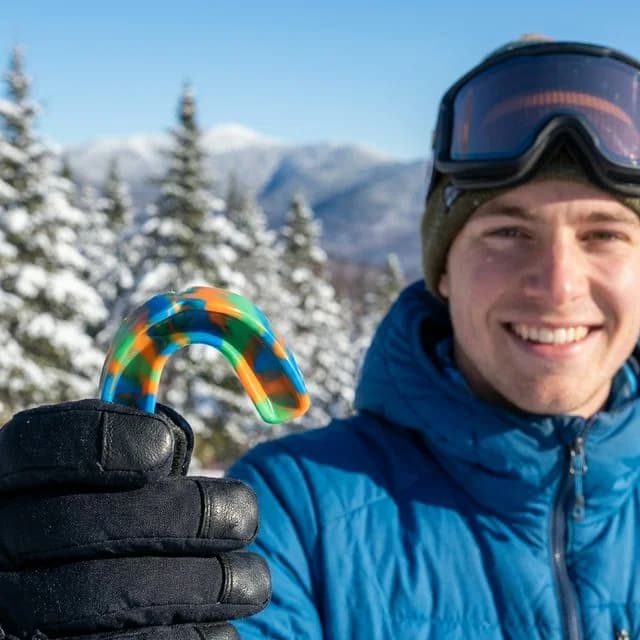
- Pros: Fabricated from an exact digital impression of your teeth. Uniform thickness (typically 3–4mm) across all impact zones. Superior shock absorption. Comfortable enough to wear for hours without affecting breathing or speech. Retains protective properties in cold temperatures.
- Cons: Higher initial cost ($150–$300).
- The verdict: The ADA recommends custom-fitted mouthguards for all contact sports. For high-impact winter sports, a custom guard offers the best defense against expensive emergency restorative work that can cost $1,000–$5,000+ per tooth.
Custom mouthguard types and costs at Innova Smiles
All custom guards are fabricated from digital impressions taken with our TRIOS® 5 scanner, no goopy impression material. The guard is typically ready within 5–7 business days.
What to do if a tooth is knocked out on the slopes
If an accident happens on the mountain, at the rink, or on the sledding hill, quick action can save a tooth. Every minute counts.
Knocked-out (avulsed) permanent tooth, step by step
- Find the tooth. Look in snow, on ice, or in the athlete's helmet or mask.
- Handle ONLY by the crown (the white part you can see in the mouth). Never touch the root, the root surface contains living cells (periodontal ligament fibers) that are essential for reattachment.
- Rinse gently with water or saline if the tooth is dirty. Do not scrub, do not use soap, do not wrap in tissue.
- Re-implant if possible (adult teeth only, not baby teeth). Gently push the tooth back into the socket and have the patient bite down on a cloth to hold it in place. This is the single best thing you can do for long-term tooth survival.
- If you cannot re-implant: Store the tooth in cold whole milk (not skim), saline solution, or the patient's own saliva. Commercial tooth preservation kits like Save-A-Tooth contain Hanks Balanced Salt Solution, which keeps periodontal cells alive the longest, up to 24 hours.
- Get to a dentist within 60 minutes. The International Association of Dental Traumatology (IADT) emphasizes that reimplantation within the first hour offers the best chance of tooth survival, with clinical studies showing approximately 65% of teeth remaining in their sockets long-term when following IADT guidelines. After two hours, the prognosis drops dramatically.
Do NOT: Store the tooth in water (hypotonic solution kills root cells). Do NOT let the tooth dry out. Do NOT attempt to re-implant a baby tooth in a child.
Chipped or fractured tooth
- Find the fragment if possible. Keep it moist in milk or saliva.
- Rinse the mouth with warm water.
- Apply a cold compress to the face to reduce swelling.
- Call Innova Smiles immediately at (508) 481-0110. We reserve same-day emergency appointments for dental trauma. For a full breakdown of repair options from bonding to crowns, visit our broken tooth repair page.
Jaw injury or suspected fracture
If the athlete cannot open or close their mouth normally, has visible jaw asymmetry, or reports numbness in the chin or lower lip, go directly to an emergency room. Jaw fractures require imaging (CT scan) and may need surgical intervention.
Post-injury treatment options at Innova Smiles
Depending on the type and severity of the dental injury, treatment may include:
- Dental bonding: For minor chips, tooth-colored composite resin restores the tooth in a single visit ($200–$500 per tooth)
- Porcelain crown: For significant fractures that compromise tooth structure, a custom crown protects and restores the tooth ($1,000–$1,800)
- Tooth reimplantation and splinting: A knocked-out tooth that is successfully reimplanted is stabilized with a flexible wire splint for 7–14 days while the periodontal ligament reattaches
- Root canal therapy: Many reimplanted teeth eventually need a root canal because the nerve supply is disrupted during avulsion
- Dental implant: If the tooth cannot be saved, an implant provides a permanent replacement that looks and functions like a natural tooth
The cost of treating a single knocked-out tooth, from emergency visit through final restoration, frequently reaches $3,000–$5,000. A $200 custom mouthguard is a good investment by comparison.
Caring for your mouthguard
A mouthguard only works if it is in good condition. Follow these care tips to extend its life and maintain hygiene:
- Rinse with cool water or mouthwash after each use. Hot water can warp the material and change the fit.
- Store it in a ventilated case to prevent bacterial growth. Keep the case in your gear bag, not loose in a gym locker.
- Bring it to your dental checkups so Dr. Fatima can inspect it for wear and ensure it still fits properly.
- Replace the guard each season or whenever you notice cracks, thinning, or a loose fit.
- For cold-weather athletes: allow the guard to return to room temperature before placing it in your mouth. Inserting a frozen guard can cause it to crack.
- For hot-weather athletes: do not leave the guard in a parked car or hot gym bag. The plastic can deform at temperatures above 140°F and lose its fit.
Sports and braces or aligners
Athletes wearing braces face an added risk in any contact sport. A direct impact to the mouth can cause brackets to cut into soft tissue, snap archwires, or damage the teeth underneath. A custom mouthguard designed to fit over orthodontic hardware provides a critical buffer between brackets and lips. Orthodontic mouthguards are slightly bulkier to accommodate the hardware, but the protection is essential.
For patients using Spark clear aligners or Invisalign, the aligners alone do not provide sufficient impact protection. Aligners are designed to move teeth, not absorb shock. A separate sport guard is still recommended for high-contact activities like hockey. Some patients remove their aligners during sports and wear a mouthguard instead, this is acceptable as long as total daily aligner wear still reaches 20–22 hours.
Concussion awareness: the dental connection
Research published in the British Journal of Sports Medicine suggests that properly fitted mouthguards may help reduce concussion risk by absorbing impact forces transmitted through the jaw to the skull base. While the evidence is still evolving, the potential concussion-reduction benefit adds another reason to invest in a quality guard, especially for young hockey, football, and lacrosse players in the Sudbury, Westborough, and Marlborough youth sports programs.
Frequently asked questions
Q: Does my child need a mouthguard for recreational sports, or only competitive ones? Yes for both. The ADA recommends mouthguards for any activity where there is a risk of falls or contact with hard surfaces, regardless of competitive level. A casual scrimmage at the park can produce the same dental injury as a sanctioned league game.
Q: How much does a custom mouthguard cost? A custom-fitted mouthguard at Innova Smiles typically costs $150 to $300, depending on the design and material. Many dental insurance plans partially cover athletic mouthguards as a preventive device. Compared to the cost of emergency dental treatment for a knocked-out or fractured tooth (often $1,000 to $5,000+), a custom guard is an excellent investment.
Q: Can adults benefit from custom mouthguards too? Yes. Adults who play recreational hockey, ski, snowboard, or participate in martial arts face the same dental injury risks as young athletes. Custom mouthguards fit more comfortably and securely than store-bought alternatives, which means adults are more likely to actually wear them consistently.
Q: My child has baby teeth. Is a mouthguard still necessary? Yes. Trauma to baby teeth can damage the developing permanent teeth underneath. A hard blow can push a baby tooth into the jawbone and disrupt the permanent tooth bud. Custom guards for children with mixed dentition (both baby and permanent teeth) are designed to accommodate the changing tooth structure.
Q: How long does it take to get a custom mouthguard made? At Innova Smiles, the process requires one short appointment for digital impressions. The guard is fabricated in the lab and typically ready for pickup within 5 to 7 business days. We recommend scheduling at least two weeks before the start of any new sport season.
Schedule before the season starts
Don't wait for an injury to think about protection. We can fabricate a custom mouthguard quickly using digital impressions, so your teen or young athlete is ready for the first practice. The process takes just one short appointment at our Marlborough office, and the guard is typically ready within days.
Families from Northborough, Framingham, Shrewsbury, and across MetroWest count on Innova Smiles for sports dental protection year-round. Whether the season is football, hockey, lacrosse, or skiing, make mouthguard fitting part of your pre-season routine.
Play hard, stay safe. Call (508) 481-0110 or book a mouthguard appointment to schedule your custom mouthguard impression today.
Related Articles
- Dental Emergency Guide for Marlborough
- Wisdom Teeth Removal: What to Expect
- Children's Dentist Near Me — 01752 Marlborough
Related Services
Sources & Further Reading
- Mouthguards — Patient Information — American Dental Association (MouthHealthy)
- The Importance of Using Mouthguards (Council on Access, Prevention and Interprofessional Relations report) — American Dental Association
- Dental Trauma Guidelines — Avulsion of Permanent Teeth (IADT) — International Association of Dental Traumatology
- Dental Traumatology — International Association of Dental Traumatology / Wiley
- British Journal of Sports Medicine — BMJ / British Association of Sport and Exercise Medicine