
Why Mouthguards Matter
Contact and collision sports greatly increase the risk of chipped, fractured, or avulsed (knocked-out) teeth. The American Dental Association (ADA) estimates that mouthguards prevent more than 200,000 dental injuries each year in the United States. A 2023 review in the Journal of Sports Science & Medicine confirmed that custom-fitted mouthguards reduce dental injury risk by up to 82% compared to no protection. At Innova Smiles in Marlborough, MA, Dr. Fatima works with local athletes and families across MetroWest to ensure every player has the right level of protection before the season starts.
Fall sports season in MetroWest brings a surge of activity on fields and rinks across the region. Football practices at Kelleher Field, soccer at Ghiloni Park, and field hockey at Marlborough High School all carry real dental injury risk. By the time leaves start turning on the Assabet River Rail Trail, our office sees a predictable uptick in chipped teeth, split lips, and loose crowns from sports impacts. Most of those injuries could have been prevented or minimized with a properly fitted mouthguard.
The Scope of Sports Dental Injuries
The numbers behind athletic dental trauma are sobering. The National Youth Sports Safety Foundation reports that over 5 million teeth are knocked out in sporting events annually in the United States. The lifetime cost of managing a single avulsed permanent tooth -- including the initial reimplantation, follow-up root canal, and eventual replacement with a dental implant -- can exceed $20,000 over a patient's lifetime.
A 2022 study in Dental Traumatology surveyed 1,200 high school athletes and found that 39% had experienced at least one dental injury during organized sports. Of those who suffered injuries, 75% were not wearing a mouthguard at the time. The sports with the highest dental injury rates were basketball (33% of all injuries), football (18%), hockey (15%), and soccer (12%). These are exactly the sports that fill fall schedules in Marlborough and surrounding MetroWest communities.
Types of Mouthguards
Not all mouthguards offer the same protection. Here is how the three main types compare:
1. Stock Mouthguards
Available at sporting goods stores for $5 to $15, these pre-formed guards come in small, medium, and large sizes. They cannot be adjusted for fit, which means they are often bulky, uncomfortable, and can interfere with breathing and speaking. Because of the poor fit, many athletes remove them during play--defeating their purpose entirely. The ADA does not recommend stock mouthguards for most athletes.
Stock guards typically have uniform thickness throughout, which means they are excessively bulky in areas that need less protection (the back teeth) and inadequately thick where protection matters most (the front teeth and biting surfaces). A 2020 study in the Journal of the American Dental Association measured impact absorption across guard types and found stock guards absorbed only 40-60% of the force compared to custom guards.
2. Boil-and-Bite Mouthguards
A step up from stock guards, boil-and-bite mouthguards ($15 to $40) are softened in hot water and then molded to the teeth by biting down. They offer a better fit than stock options and are available at most pharmacies and sporting goods stores. However, they tend to be thicker than necessary in some areas and thinner in others, providing uneven protection. They also lose their shape over time and typically need replacement every few months.
The boiling process also degrades the material. Research in Sports Engineering found that the repeated heating required to achieve a fit reduces the energy-absorbing capacity of the plastic by up to 30%. Additionally, most parents do not achieve an optimal mold on the first try -- the guard needs to be heated and bitten into with very specific timing and technique. A poorly molded boil-and-bite guard offers minimal improvement over a stock option.
3. Custom-Fitted Mouthguards (Dentist-Made)
Custom mouthguards are the gold standard. At Innova Smiles, we create yours from a precise digital scan of your teeth--no messy impressions needed. The guard is fabricated in a dental lab using durable, medical-grade materials with precisely controlled thickness for optimal protection and comfort. Custom guards allow athletes to breathe, speak, and drink water easily, which means they actually wear them during both practices and games.
The fabrication process uses pressure-laminated ethylene vinyl acetate (EVA) material that is layered and compressed under heat and vacuum. This produces a guard with calibrated thickness: 4 mm in the labial (front) zone where most impacts occur, 2 mm on the occlusal (biting) surface for shock distribution, and a trimmed, polished palatal edge that does not trigger the gag reflex. The result is a guard that absorbs and distributes impact force across a wide area rather than concentrating it on a single tooth.
Custom vs. Boil-and-Bite: The Real Difference
- Fit and comfort: Custom guards are made from a scan of your teeth--less bulk, better retention, and no gagging. Athletes report significantly higher comfort and are more likely to wear them consistently.
- Protection: Even coverage and scientifically calibrated thickness in the right places (the front and biting surfaces) for football, hockey, lacrosse, and other high-impact sports.
- Longevity: Durable materials stand up to a full season or more. If the guard is lost, it can be remade from the saved digital scan without another office visit for impressions.
- Breathing: Custom guards are trimmed to allow full airflow, which is critical for athletic performance. Research published in the British Journal of Sports Medicine shows that poorly fitting mouthguards can reduce oxygen intake by up to 10 percent.
- Communication: Athletes in sports like football and basketball need to communicate with teammates during play. A bulky stock or boil-and-bite guard muffles speech. Custom guards are designed with precise palatal coverage that preserves clear speech patterns.
The Science of Impact Absorption
Understanding how mouthguards protect teeth helps explain why quality matters. When a ball, elbow, or stick strikes the face, the impact force transfers through the lips and soft tissue directly to the teeth. Without a guard, that force is concentrated on the one or two teeth closest to the point of impact -- often the upper central incisors, which are the teeth most commonly injured in sports.
A mouthguard works by distributing that concentrated force across the entire dental arch. The EVA material compresses on impact, absorbing energy and extending the time over which the force is delivered -- the same principle that makes car airbags effective. A 2021 finite element analysis published in Clinical Biomechanics found that a properly fitted custom guard reduced peak stress on the upper central incisors by 78% during a simulated hockey puck impact. Boil-and-bite guards reduced stress by 45-55% in the same model, and stock guards by only 30-40%.
For football players at Marlborough High and youth leagues across MetroWest, these differences can mean the difference between finishing the game with teeth intact and an emergency trip to our office on Route 20.
Sports That Require or Benefit from Mouthguards
The ADA recommends mouthguards for 29 sports. In the Marlborough and MetroWest area, the most relevant include:
- Football: Required by most leagues. Custom guards provide superior protection under helmets.
- Ice hockey: Required at all youth and high school levels. A guard that fits well under a cage or visor is essential.
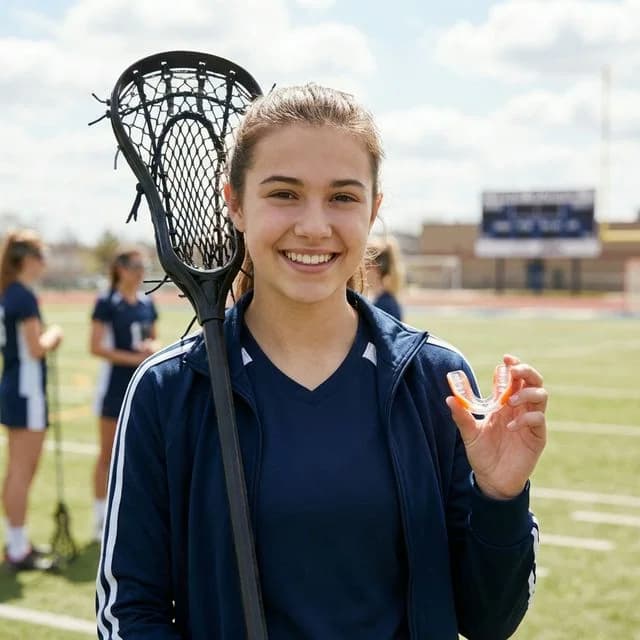
- Lacrosse: Required for boys; strongly recommended for girls. High-velocity ball impacts make dental injuries common.
- Field hockey: Recommended, especially for goalkeepers and defensive players.
- Soccer: Not typically required, but elbow contact, headers, and falls make dental injuries surprisingly common.
- Basketball: One of the highest-risk sports for dental injuries due to elbow and hand contact near the face.
- Wrestling and martial arts: Close contact and impact make mouthguards essential.
- Baseball and softball: Recommended for batters, catchers, and infielders.
- Skateboarding and BMX: Falls and collisions at local parks cause facial and dental trauma.
- Cheerleading and gymnastics: Falls, collisions during stunts, and tumbling contact cause more dental injuries than many parents expect. The National Electronic Injury Surveillance System reports cheerleading accounts for roughly 16,000 emergency room visits per year.
Who Benefits Most in Marlborough?
- High-impact athletes at Marlborough High School and local clubs (football, hockey, lacrosse)
- Goalkeepers and infielders who face unpredictable impact from balls and collisions
- Teens with braces--special designs protect cheeks, brackets, and wires. For more on protecting teeth during summer sports, see our emergency guide.
- Youth athletes in Hudson, Northborough, and Southborough recreation leagues
- Adult recreational league players (basketball, hockey, flag football)
- Weekend warriors who play in adult soccer, softball, or pickup basketball leagues at the Navin Rink or New England Sports Center
The Cost of Not Wearing a Mouthguard
The financial argument for a custom mouthguard is compelling. A single knocked-out tooth can cost $3,000 to $6,000 to replace with a dental implant, and a fractured tooth requiring a crown runs $1,200 to $2,000. The National Youth Sports Safety Foundation estimates that athletes who do not wear mouthguards are 60 times more likely to suffer dental injuries. A custom mouthguard at $300 to $500 is a fraction of the cost of emergency dental treatment.
Consider the full cost trajectory for a 14-year-old who loses a front tooth playing hockey without a mouthguard. Immediate treatment includes emergency reimplantation or a temporary bridge ($800-$1,500). If the tooth cannot be saved, a Maryland bridge serves as a placeholder until jaw growth is complete around age 18-20 ($1,200-$2,500). Then the definitive dental implant placement runs $3,500-$5,500. Over the patient's lifetime, the implant crown may need replacement once or twice ($1,500-$2,500 each time). Total lifetime cost: $8,000-$14,000 -- all to replace one tooth that a $400 mouthguard would have protected.
How Custom Mouthguards Are Made at Innova Smiles
The process is quick, comfortable, and completely digital:
- Digital scan (5 minutes): Using our iTero digital scanner, we capture a precise 3D map of your teeth and bite. No goopy impression trays, no gagging. The scan is stored digitally, so if the guard is lost or damaged, we can fabricate a replacement without a return visit for new impressions.
- Design and fabrication (5-7 business days): The scan is sent to a specialized dental laboratory where technicians design the guard with sport-specific thickness zones. Football guards receive heavier labial protection. Hockey guards include extended lip coverage. Basketball guards are lighter for maximum comfort during running and communication.
- Fitting appointment (15 minutes): Dr. Fatima checks the guard for retention, coverage, bite balance, and comfort. Minor adjustments are made chairside. We ensure the athlete can breathe freely through the mouth and speak clearly with the guard in place.
- Game ready: The athlete leaves with the guard and a ventilated storage case.
Mouthguards for Kids with Braces
Athletes wearing braces face additional risk because brackets and wires can cut soft tissue during impact. Dr. Fatima designs custom mouthguards specifically for orthodontic patients that accommodate brackets while providing full protection. These guards have extra clearance in the front and along the cheek side to cushion both the teeth and the orthodontic hardware. Over-the-counter boil-and-bite guards are not recommended for patients with braces because they can bond to brackets or distort during molding.
For patients currently in Spark aligner treatment, the approach differs. Aligners are removed during contact sports, and a standard custom mouthguard is worn instead. Dr. Fatima coordinates the mouthguard design with the current stage of orthodontic movement so the guard fits properly even as teeth shift.
Concussion Protection: What the Research Shows
An emerging area of sports dentistry research examines whether mouthguards reduce concussion risk. The theory is straightforward: a mouthguard acts as a shock absorber that dampens impact forces transmitted through the mandible to the skull base and temporal bone.
A 2014 study in General Dentistry found that high school football players wearing custom mouthguards were 3.6 times less likely to suffer a concussion than those wearing store-bought guards. While the evidence is not yet conclusive enough for the ADA to make a formal concussion-prevention claim, the biomechanical rationale is sound. Custom guards that properly position the mandible in a slightly open, forward posture create a natural shock-absorbing space in the temporomandibular joint.
For parents in MetroWest concerned about their child's concussion risk in football, hockey, or lacrosse, a properly fitted custom guard is one additional layer of protection alongside proper helmet fitting and rule enforcement.
When to See a Dentist After a Sports Injury
Even minor-seeming dental trauma should be evaluated promptly. A tooth that appears fine after a hit may have a root fracture or nerve damage that only shows up on an X-ray. If your child experiences any of the following after a sports impact, call Innova Smiles immediately at (508) 481-0110:
- Tooth is loose, displaced, or knocked out
- Tooth changes color (darkens) within days of the injury
- Pain when biting or sensitivity to temperature
- Visible crack or chip
- Swelling, bleeding, or numbness in the lip or jaw
Time is critical for a knocked-out permanent tooth. The periodontal ligament cells on the root surface begin to die within 20-30 minutes of being outside the socket. If you can reimplant the tooth immediately and get to our office within 60 minutes, the survival rate is approximately 85%. After two hours, the prognosis drops dramatically. Store the tooth in cold milk, saline, or the athlete's own saliva (inside the cheek) -- never wrap it in tissue or let it dry out.
Care and Replacement
Proper care extends the life of your mouthguard and keeps it hygienic:
- Rinse with cool water or mouthwash after every use
- Brush gently with a toothbrush and mild soap weekly
- Store in a ventilated case (not a sealed bag) to prevent bacterial growth
- Avoid leaving it in hot cars, direct sunlight, or hot water, which can warp the material
- Bring it to dental checkups so Dr. Fatima can inspect for wear and fit changes
- Replace each season or after any major dental changes (new fillings, crowns, or orthodontic adjustments)
A study in the British Journal of Sports Medicine found that bacteria colonize mouthguard surfaces within 48 hours of use if not cleaned properly. Methicillin-resistant Staphylococcus aureus (MRSA) and Candida species were among the organisms identified on guards in a locker room setting. Simple rinsing and weekly brushing with antibacterial soap eliminates this risk.
Frequently Asked Questions
How much does a custom mouthguard cost? Custom mouthguards at Innova Smiles typically cost $300 to $500, depending on the design and sport requirements. This investment protects against emergency dental bills that can run $1,000 to $6,000+ for knocked-out or fractured teeth.
Can my child wear a mouthguard with braces? Yes. We design orthodontic-specific guards that accommodate brackets and wires while providing full protection. Over-the-counter guards are not recommended for patients with braces because they can bond to brackets during molding.
How long does a custom mouthguard last? For growing children and teens, mouthguards should be replaced each sports season because jaw growth and tooth eruption change the fit. Adult guards can last two or more seasons with proper care.
Is a mouthguard required for non-contact sports? While not always required, the ADA recommends mouthguards for 29 sports, including many non-contact activities like gymnastics, skateboarding, and mountain biking where falls and impacts are common.
Do mouthguards affect athletic performance? A properly fitted custom guard does not impair breathing, speech, or hydration. A 2019 study in the Journal of Strength and Conditioning Research measured VO2 max, ventilation rate, and perceived exertion in college athletes wearing custom guards versus no guard and found no statistically significant difference in any performance metric. Stock and boil-and-bite guards, however, can impair breathing and reduce oxygen intake by up to 10%.
Should goalkeepers wear mouthguards? Goalkeepers in hockey, soccer, lacrosse, and field hockey face some of the highest dental injury risk on the field. Pucks, balls, and sticks travel at speeds exceeding 60 mph at the high school level. A custom guard is strongly recommended even when a cage or visor is worn, because facial protection equipment does not fully prevent force transmission to the teeth during direct impacts.
Want a student-athlete fit before the next game? Call (508) 481-0110 or book a visit and we will take digital scans--no messy impressions. Families from Framingham, Westborough, Sudbury, and across MetroWest trust Innova Smiles for custom athletic mouthguards that protect smiles and support performance.
Related Articles
- Winter Sports Safety: Protecting Your Smile
- Summer Sports Dental Emergencies
- Dental Emergency Guide for Marlborough
- Summer Smile Survival Guide: Tips for Marlborough Families
Related Services
- Night Guards & Mouthguards -- custom athletic and sleep mouthguards for Marlborough athletes
- Emergency Dentistry -- same-day care for sports dental injuries
- Dental Exams & Cleanings -- seasonal check-ups to keep athletes' smiles game-ready